Test Online Free Microsoft DP-300 Exam Questions and Answers
Practice a live sample before buying full access. This page keeps the free DP-300 question set organized by page so visitors and search engines can reach the canonical -questions.html URL directly.
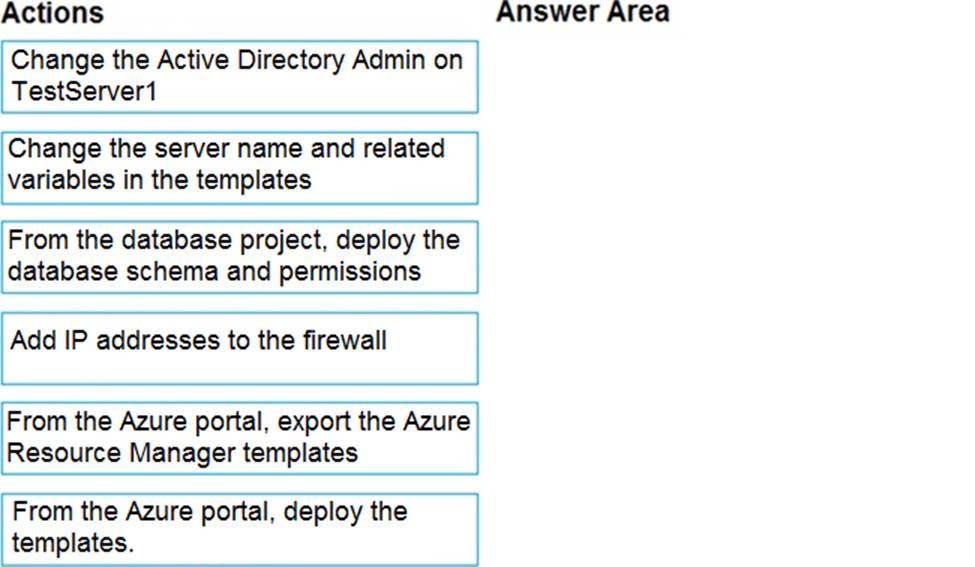
DRAG DROP
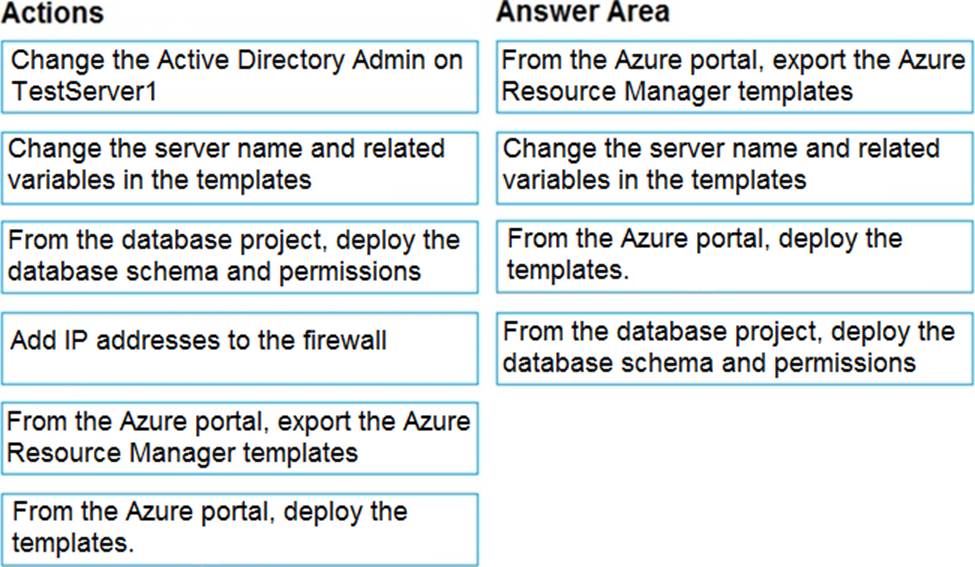
You have a resource group named App1Dev that contains an Azure SQL Database server named DevServer1. DevServer1 contains an Azure SQL database named DB1. The schema and permissions for DB1 are saved in a Microsoft SQL Server Data Tools (SSDT) database project.
You need to populate a new resource group named App1Test with the DB1 database and an Azure SQL Server named TestServer1. The resources in App1Test must have the same configurations as the resources in App1Dev.
Which four actions should you perform in sequence? To answer, move the appropriate actions from the list of actions to the answer area and arrange them in the correct order.
Answer:
Question 78Selectable Answer
You have an Azure virtual machine named VM1 that runs Windows Server 2022 and hosts a Microsoft SQL Server 2019 instance named SQL1. You need to configure SQL! to use mixed mode authentication.
Which procedure should you run?
Answer:
Question 79Selectable Answer
You have an Azure Data Factory pipeline that performs an incremental load of source data to an Azure Data Lake Storage Gen2 account.
Data to be loaded is identified by a column named LastUpdatedDate in the source table.
You plan to execute the pipeline every four hours.
You need to ensure that the pipeline execution meets the following requirements:
Automatically retries the execution when the pipeline run fails due to concurrency or throttling limits.
Supports backfilling existing data in the table.
Which type of trigger should you use?
Answer: Explanation:
The Tumbling window trigger supports backfill scenarios. Pipeline runs can be scheduled for windows in the past.
Reference: https://docs.microsoft.com/en-us/azure/data-factory/concepts-pipeline-execution-triggers
Question 80Selectable Answer
You need to design a data retention solution for the Twitter feed data records. The solution must meet the customer sentiment analytics requirements.
Which Azure Storage functionality should you include in the solution?
Answer: Explanation:
The lifecycle management policy lets you:
Delete blobs, blob versions, and blob snapshots at the end of their lifecycles
Reference: https://docs.microsoft.com/en-us/azure/storage/blobs/storage-lifecycle-management-concepts
Question 81Written Answer
HOTSPOT
You have an Azure subscription.
You plan to migrate 10 on-premises Microsoft SQL Server instances to Azure.
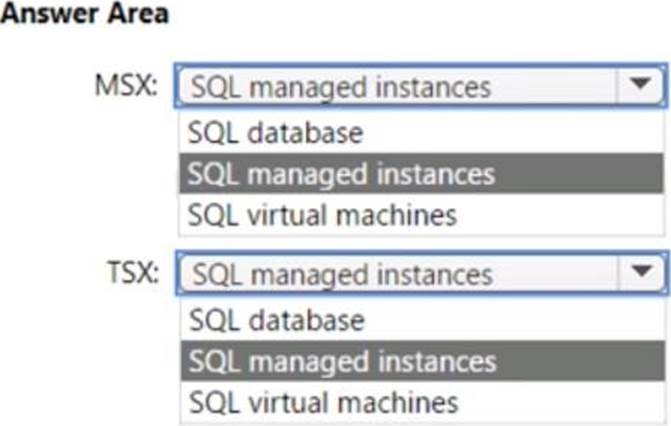
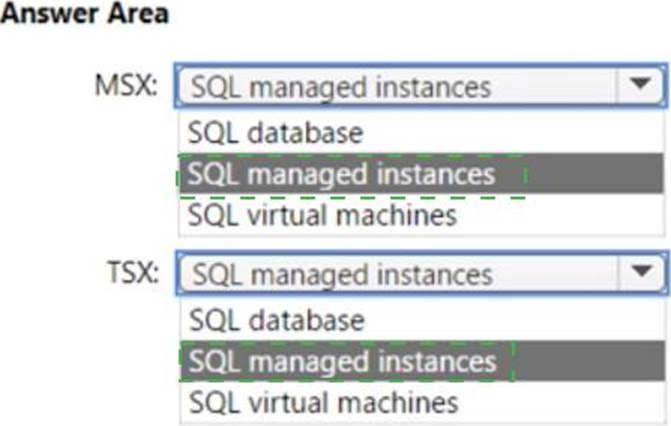
You need to ensure that the migrated environment can be managed by using multiserver administration and supports master/target (MSX/TSX) jobs. The solution must minimize administrative effort.
Which SQL deployment options should you select as the master server (MSX) and the target server (TSX)? To answer, select the appropriate options in the answer area. NOTE: Each correct selection is worth one point.
Answer:
Question 82Written Answer
HOTSPOT
You have an Azure subscription.
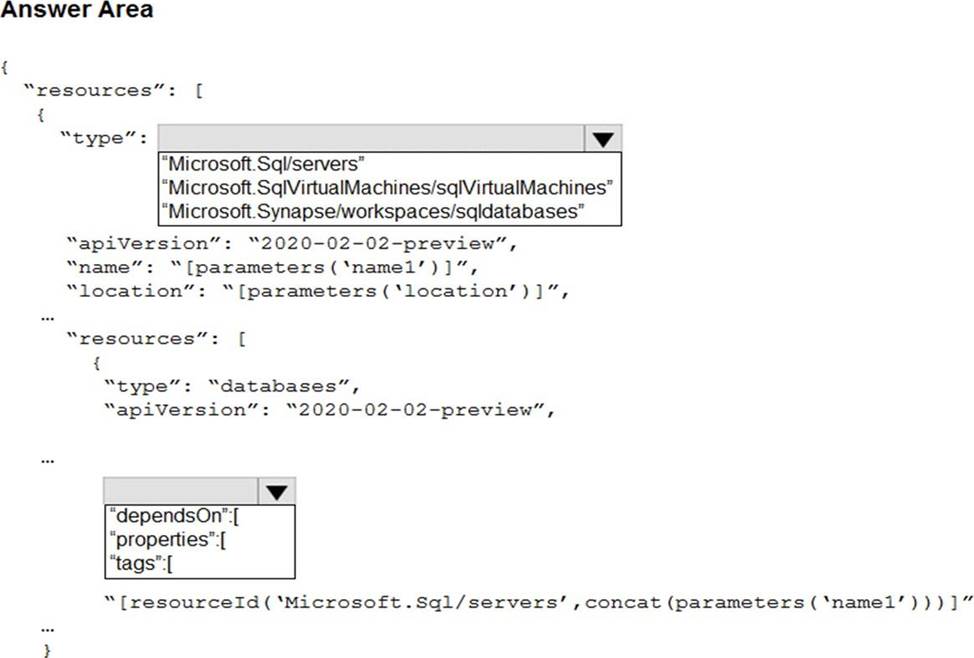
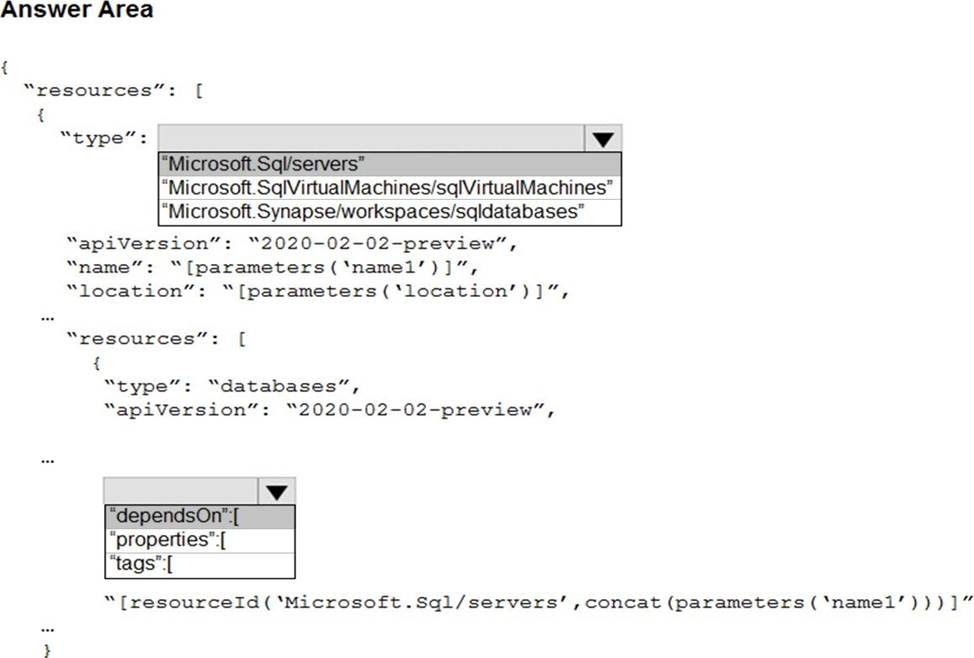
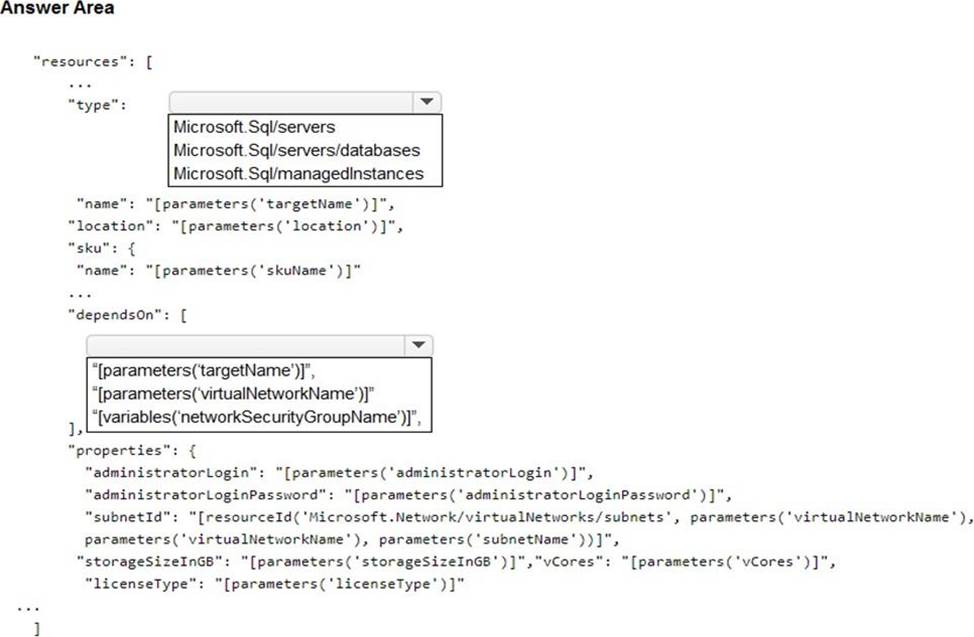
You plan to deploy an Azure SQL database by using an Azure Resource Manager template.
How should you complete the template? To answer, select the appropriate options in the answer area. NOTE: Each correct selection is worth one point.
Answer:
Explanation:
Text
Description automatically generated
Question 83Selectable Answer
Note: This question is part of a series of questions that present the same scenario. Each question in the series contains a unique solution that might meet the stated goals. Some question sets might have more than one correct solution, while others might not have a correct solution.
After you answer a question in this section, you will NOT be able to return to it. As a result, these questions will not appear in the review screen.
You have an Azure SQL database named Sales.
You need to implement disaster recovery for Sales to meet the following requirements:
✑ During normal operations, provide at least two readable copies of Sales.
✑ Ensure that Sales remains available if a datacenter fails.
Solution: You deploy an Azure SQL database that uses the General Purpose service tier and failover groups.
Does this meet the goal?
Answer: Explanation:
Instead deploy an Azure SQL database that uses the Business Critical service tier and Availability Zones.
Note: Premium and Business Critical service tiers leverage the Premium availability model, which integrates compute resources (sqlservr.exe process) and storage (locally attached SSD) on a single node. High availability is achieved by replicating both compute and storage to additional nodes creating a three to four-node cluster.
By default, the cluster of nodes for the premium availability model is created in the same datacenter. With the introduction of Azure Availability Zones, SQL Database can place different replicas of the Business Critical database to different availability zones in the same region. To eliminate a single point of failure, the control ring is also duplicated across multiple zones as three gateway rings (GW).
Reference: https://docs.microsoft.com/en-us/azure/azure-sql/database/high-availability-sla
Question 84Written Answer
DRAG DROP
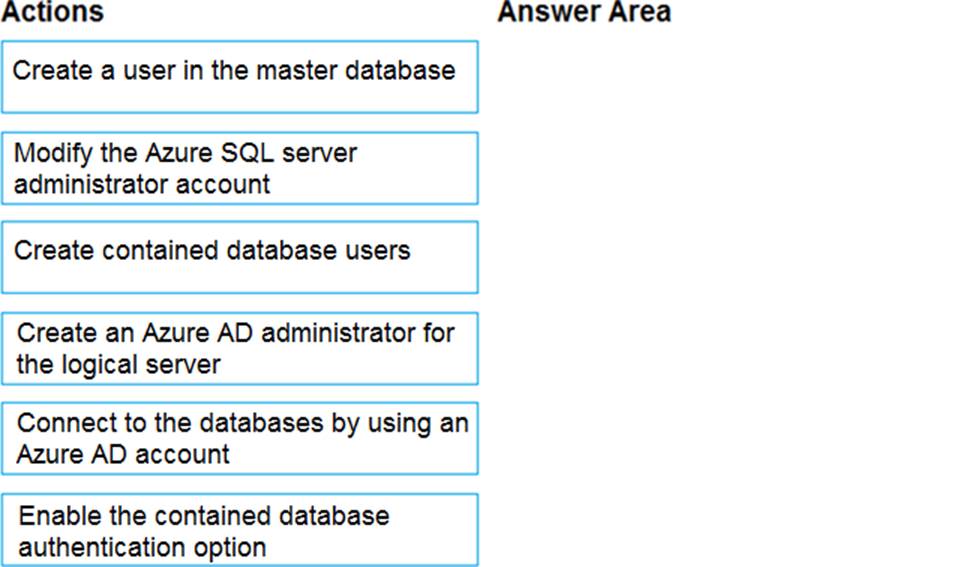
You need to configure user authentication for the SERVER1 databases. The solution must meet the security and compliance requirements.
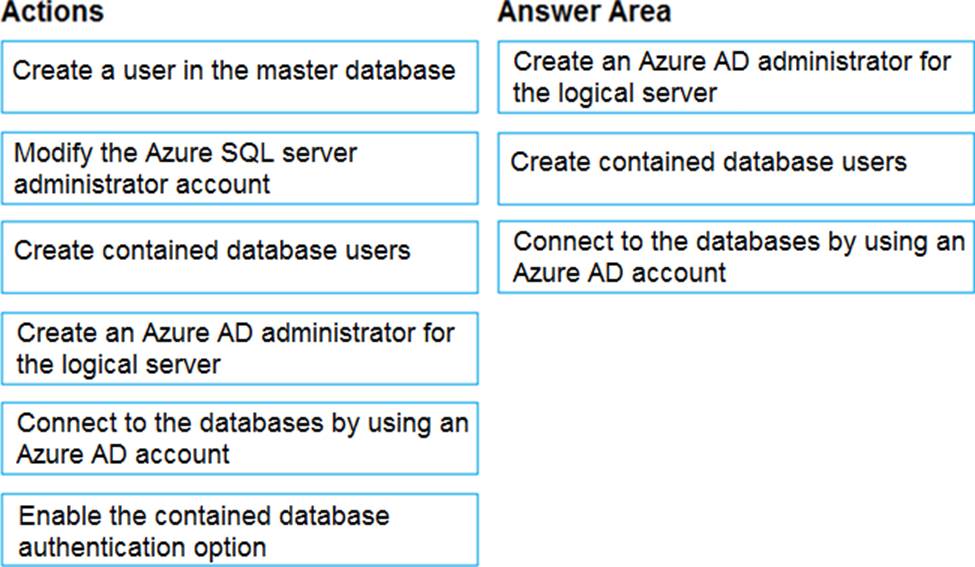
Which three actions should you perform in sequence? To answer, move the appropriate actions from the list of actions to the answer area and arrange them in the correct order.
Answer:
Explanation:
Scenario: Authenticate database users by using Active Directory credentials.
The configuration steps include the following procedures to configure and use Azure Active Directory authentication.
✑ Create and populate Azure AD.
✑ Optional: Associate or change the active directory that is currently associated with your Azure Subscription.
✑ Create an Azure Active Directory administrator. (Step 1)
✑ Configure your client computers.
✑ Create contained database users in your database mapped to Azure AD identities. (Step 2)
✑ Connect to your database by using Azure AD identities. (Step 3)
Question 85Written Answer
HOTSPOT
You have an Azure subscription.
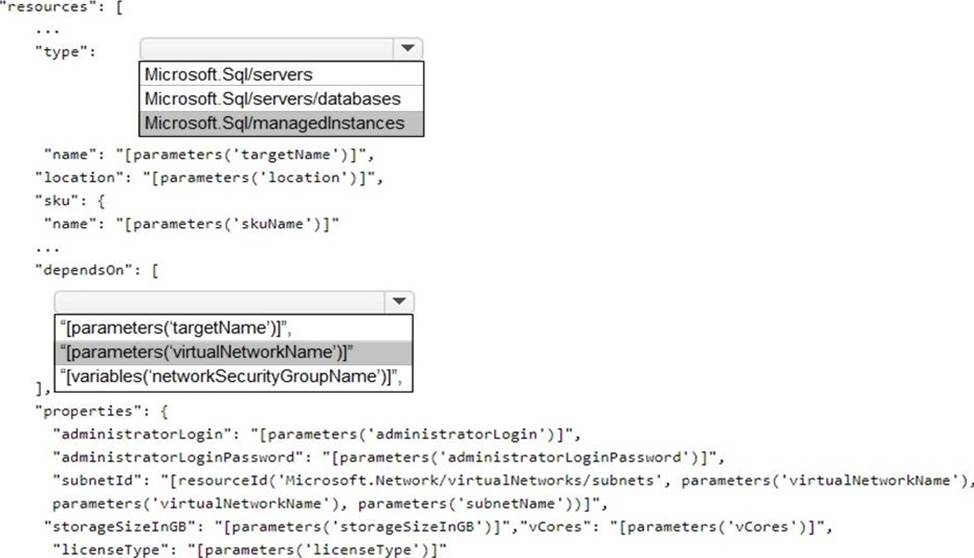
You need to deploy an Azure SQL resource that will support cross database queries by using an Azure Resource Manager (ARM) template.
How should you complete the ARM template? To answer, select the appropriate options in the answer area. NOTE: Each correct selection is worth one point.
Answer:
Explanation:
Graphical user interface, text, application, Word, email
Description automatically generated
Question 86Selectable Answer
You have an Azure subscription that contains two Azure SQL managed instances named SQLMI1 and SQLMI2. SQLM2 contains a database named DB1 and a user named User1.
User1 drops DB1.
You need to perform a point-in-time restore of DB1 to SQLMI2.
Answer:
Question 87Selectable Answer
You are creating a new notebook in Azure Databricks that will support R as the primary language but will also support Scala and SQL.
Which switch should you use to switch between languages?
Answer: Explanation:
Reference: You can override the default language by specifying the language magic command %<language> at the beginning of a cell. The supported magic commands are: %python, %r, %scala, and %sql.
Reference: https://docs.microsoft.com/en-us/azure/databricks/notebooks/notebooks-use
Question 88Written Answer
DRAG DROP
You have an Azure SQL database that contains a table named Employees. Employees contains a column named Salary.
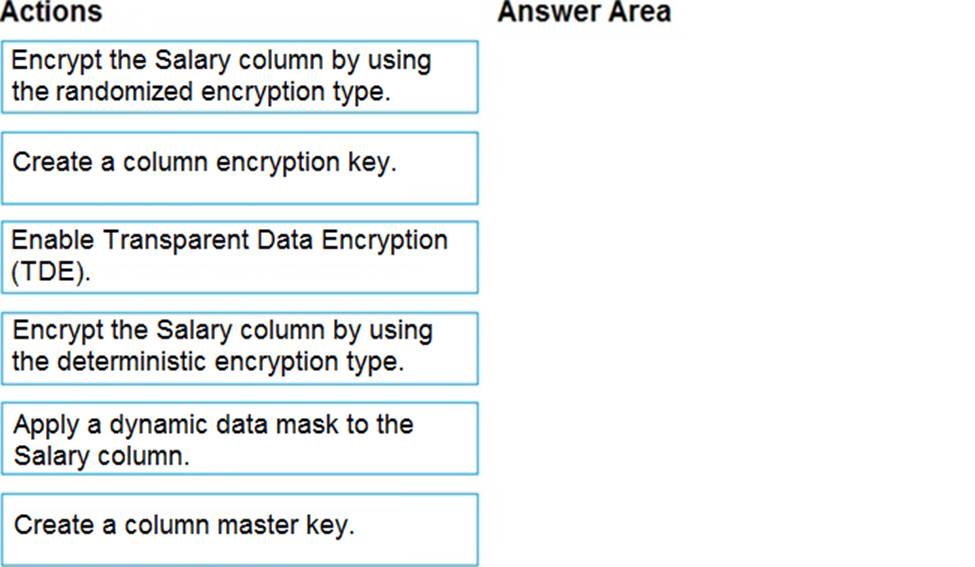
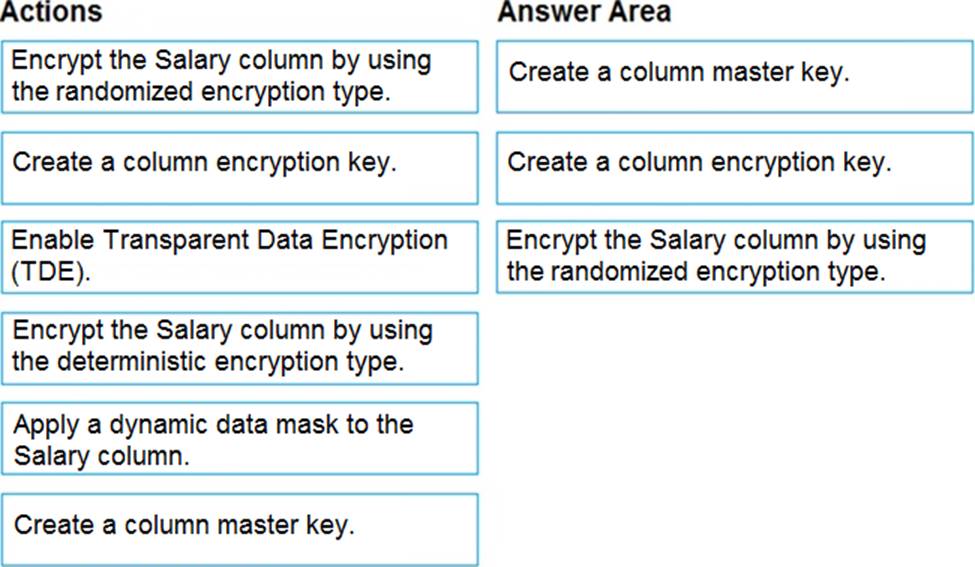
You need to encrypt the Salary column. The solution must prevent database administrators from reading the data in the Salary column and must provide the most secure encryption.
Which three actions should you perform in sequence? To answer, move the appropriate actions from the list of actions to the answer area and arrange them in the correct order.
Answer:
Explanation:
Step 1: Create a column master key
Create a column master key metadata entry before you create a column encryption key metadata entry in the database and before any column in the database can be encrypted using Always Encrypted.
Step 2: Create a column encryption key.
Step 3: Encrypt the Salary column by using the randomized encryption type. Randomized encryption uses a method that encrypts data in a less predictable manner. Randomized encryption is more secure, but prevents searching, grouping, indexing, and joining on encrypted columns.
Note: A column encryption key metadata object contains one or two encrypted values of a column encryption key that is used to encrypt data in a column. Each value is encrypted using a column master key.
Question 89Selectable Answer
You have an on-premises Microsoft SQL Server 2019 database named SQL1 that uses merge replication. You need to migrate SQL1 to Azure.
Which service should you use?
Answer:
Question 90Written Answer
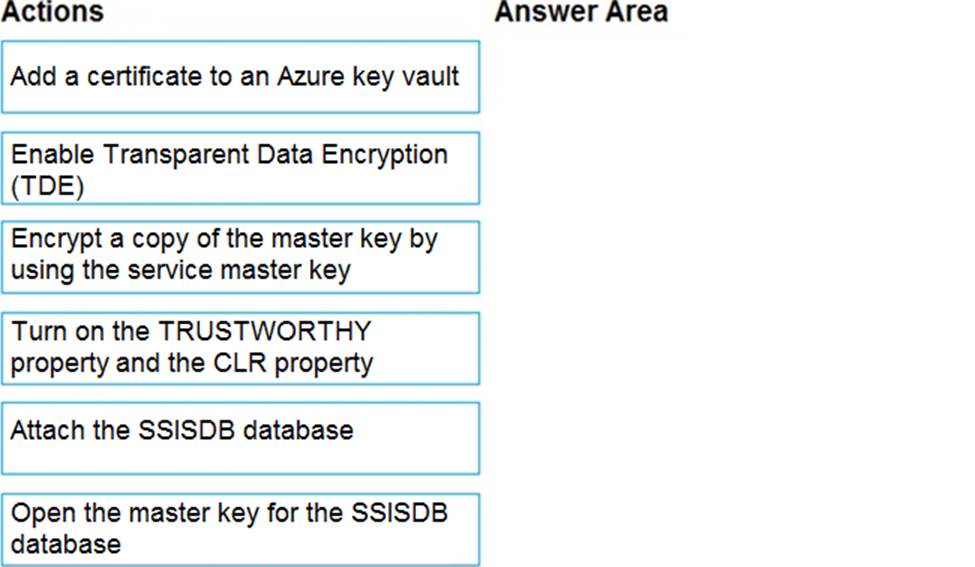
DRAG DROP
You have SQL Server 2019 on an Azure virtual machine that contains an SSISDB database.
A recent failure causes the master database to be lost.
You discover that all Microsoft SQL Server integration Services (SSIS) packages fail to run on the virtual machine.
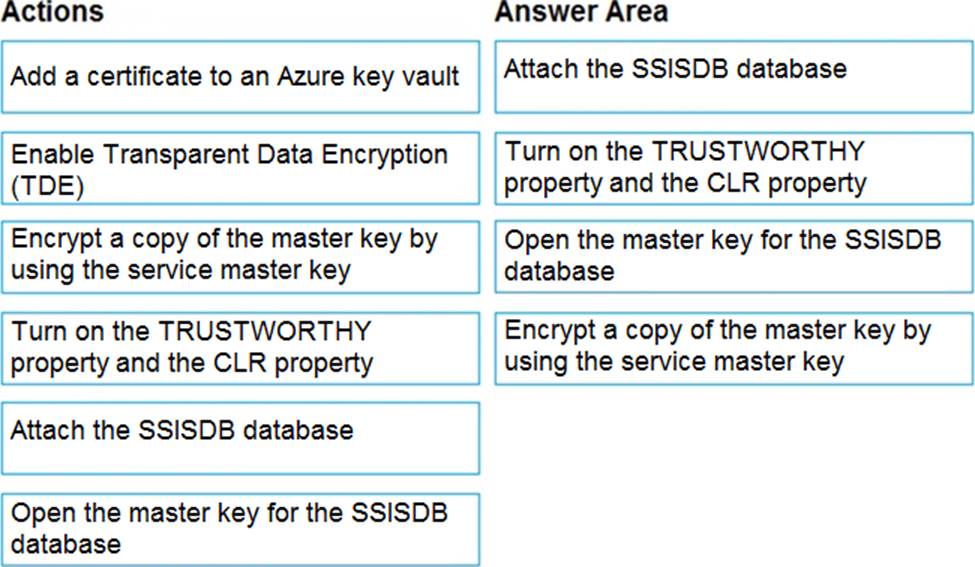
Which four actions should you perform in sequence to resolve the issue? To answer, move the appropriate actions from the list of actions to the answer area and arrange them in the correct.
Answer:
Explanation:
Step 1: Attach the SSISDB database
Step 2: Turn on the TRUSTWORTHY property and the CLR property
If you are restoring the SSISDB database to an SQL Server instance where the SSISDB catalog was never created, enable common language runtime (clr)
Step 3: Open the master key for the SSISDB database
Restore the master key by this method if you have the original password that was used to create SSISDB.
open master key decryption by password = 'LS1Setup!' --'Password used when creating
SSISDB'
Alter Master Key Add encryption by Service Master Key
Step 4: Encrypt a copy of the mater key by using the service master key