Free Demo Questions

Test Online Free Microsoft DP-300 Exam Questions and Answers

Practice a live sample before buying full access. This page keeps the free DP-300 question set organized by page so visitors and search engines can reach the canonical -questions.html URL directly.

Updated Jan 24, 2026 147 Questions 10 Pages
Page 5 of 10
Question 61 Selectable Answer
You have 50 Azure SQL databases.
You need to notify the database owner when the database settings, such as the database size and pricing tier, are modified in Azure.
What should you do?

Answer:
Explanation:
Activity log events - An alert can trigger on every event, or, only when a certain number of events occur.
Reference: https://docs.microsoft.com/en-us/azure/azure-sql/database/alerts-insights-configure-portal
Question 62 Written Answer
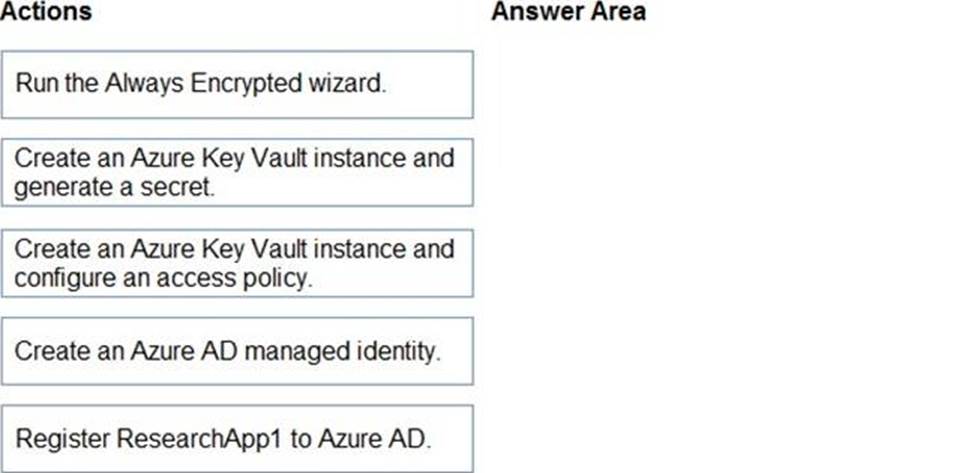
DRAG DROP
You create all of the tables and views for ResearchDB1.
You need to implement security for ResearchDB1. The solution must meet the security and compliance requirements.
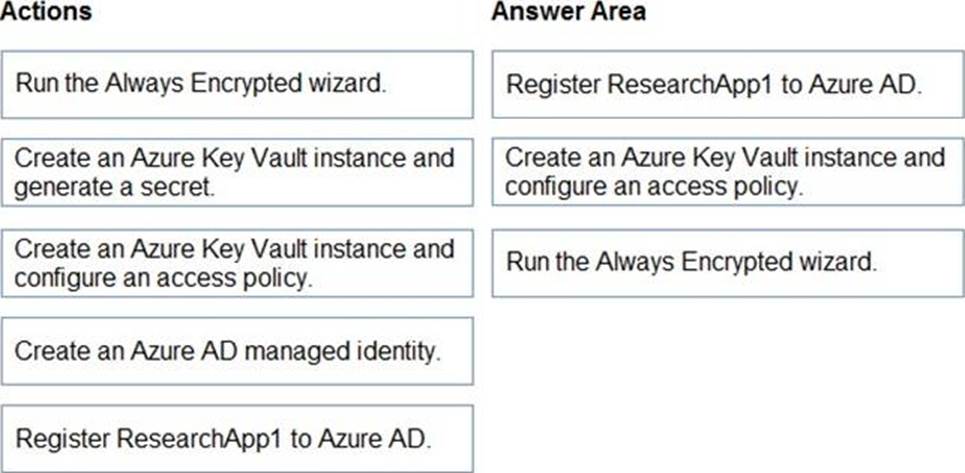
Which three actions should you perform in sequence? To answer, move the appropriate actions from the list of actions to the answer area and arrange them in the correct order.


Answer:


Explanation:
Graphical user interface, text, application
Description automatically generated
Question 63 Selectable Answer
You have an Azure SQL database.
You discover that the plan cache is full of compiled plans that were used only once.
You run the select * from sys.database_scoped_configurations Transact-SQL command and receive the results shown in the following table.


You need relieve the memory pressure.
What should you configure?

Answer:
Explanation:
OPTIMIZE_FOR_AD_HOC_WORKLOADS = { ON | OFF }
Enables or disables a compiled plan stub to be stored in cache when a batch is compiled for the first time. The default is OFF. Once the database scoped configuration OPTIMIZE_FOR_AD_HOC_WORKLOADS is enabled for a database, a compiled plan stub will be stored in cache when a batch is compiled for the first time. Plan stubs have a smaller memory footprint compared to the size of the full compiled plan.
Reference: https://docs.microsoft.com/en-us/sql/t-sql/statements/alter-database-scoped-configuration-transact-sql
Question 64 Written Answer
HOTSPOT
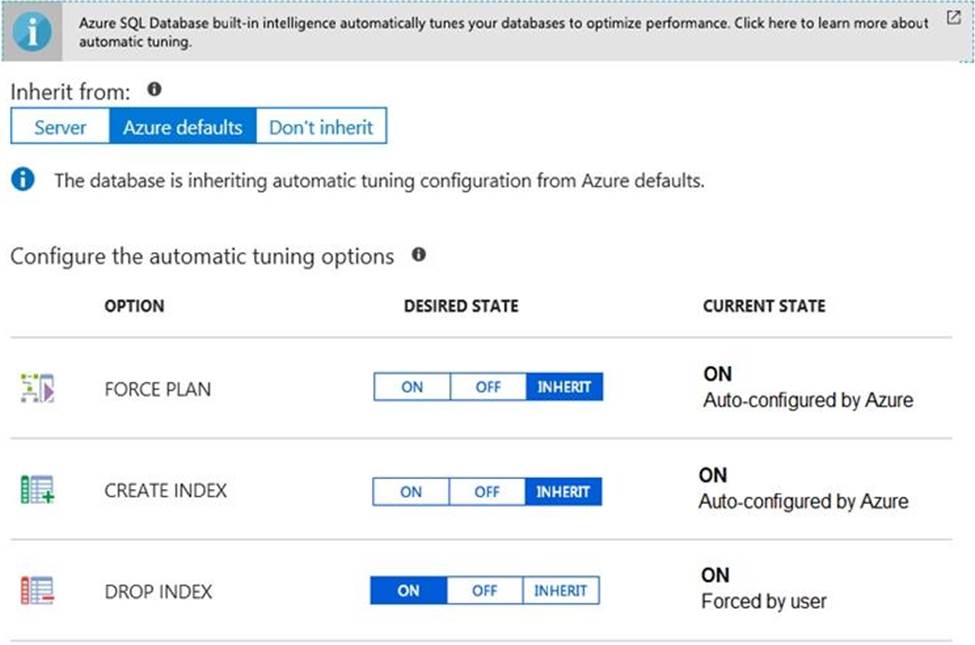
You have an Azure SQL database named DB1.
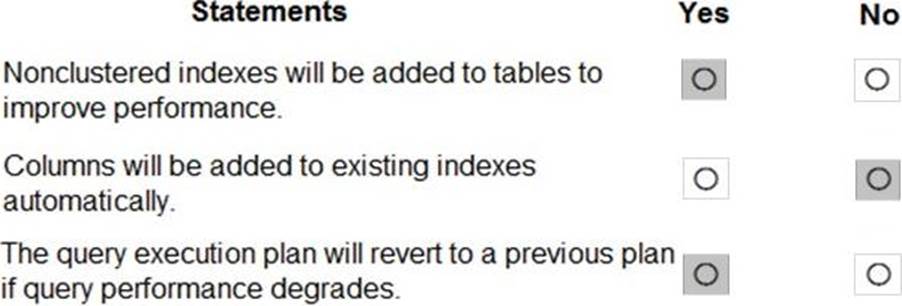
The automatic tuning options for DB1 are configured as shown in the following exhibit.


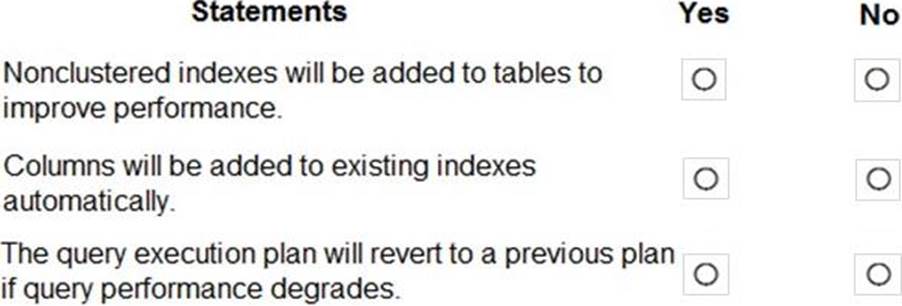
For each of the following statements, select Yes if the statement is true. Otherwise, select No. NOTE: Each correct selection is worth one point.


Answer:


Explanation:
Box 1: Yes
We see: Tuning option: Create index ON
CREATE INDEX - Identifies indexes that may improve performance of your workload, creates indexes, and automatically verifies that performance of queries has improved.
Box 2: No
Box 3: Yes
FORCE LAST GOOD PLAN (automatic plan correction) - Identifies Azure SQL queries using an execution plan that is slower than the previous good plan, and queries using the last known good plan instead of the regressed plan.
Question 65 Selectable Answer
What should you do after a failover of SalesSQLDb1 to ensure that the database remains accessible to SalesSQLDb1App1?

Answer:
Explanation:
Scenario: SalesSQLDb1 uses database firewall rules and contained database users.
Question 66 Selectable Answer
You manage an enterprise data warehouse in Azure Synapse Analytics.
Users report slow performance when they run commonly used queries. Users do not report performance changes for infrequently used queries.
You need to monitor resource utilization to determine the source of the performance issues.
Which metric should you monitor?

Answer:
Explanation:
Tempdb is used to hold intermediate results during query execution. High utilization of the tempdb database can lead to slow query performance.
Note: If you have a query that is consuming a large amount of memory or have received an error message related to allocation of tempdb, it could be due to a very large CREATE TABLE AS SELECT (CTAS) or INSERT SELECT statement running that is failing in the final data movement operation.
Reference: https://docs.microsoft.com/en-us/azure/synapse-analytics/sql-data-warehouse/sql-data-warehouse-managemonitor#monitor-tempdb
Question 67 Selectable Answer
Which windowing function should you use to perform the streaming aggregation of the sales data?

Answer:
Explanation:
Scenario: The sales data, including the documents in JSON format, must be gathered as it arrives and analyzed online by using Azure Stream Analytics. The analytics process will perform aggregations that must be done continuously, without gaps, and without overlapping.
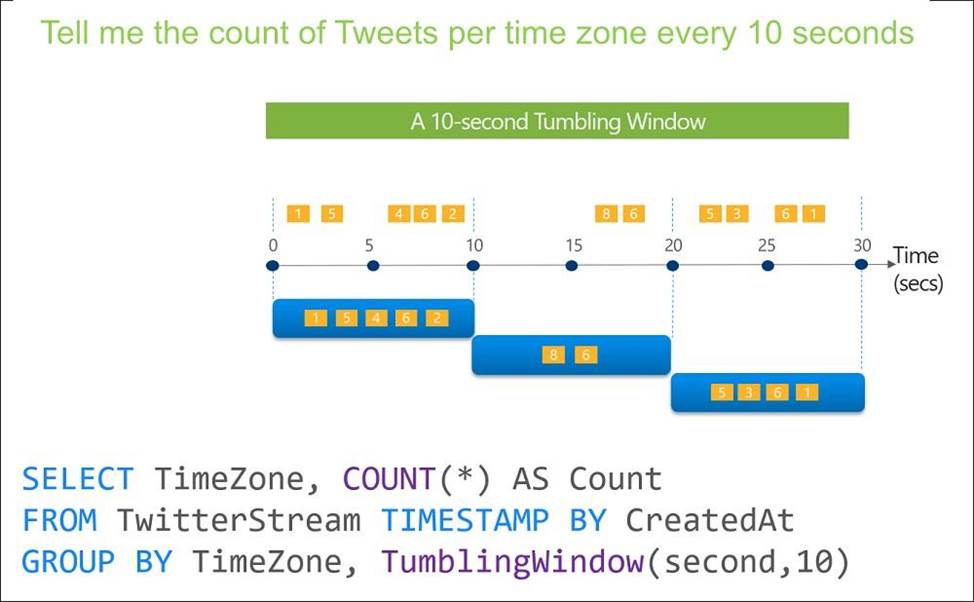
Tumbling window functions are used to segment a data stream into distinct time segments and perform a function against them, such as the example below. The key differentiators of a Tumbling window are that they repeat, do not overlap, and an event cannot belong to more than one tumbling window.


Timeline
Description automatically generated
Reference: https://github.com/MicrosoftDocs/azure-docs/blob/master/articles/stream-analytics/stream-analytics-window-functions.md
Question 68 Written Answer
HOTSPOT
You have an Azure subscription.
You need to deploy an Azure SQL managed instance that meets the following requirements:
• Optimize latency.
• Maximize the memory-to-vCore ratio.
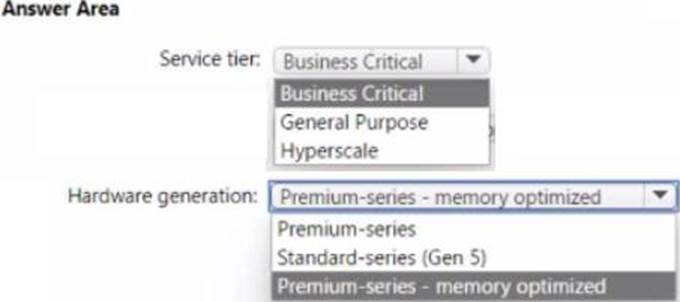
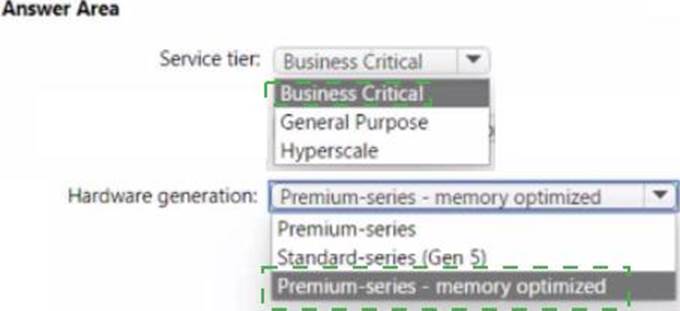
Which service tier and hardware generation should you use? To answer, select the apocopate options in the answer area. NOTE: Each correct selection is worth one point.


Answer:

Question 69 Selectable Answer
Topic 2, Contoso Ltd

Case study
This is a case study. Case studies are not timed separately. You can use as much exam time as you would like to complete each case. However, there may be additional case studies and sections on this exam. You must manage your time to ensure that you are able to complete all questions included on this exam in the time provided.

To answer the questions included in a case study, you will need to reference information that is provided in the case study. Case studies might contain exhibits and other resources that provide more information about the scenario that is described in the case study. Each question is independent of the other questions in this case study.

At the end of this case study, a review screen will appear. This screen allows you to review your answers and to make changes before you move to the next section of the exam. After you begin a new section, you cannot return to this section.

To start the case study
To display the first question in this case study, click the Next button. Use the buttons in the left pane to explore the content of the case study before you answer the questions. Clicking these buttons displays information such as business requirements, existing environment, and problem statements. If the case study has an All Information tab, note that the information displayed is identical to the information displayed on the subsequent tabs. When you are ready to answer a question, click the Question button to return to the question.

Overview
Existing Environment
Contoso, Ltd. is a financial data company that has 100 employees. The company delivers financial data to customers.

Active Directory
Contoso has a hybrid Azure Active Directory (Azure AD) deployment that syncs to on-premises Active Directory.

Database Environment
Contoso has SQL Server 2017 on Azure virtual machines shown in the following table.



SQL1 and SQL2 are in an Always On availability group and are actively queried. SQL3 runs jobs, provides historical data, and handles the delivery of data to customers.
The on-premises datacenter contains a PostgreSQL server that has a 50-TB database.

Current Business Model
Contoso uses Microsoft SQL Server Integration Services (SSIS) to create flat files for customers. The customers receive the files by using FTP.

Requirements
Planned Changes
Contoso plans to move to a model in which they deliver data to customer databases that run as platform as a service (PaaS) offerings. When a customer establishes a service agreement with Contoso, a separate resource group that contains an Azure SQL database will be provisioned for the customer. The database will have a complete copy of the financial data. The data to which each customer will have access will depend on the service agreement tier. The customers can change tiers by changing their service agreement.
The estimated size of each PaaS database is 1 TB.
Contoso plans to implement the following changes:
Move the PostgreSQL database to Azure Database for PostgreSQL during the next six months.
Upgrade SQL1, SQL2, and SQL3 to SQL Server 2019 during the next few months.
Start onboarding customers to the new PaaS solution within six months.

Business Goals
Contoso identifies the following business requirements:
Use built-in Azure features whenever possible.
Minimize development effort whenever possible.
Minimize the compute costs of the PaaS solutions.
Provide all the customers with their own copy of the database by using the PaaS solution. Provide the customers with different table and row access based on the customer’s service agreement.
In the event of an Azure regional outage, ensure that the customers can access the PaaS solution with minimal downtime. The solution must provide automatic failover.
Ensure that users of the PaaS solution can create their own database objects but he prevented from modifying any of the existing database objects supplied by Contoso.

Technical Requirements
Contoso identifies the following technical requirements:
Users of the PaaS solution must be able to sign in by using their own corporate Azure AD credentials or have Azure AD credentials supplied to them by Contoso. The solution must avoid using the internal Azure AD of Contoso to minimize guest users.
All customers must have their own resource group, Azure SQL server, and Azure SQL database. The deployment of resources for each customer must be done in a consistent fashion.
Users must be able to review the queries issued against the PaaS databases and identify any new objects created.
Downtime during the PostgreSQL database migration must be minimized.

Monitoring Requirements
Contoso identifies the following monitoring requirements:
Notify administrators when a PaaS database has a higher than average CPU usage.
Use a single dashboard to review security and audit data for all the PaaS databases.
Use a single dashboard to monitor query performance and bottlenecks across all the PaaS databases.
Monitor the PaaS databases to identify poorly performing queries and resolve query performance issues automatically whenever possible.

PaaS Prototype
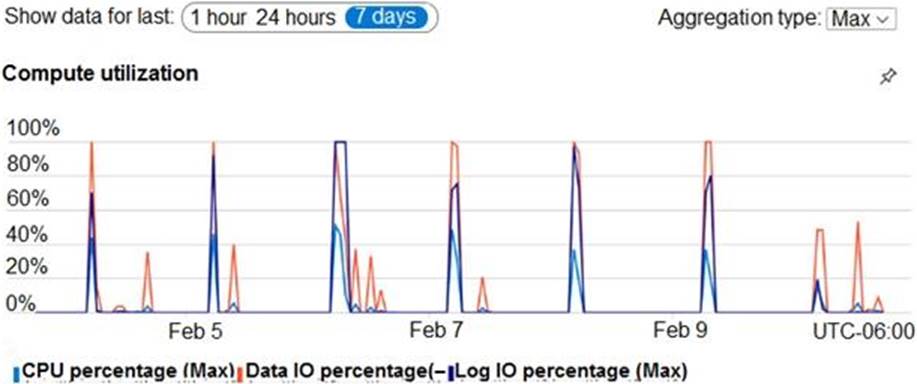
During prototyping of the PaaS solution in Azure, you record the compute utilization of a customer’s Azure SQL database as shown in the following exhibit.


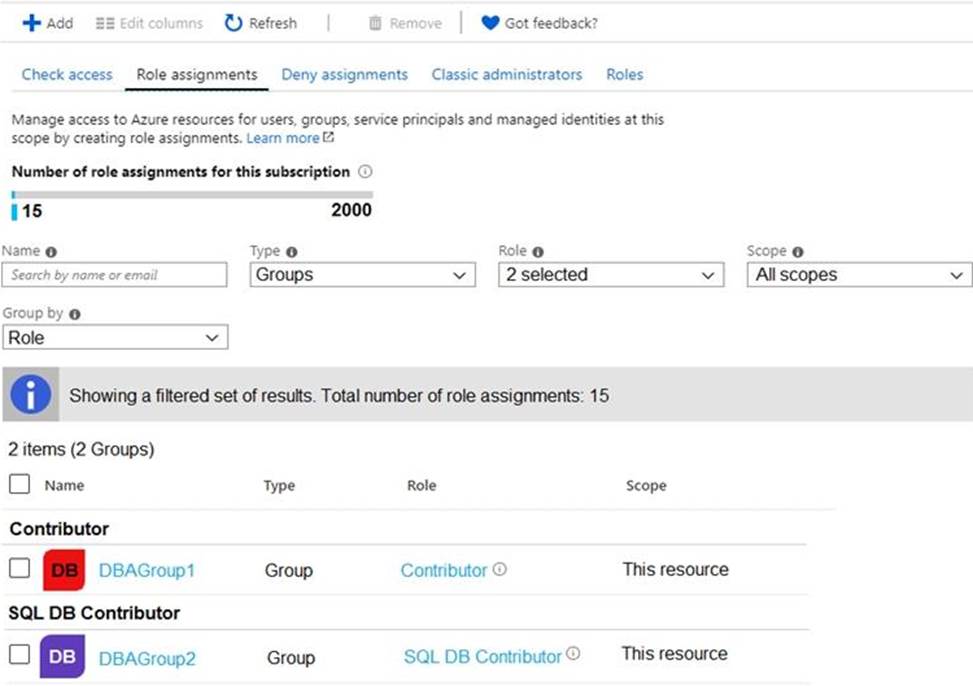
Role Assignments
For each customer’s Azure SQL Database server, you plan to assign the roles shown in the following exhibit.


Based on the PaaS prototype, which Azure SQL Database compute tier should you use?

Answer:
Explanation:
There are CPU and Data I/O spikes for the PaaS prototype. Business Critical 4-vCore is needed.
Reference: https://docs.microsoft.com/en-us/azure/azure-sql/database/reserved-capacity-overview
Question 70 Written Answer
DRAG DROP
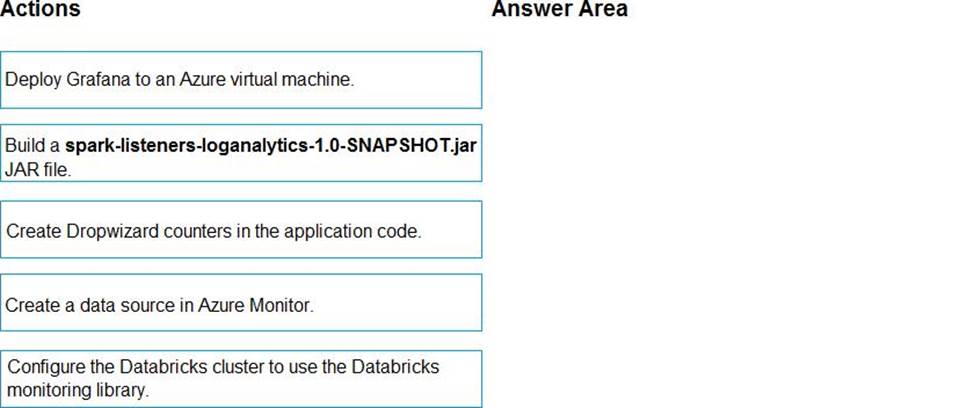
Your company analyzes images from security cameras and sends alerts to security teams that respond to unusual activity. The solution uses Azure Databricks.
You need to send Apache Spark level events, Spark Structured Streaming metrics, and application metrics to Azure Monitor.
Which three actions should you perform in sequence? To answer, move the appropriate actions from the list of actions in the answer area and arrange them in the correct order.


Answer:


Explanation:
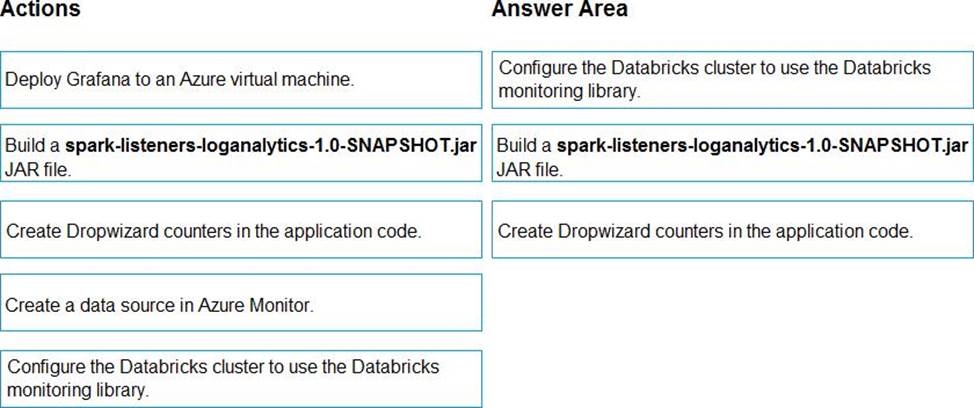
Graphical user interface, text, application
Description automatically generated with medium confidence
Send application metrics using Dropwizard.
Spark uses a configurable metrics system based on the Dropwizard Metrics Library.
To send application metrics from Azure Databricks application code to Azure Monitor, follow these steps:
Step 1: Configure your Azure Databricks cluster to use the Databricksmonitoring library.
Prerequisite: Configure your Azure Databricks cluster to use the monitoring library.
Step 2: Build the spark-listeners-loganalytics-1.0-SNAPSHOT.jar JAR file
Step 3: Create Dropwizard counters in your application code Create Dropwizard gauges or counters in your application code
Question 71 Written Answer
HOTSPOT
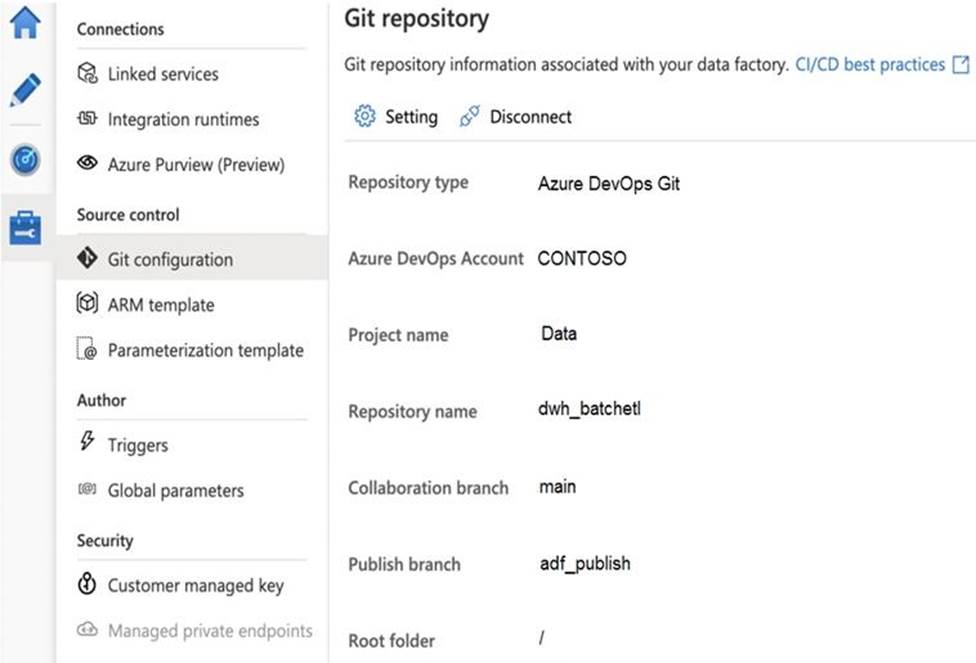
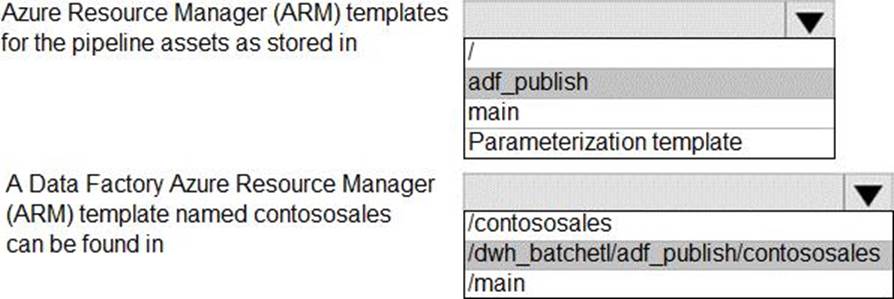
You configure version control for an Azure Data Factory instance as shown in the following exhibit.


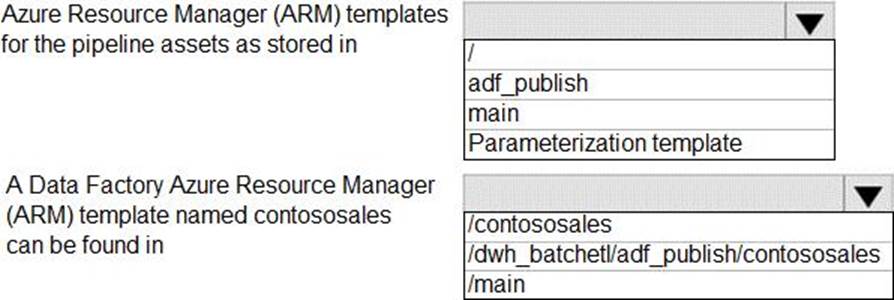
Use the drop-down menus to select the answer choice that completes each statement based on the information presented in the graphic. NOTE: Each correct selection is worth one point.


Answer:


Explanation:
Graphical user interface, text, application
Description automatically generated
Box 1: adf_publish
By default, data factory generates the Resource Manager templates of the published factory and saves them into a branch called adf_publish. To configure a custom publish branch, add a publish_config.json file to the root folder in the collaboration branch. When publishing, ADF reads this file, looks for the field publishBranch, and saves all Resource Manager templates to the specified location. If the branch doesn't exist, data factory will automatically create it. And example of what this file looks like is below:
{
"publishBranch": "factory/adf_publish"
}
Box 2: /dwh_barchlet/ adf_publish/contososales
RepositoryName: Your Azure Repos code repository name. Azure Repos projects contain Git repositories to manage your source code as your project grows. You can create a new repository or use an existing repository that's already in your project.
Question 72 Selectable Answer
You are designing an anomaly detection solution for streaming data from an Azure IoT hub.
The solution must meet the following requirements:
✑ Send the output to an Azure Synapse.
✑ Identify spikes and dips in time series data.
✑ Minimize development and configuration effort.
Which should you include in the solution?

Answer:
Explanation:
Anomalies can be identified by routing data via IoT Hub to a built-in ML model in Azure Stream Analytics
Reference:
https://docs.microsoft.com/en-us/learn/modules/data-anomaly-detection-using-azure-iot-hub/
https://docs.microsoft.com/en-us/azure/stream-analytics/azure-synapse-analytics-output
Question 73 Selectable Answer
You need to implement the surrogate key for the retail store table. The solution must meet the sales transaction dataset requirements.
What should you create?

Answer:
Explanation:
Scenario: Contoso requirements for the sales transaction dataset include:
Implement a surrogate key to account for changes to the retail store addresses.
A surrogate key on a table is a column with a unique identifier for each row. The key is not generated from the table data. Data modelers like to create surrogate keys on their tables when they design data warehouse models. You can use the IDENTITY property to achieve this goal simply and effectively without affecting load performance.
Reference: https://docs.microsoft.com/en-us/azure/synapse-analytics/sql-data-warehouse/sql-data-warehouse-tablesidentity
Question 74 Selectable Answer
You have an Azure SQL database. The database contains a table that uses a columnstore index and is accessed infrequently.
You enable columnstore archival compression.
What are two possible results of the configuration? Each correct answer presents a complete solution. NOTE: Each correct selection is worth one point.

Answer:
Explanation:
For rowstore tables and indexes, use the data compression feature to help reduce the size of the database. In addition to saving space, data compression can help improve performance of I/O intensive workloads because the data is stored in fewer pages and queries need to read fewer pages from disk.
Use columnstore archival compression to further reduce the data size for situations when you can afford extra time and CPU resources to store and retrieve the data.
Question 75 Selectable Answer
Note: This question is part of a series of questions that present the same scenario. Each question in the series contains a unique solution that might meet the stated goals. Some question sets might have more than one correct solution, while others might not have a correct solution.
After you answer a question in this section, you will NOT be able to return to it. As a result, these questions will not appear in the review screen.
You have an Azure Data Lake Storage account that contains a staging zone.
You need to design a daily process to ingest incremental data from the staging zone, transform the data by executing an R script, and then insert the transformed data into a data warehouse in Azure Synapse Analytics.
Solution: You use an Azure Data Factory schedule trigger to execute a pipeline that executes an Azure Databricks notebook, and then inserts the data into the data warehouse.
Does this meet the goal?

Answer:
Showing page 5 of 10