Test Online Free Microsoft DP-300 Exam Questions and Answers
Practice a live sample before buying full access. This page keeps the free DP-300 question set organized by page so visitors and search engines can reach the canonical -questions.html URL directly.
You have a on-premises Microsoft SQL Server named SQL1 that hosts five databases.
You need to migrate the databases to an Azure SQL managed instance. The solution must minimize downtime and prevent data loss.
What should you use?
Answer:
Question 92Selectable Answer
You have an Azure SQL Database managed instance.
The instance starts experiencing performance issues.
You need to identify which query is causing the issue and retrieve the execution plan for the query. The solution must minimize administrative effort.
What should you use?
You are building a database backup solution for a SQL Server database hosted on an Azure virtual machine.
In the event of an Azure regional outage, you need to be able to restore the database backups. The solution must minimize costs.
Which type of storage accounts should you use for the backups?
Answer: Explanation:
Geo-redundant storage (with GRS or GZRS) replicates your data to another physical location in the secondary region to protect against regional outages. However, that data is available to be read only if the customer or Microsoft initiates a failover from the primary to secondary region. When you enable read access to the secondary region, your data is available to be read if the primary region becomes unavailable. For read access to the secondary region, enable read-access geo-redundant storage (RA-GRS) or read-access geo-zone-redundant storage (RA-GZRS).
Reference: https://docs.microsoft.com/en-us/azure/storage/common/storage-redundancy
Question 94Selectable Answer
You need to recommend a solution to ensure that the customers can create the database objects. The solution must meet the business goals.
What should you include in the recommendation?
Answer:
Question 95Selectable Answer
You need to identify the cause of the performance issues on SalesSQLDb1.
Which two dynamic management views should you use? Each correct answer presents part of the solution. NOTE: Each correct selection is worth one point.
Answer: Explanation:
SalesSQLDb1 experiences performance issues that are likely due to out-of-date statistics and frequent blocking queries.
A: Use sys.dm_pdw_nodes_tran_locks instead of sys.dm_tran_locks from Azure Synapse Analytics (SQL Data Warehouse) or Parallel Data Warehouse.
E: Example:
The following query will show blocking information.
SELECT
t1.resource_type,
t1.resource_database_id,
t1.resource_associated_entity_id,
t1.request_mode,
t1.request_session_id,
t2.blocking_session_id
FROM sys.dm_tran_locks as t1
INNER JOIN sys.dm_os_waiting_tasks as t2
ON t1.lock_owner_address = t2.resource_address;
Note: Depending on the system you’re working with you can access these wait statistics from one of three locations:
sys.dm_os_wait_stats: for SQL Server
sys.dm_db_wait_stats: for Azure SQL Database
sys.dm_pdw_nodes_os_wait_stats: for Azure SQL Data Warehouse
Reference: https://docs.microsoft.com/en-us/sql/relational-databases/system-dynamic-management-views/sys-dm-tran-locks-transact-sql
Question 96Selectable Answer
Topic 3, ADatum Corporation
This is a case study. Case studies are not timed separately. You can use as much exam time as you would like to complete each case. However, there may be additional case studies and sections on this exam. You must manage your time to ensure that you are able to complete all questions included on this exam in the time provided.
To answer the questions included in a case study, you will need to reference information that is provided in the case study. Case studies might contain exhibits and other resources that provide more information about the scenario that is described in the case study. Each question is independent of the other questions in this case study.
At the end of this case study, a review screen will appear. This screen allows you to review your answers and to make changes before you move to the next section of the exam. After you begin a new section, you cannot return to this section.
To start the case study
To display the first question in this case study, click the Next button. Use the buttons in the left pane to explore the content of the case study before you answer the questions. Clicking these buttons displays information such as business requirements, existing environment, and problem statements. If the case study has an All Information tab, note that the information displayed is identical to the information displayed on the subsequent tabs. When you are ready to answer a question, click the Question button to return to the question.
Overview
ADatum Corporation is a retailer that sells products through two sales channels: retail stores and a website.
Existing Environment
ADatum has one database server that has Microsoft SQL Server 2016 installed. The server hosts three mission-critical databases named SALESDB, DOCDB, and REPORTINGDB.
SALESDB collects data from the stores and the website.
DOCDB stores documents that connect to the sales data in SALESDB. The documents are stored in two different JSON formats based on the sales channel.
REPORTINGDB stores reporting data and contains several columnstore indexes. A daily process creates reporting data in REPORTINGDB from the data in SALESDB. The process is implemented as a SQL Server Integration Services (SSIS) package that runs a stored procedure from SALESDB.
Requirements
Planned Changes
ADatum plans to move the current data infrastructure to Azure.
The new infrastructure has the following requirements:
✑ Migrate SALESDB and REPORTINGDB to an Azure SQL database.
✑ Migrate DOCDB to Azure Cosmos DB.
✑ The sales data, including the documents in JSON format, must be gathered as it arrives and analyzed online by using Azure Stream Analytics. The analytics process will perform aggregations that must be done continuously, without gaps, and without overlapping.
✑ As they arrive, all the sales documents in JSON format must be transformed into one consistent format.
✑ Azure Data Factory will replace the SSIS process of copying the data from SALESDB to REPORTINGDB.
Technical Requirements
The new Azure data infrastructure must meet the following technical requirements:
✑ Data in SALESDB must encrypted by using Transparent Data Encryption (TDE). The encryption must use your own key.
✑ SALESDB must be restorable to any given minute within the past three weeks.
✑ Real-time processing must be monitored to ensure that workloads are sized properly based on actual usage patterns.
✑ Missing indexes must be created automatically for REPORTINGDB.
✑ Disk IO, CPU, and memory usage must be monitored for SALESDB.
Which counter should you monitor for real-time processing to meet the technical requirements?
Answer: Explanation:
Scenario: Real-time processing must be monitored to ensure that workloads are sized properly based on actual usage patterns.
To monitor the performance of a database in Azure SQL Database and Azure SQL Managed Instance, start by monitoring the CPU and IO resources used by your workload relative to the level of database performance you chose in selecting a particular service tier and performance level.
Reference: https://docs.microsoft.com/en-us/azure/azure-sql/database/monitor-tune-overview
Question 97Selectable Answer
You have an Azure SQL Database server named sqlsrv1 that hosts 10 Azure SQL databases.
The databases perform slower than expected.
You need to identify whether the performance issue relates to the use of tempdb on sqlsrv1.
What should you do?
Answer: Explanation:
The diagnostics log outputs tempDB contention details. You can use the information as the starting point for troubleshooting.
You can use the Intelligent Insights performance diagnostics log of Azure SQL Database to troubleshoot performance issues.
Reference:
https://docs.microsoft.com/en-us/azure/azure-sql/database/intelligent-insights-troubleshoot-performance#tempdb-contention
https://docs.microsoft.com/en-us/azure/azure-sql/database/intelligent-insights-use-diagnostics-log
Question 98Selectable Answer
You have an Azure SQL database named DB1.
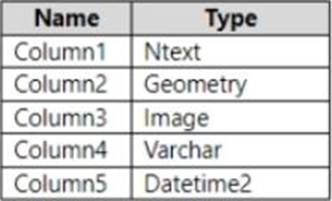
DB1 has a table named Table1 that contains the following columns.
You plan to enable Always Encrypted for Table1.
Which two columns support encryption? Each correct answer presents a complete solution. NOTE: Each correct selection is worth one point
Answer:
Question 99Written Answer
HOTSPOT
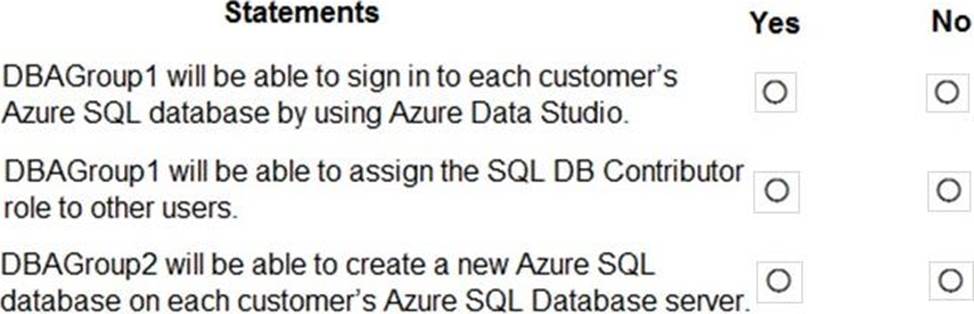
You are evaluating the role assignments.
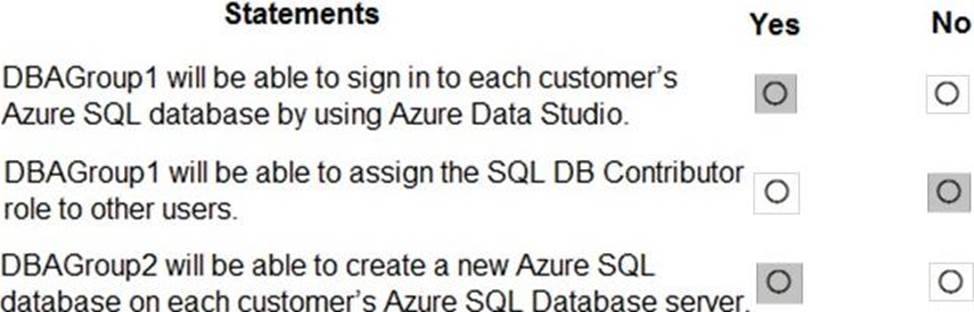
For each of the following statements, select Yes if the statement is true. Otherwise, select No. NOTE: Each correct selection is worth one point.
Answer:
Explanation:
Box 1: Yes
DBAGroup1 is member of the Contributor role.
The Contributor role grants full access to manage all resources, but does not allow you to assign roles in Azure RBAC, manage assignments in Azure Blueprints, or share image galleries.
Box 2: No
Box 3: Yes
DBAGroup2 is member of the SQL DB Contributor role.
The SQL DB Contributor role lets you manage SQL databases, but not access to them. Also, you can't manage their security-related policies or their parent SQL servers. As a member of this role you can create and manage SQL databases.
Question 100Selectable Answer
You have an Azure subscription that contains an Azure Data Factory version 2 (V2) data factory named df1.
DF1 contains a linked service.
You have an Azure Key vault named vault1 that contains an encryption kay named key1.
You need to encrypt df1 by using key1.
What should you do first?
Answer: Explanation:
A customer-managed key can only be configured on an empty data Factory. The data factory can't contain any resources such as linked services, pipelines and data flows. It is recommended to enable customer-managed key right after factory creation.
Note: Azure Data Factory encrypts data at rest, including entity definitions and any data cached while runs are in progress. By default, data is encrypted with a randomly generated Microsoft-managed key that is uniquely assigned to your data factory.
Reference: https://docs.microsoft.com/en-us/azure/data-factory/enable-customer-managed-key
Question 101Selectable Answer
Note: This question is part of a series of questions that present the same scenario. Each question in the series contains a unique solution that might meet the stated goals. Some question sets might have more than one correct solution, while others might not have a correct solution.
After you answer a question in this section, you will NOT be able to return to it. As a result, these questions will not appear in the review screen.
You have an Azure SQL database named Sales.
You need to implement disaster recovery for Sales to meet the following requirements:
✑ During normal operations, provide at least two readable copies of Sales.
✑ Ensure that Sales remains available if a datacenter fails.
Solution: You deploy an Azure SQL database that uses the General Purpose service tier and geo-replication.
Does this meet the goal?
Answer: Explanation:
Instead deploy an Azure SQL database that uses the Business Critical service tier and Availability Zones.
Note: Premium and Business Critical service tiers leverage the Premium availability model, which integrates compute resources (sqlservr.exe process) and storage (locally attached SSD) on a single node. High availability is achieved by replicating both compute and storage to additional nodes creating a three to four-node cluster.
By default, the cluster of nodes for the premium availability model is created in the same datacenter. With the introduction of Azure Availability Zones, SQL Database can place different replicas of the Business Critical database to different availability zones in the same region. To eliminate a single point of failure, the control ring is also duplicated across multiple zones as three gateway rings (GW).
Reference: https://docs.microsoft.com/en-us/azure/azure-sql/database/high-availability-sla
Question 102Written Answer
HOTSPOT
You are building an Azure Stream Analytics job to retrieve game data.
You need to ensure that the job returns the highest scoring record for each five-minute time interval of each game.
How should you complete the Stream Analytics query? To answer, select the appropriate options in the answer area. NOTE: Each correct selection is worth one point.
Answer:
Explanation:
Graphical user interface, text, application, email
Description automatically generated
Box 1: TopOne() OVER(PARTITION BY Game ORDER BY Score Desc)
TopOne returns the top-rank record, where rank defines the ranking position of the event in the window according to the specified ordering. Ordering/ranking is based on event columns and can be specified in ORDER BY clause.
Analytic Function Syntax:
TopOne() OVER ([<PARTITION BY clause>] ORDER BY (<column name> [ASC |DESC])+ <LIMIT DURATION clause> [<WHEN clause>])
Box 2: Tumbling (minute 5)
Tumbling window functions are used to segment a data stream into distinct time segments and perform a function against them, such as the example below. The key differentiators of a Tumbling window are that they repeat, do not overlap, and an event cannot belong to more than one tumbling window.
Question 103Selectable Answer
Your on-premises network contains a server that hosts a 60-TB database named DB 1.
The network has a 10-Mbps internet connection.
You need to migrate DB 1 to Azure. The solution must minimize how long it takes to migrate the database.
What should you use?
You have an Azure subscription that contains a server named Server1. Server1 hosts two Azure SQL databases named DB1 and DB2.
You plan to deploy a Windows app named App1 that will authenticate to DB2 by using SQL authentication.
You need to ensure that App1 can access DB2.
The solution must meet the following requirements:
✑ App1 must be able to view only DB2.
✑ Administrative effort must be minimized.
What should you create?
You have an instance of SQL Server on Azure Virtual Machine named SQL1.
You need to monitor SQL1 and query the metrics by using Kusto query language. The solution must minimize administrative effort.
Where should you store the metrics?