Test Online Free Microsoft DP-300 Exam Questions and Answers
Practice a live sample before buying full access. This page keeps the free DP-300 question set organized by page so visitors and search engines can reach the canonical -questions.html URL directly.
You create five Azure SQL Database instances on the same logical server.
In each database, you create a user for an Azure Active Directory (Azure AD) user named User1.
User1 attempts to connect to the logical server by using Azure Data Studio and receives a login error.
You need to ensure that when User1 connects to the logical server by using Azure Data Studio, User1 can see all the databases.
What should you do?
You have an Azure AD tenant and a logical Microsoft SQL server named SQL1 that hosts several Azure SQL databases.
You plan to assign Azure AD users permissions to the databases automatically by using Azure Automation.
You need to create the required Automation accounts.
Which two accounts should you create? Each correct answer presents part of the solution. NOTE: Each correct selection is worth one point.
Answer:
Question 48Written Answer
HOTSPOT
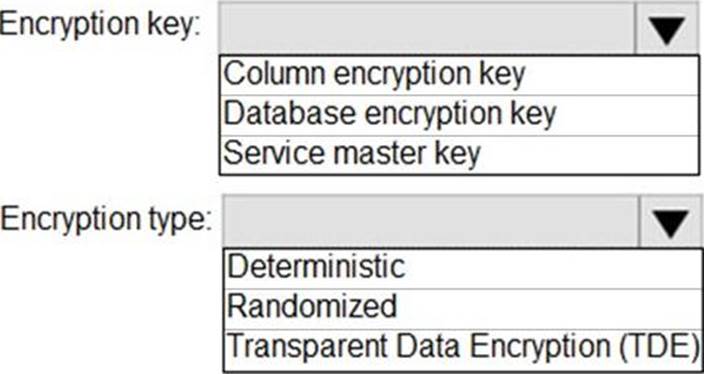
You have an Azure SQL database named DB1 that contains two tables named Table1 and Table2. Both tables contain a column named a Column1. Column1 is used for joins by an application named App1.
You need to protect the contents of Column1 at rest, in transit, and in use.
How should you protect the contents of Column1? To answer, select the appropriate options in the answer area. NOTE: Each correct selection is worth one point.
Answer:
Explanation:
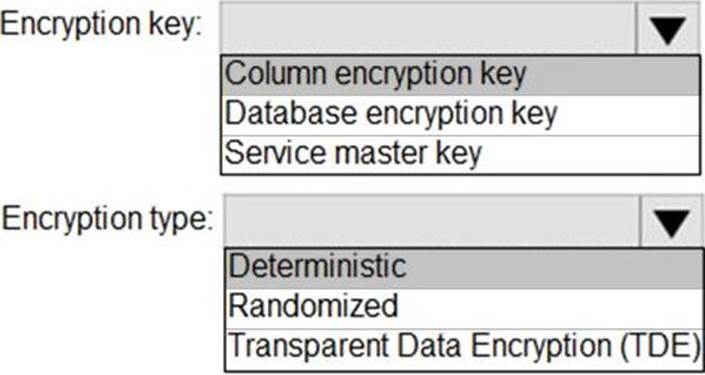
Box 1: Column encryption Key
Always Encrypted uses two types of keys: column encryption keys and column master keys. A column encryption key is used to encrypt data in an encrypted column. A column master key is a key-protecting key that encrypts one or more column encryption keys.
Question 49Selectable Answer
You have an Azure SQL database named db1 on a server named server1.
You need to modify the MAXDOP settings for db1.
What should you do?
HOTSPOT
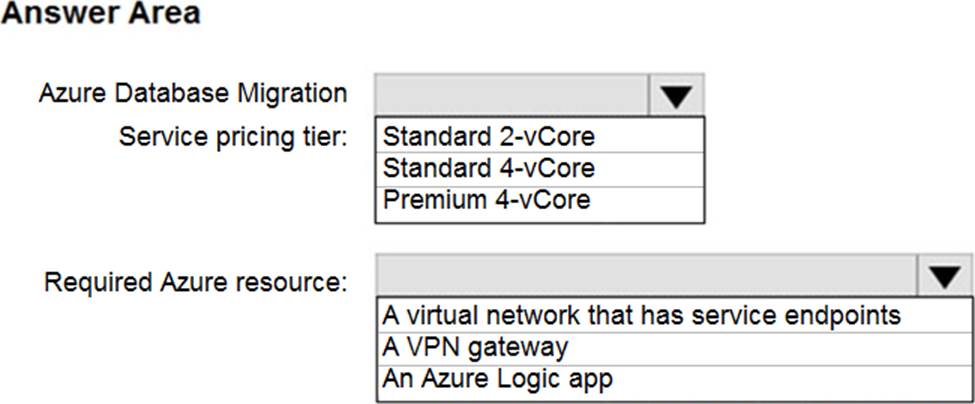
You are planning the migration of the SERVER1 databases. The solution must meet the business requirements.
What should you include in the migration plan? To answer, select the appropriate options in the answer area. NOTE: Each correct selection is worth one point.
Answer:
Explanation:
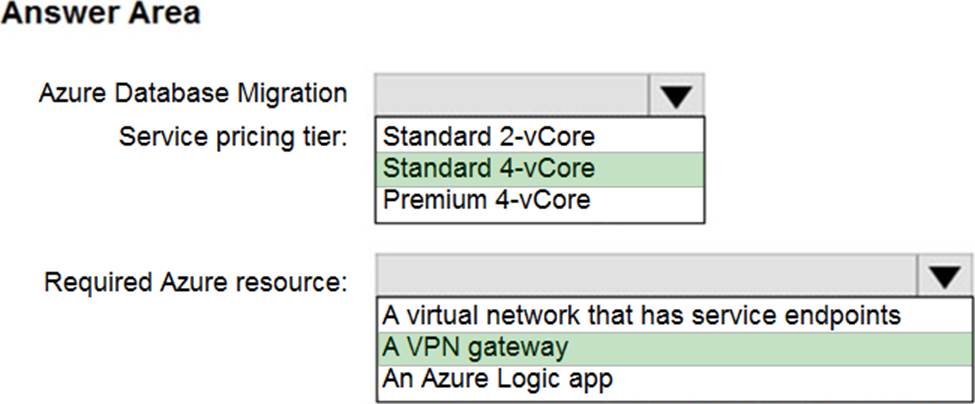
Azure Database Migration service
Box 1: Premium 4-VCore
Scenario: Migrate the SERVER1 databases to the Azure SQL Database platform.
✑ Minimize downtime during the migration of the SERVER1 databases.
Premimum 4-vCore is for large or business critical workloads. It supports online migrations, offline migrations, and faster migration speeds.
Question 51Written Answer
Topic 4, Contoso Ltd Clothing Store
HOTSPOT
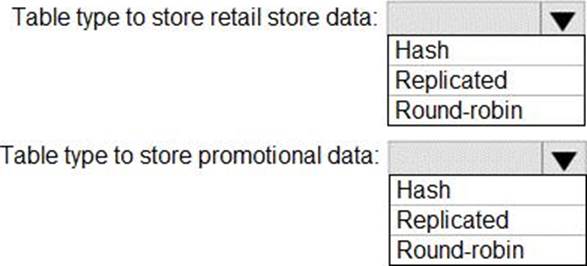
You need to design an analytical storage solution for the transactional data. The solution must meet the sales transaction dataset requirements.
What should you include in the solution? To answer, select the appropriate options in the answer area. NOTE: Each correct selection is worth one point.
Answer:
Explanation:
Graphical user interface, text, application
Description automatically generated
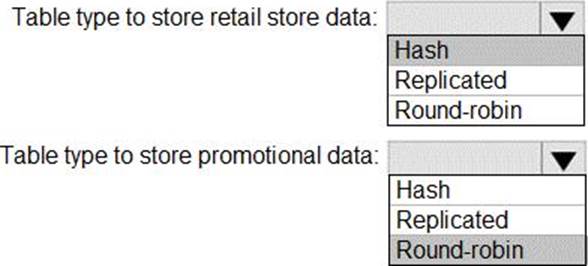
Box 1: Hash
Scenario:
Ensure that queries joining and filtering sales transaction records based on product ID complete as quickly as possible.
A hash distributed table can deliver the highest query performance for joins and aggregations on large tables.
Box 2: Round-robin
Scenario:
You plan to create a promotional table that will contain a promotion ID. The promotion ID will be associated to a specific product. The product will be identified by a product ID. The table will be approximately 5 GB.
A round-robin table is the most straightforward table to create and delivers fast performance when used as a staging table for loads.
These are some scenarios where you should choose Round robin distribution:
✑ When you cannot identify a single key to distribute your data.
✑ If your data doesn’t frequently join with data from other tables.
✑ When there are no obvious keys to join.
Question 52Selectable Answer
You have the following Azure Data Factory pipelines:
✑ Ingest Data from System1
✑ Ingest Data from System2
✑ Populate Dimensions
✑ Populate Facts
Ingest Data from System1 and Ingest Data from System2 have no dependencies. Populate
Dimensions must execute after Ingest Data from System1 and Ingest Data from System2. Populate Facts must execute after the Populate Dimensions pipeline. All the pipelines must execute every eight hours.
What should you do to schedule the pipelines for execution?
You plan to build a structured streaming solution in Azure Databricks. The solution will count new events in fiveminute intervals and report only events that arrive during the interval.
The output will be sent to a Delta Lake table.
Which output mode should you use?
Answer: Explanation:
Complete mode: You can use Structured Streaming to replace the entire table with every batch.
Reference: https://docs.databricks.com/delta/delta-streaming.html
Question 54Selectable Answer
You are evaluating the business goals.
Which feature should you use to provide customers with the required level of access based on their service agreement?
DRAG DROP
You have two instances of SQL Server on Azure virtual Machines named VM1 and VM2.
VM1 hosts a database named dbl.
You plan to create a database availability group (DAG) for dbl. The solution must use certificate authentication between VM1 and VM2.
You need to configure authentication for the outbound connections of VM1.
Which three actions should you perform in sequence? To answer, move the appropriate actions from the list of actions to the answer area and arrange them in the correct order.
Answer:
Question 56Selectable Answer
You need to implement authentication for ResearchDB1. The solution must meet the security and compliance requirements.
What should you run as part of the implementation?
Answer: Explanation:
Scenario: Authenticate database users by using Active Directory credentials. (Create a new Azure SQL database named ResearchDB1 on a logical server named ResearchSrv01.)
Authenticate the user in SQL Database or SQL Data Warehouse based on an Azure Active Directory user:
CREATE USER [[email protected]] FROM EXTERNAL PROVIDER;
Reference: https://docs.microsoft.com/en-us/sql/t-sql/statements/create-user-transact-sql
Question 57Written Answer
HOTSPOT
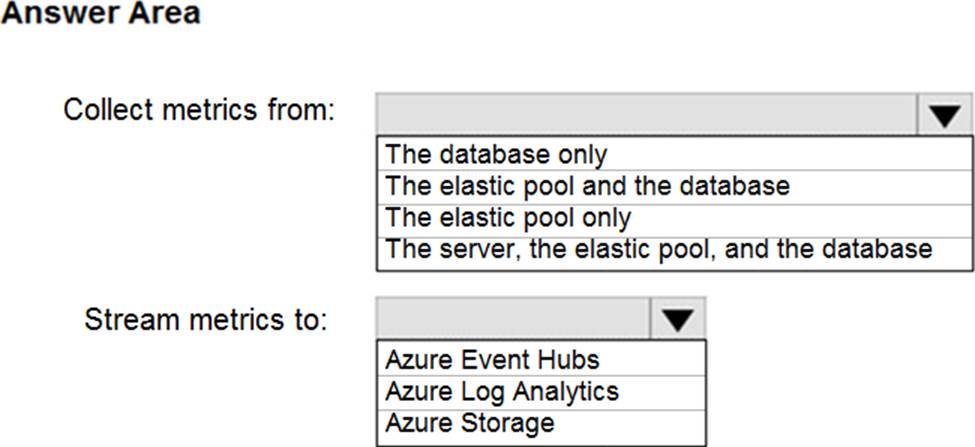
You need to implement the monitoring of SalesSQLDb1. The solution must meet the technical requirements.
How should you collect and stream metrics? To answer, select the appropriate options in the answer area. NOTE: Each correct selection is worth one point.
Answer:
Explanation:
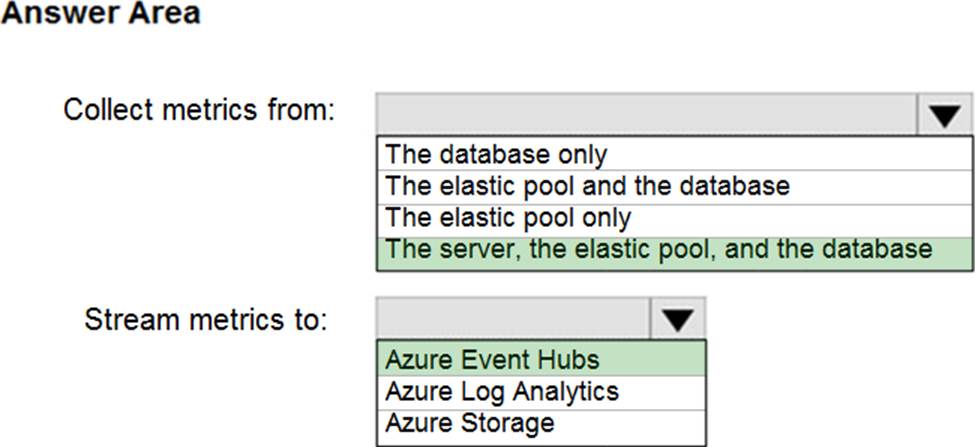
Box 1: The server, the elastic pool, and the database
Senario:
SalesSQLDb1 is in an elastic pool named SalesSQLDb1Pool.
Litware technical requirements include: all SQL Server and Azure SQL Database metrics related to CPU and storage usage and limits must be analyzed by using Azure built-in functionality.
Box 2: Azure Event hubs
Scenario: Migrate ManufacturingSQLDb1 to the Azure virtual machine platform.
Event hubs are able to handle custom metrics.
Question 58Selectable Answer
You have an Azure Databricks resource.
You need to log actions that relate to changes in compute for the Databricks resource.
Which Databricks services should you log?
Answer: Explanation:
Cloud Provider Infrastructure Logs.
Databricks logging allows security and admin teams to demonstrate conformance to data governance standards within or from a Databricks workspace. Customers, especially in the regulated industries, also need records on activities like:
✑ User access control to cloud data storage
✑ Cloud Identity and Access Management roles
✑ User access to cloud network and compute
Azure Databricks offers three distinct workloads on several VM Instances tailored for your data analytics workflow―the Jobs Compute and Jobs Light Compute workloads make it easy for data engineers to build and execute jobs, and the All-Purpose Compute workload makes it easy for data scientists to explore, visualize, manipulate, and share data and insights interactively.
Reference: https://databricks.com/blog/2020/03/25/trust-but-verify-with-databricks.html
Question 59Written Answer
HOTSPOT
You have an Azure SQL managed instance.
You need to restore a database named DB1 by using Transact-SQL.
Which command should you run? To answer, select the appropriate options in the answer area. NOTE: Each correct selection is worth one point.
Answer:
Explanation:
Text
Description automatically generated
Question 60Written Answer
HOTSPOT
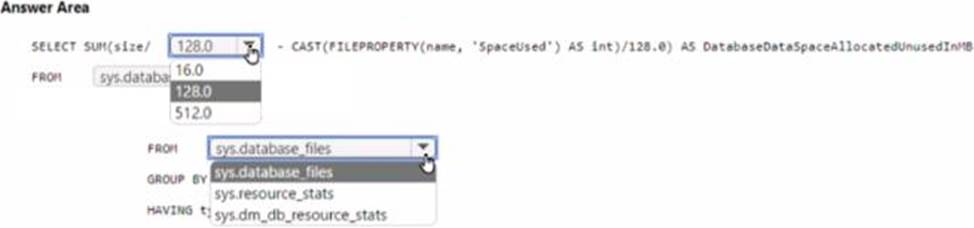
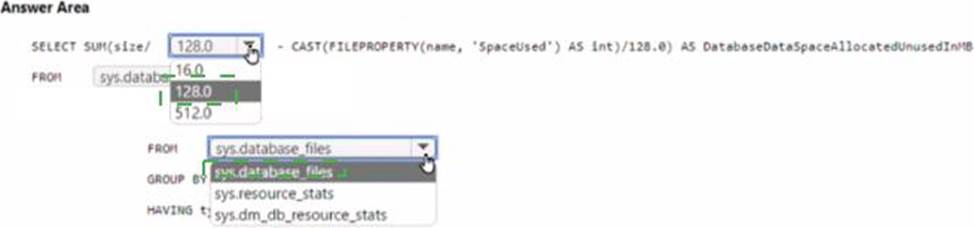
You have an Azure SQL database named D61.
You need to identify how much unused space in megabytes was allocated to DB1.
How should you complete the Transact-SQL query? To answer select the appropriate options m the answer area. NOTE: Each correct selection is worth one point.