Free Demo Questions

Test Online Free Microsoft PL-100 Exam Questions and Answers

Practice a live sample before buying full access. This page keeps the free PL-100 question set organized by page so visitors and search engines can reach the canonical -questions.html URL directly.

Updated Jul 09, 2024 149 Questions 10 Pages
Page 2 of 10
Question 16 Written Answer
DRAG DROP
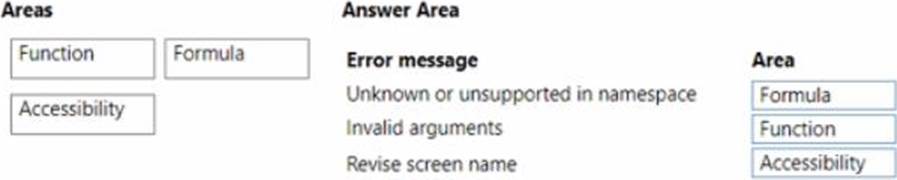
You create a canvas app. You run App checker to validate the app.
App checker returns error results.
You need to locate where the errors occur.
Which areas should you review? To answer drag the appropriate areas to the correct error messages. Each area may be used once, more than once, or not at all You may need to drag the spirt bar between panes or scroll to view content. NOTE: Each correct selection is worth one point.


Answer:

Question 17 Selectable Answer
Topic 4, Misc. Questions

Note: This question is part of a series of questions that present the same scenario. Each question in the series contains a unique solution that might meet the stated goals. Some question sets might have more than one correct solution, while others might not have a correct solution.
After you answer a question in this section, you will NOT be able to return to it. As a result, these questions will not appear in the review screen.
You are developing a model-driven app that uses a Common Data Service database. App users will have a variety of different security roles.
Development and testing must be performed using production data. Multiple testers must be used at each testing stage.
You need to provision and configure new environments for development and testing.
Solution:
✑ Provision production environments named P1 and P2.
✑ Copy the current production environment to P1 and P2.
✑ Use P1 for development and P2 for testing.
Does the solution meet the goal?

Answer:
Explanation:
Production: This is intended to be used for permanent work in an organization.
Don't use production environment for development and testing.
Reference: https://docs.microsoft.com/en-us/power-platform/admin/environments-overview
Question 18 Written Answer
HOTSPOT
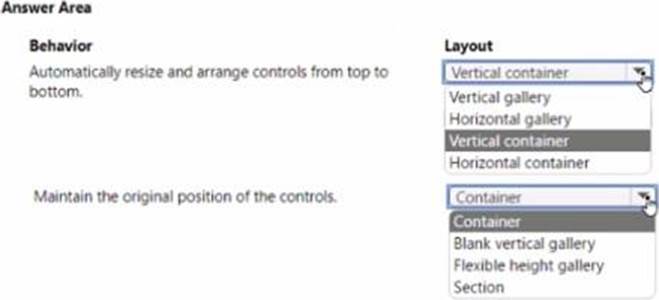
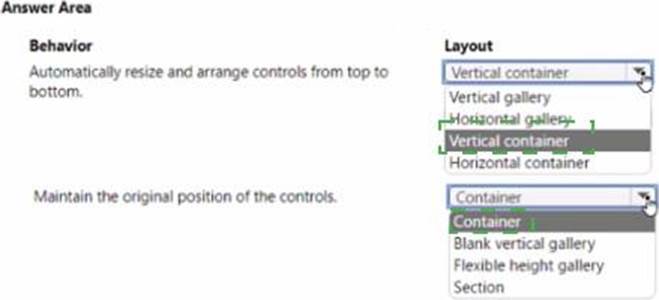
You are designing edit forms to dismay individual records selected from a list m a canvas app.
The control layout must respond to a variety of screen sizes and orientations that demonstrate the following behaviors:
• Automatically resize and arrange controls from top to bottom
• Maintain the original position of the controls.
• Require no additional property changes.
You need to select the layout type.
Which layouts should you use? To answer, select the appropriate options in the answer area.


Answer:

Question 19 Selectable Answer
You need to implement the change requested by the operations manager.
Which control should you use?

Answer:
Explanation:
Scenario: The operations manager asks that the time tracking app display the employee’s photo once they have scanned their badge.
Image control in Power Apps is a control that shows an image from, for example, a local file or a data source.
Reference: https://docs.microsoft.com/en-us/powerapps/maker/canvas-apps/controls/control-image
Question 20 Written Answer
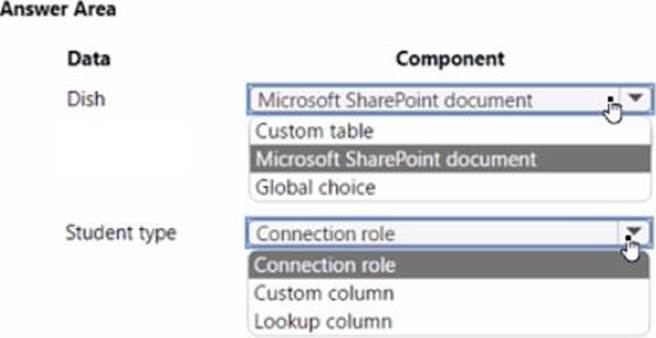
HOTSPOT
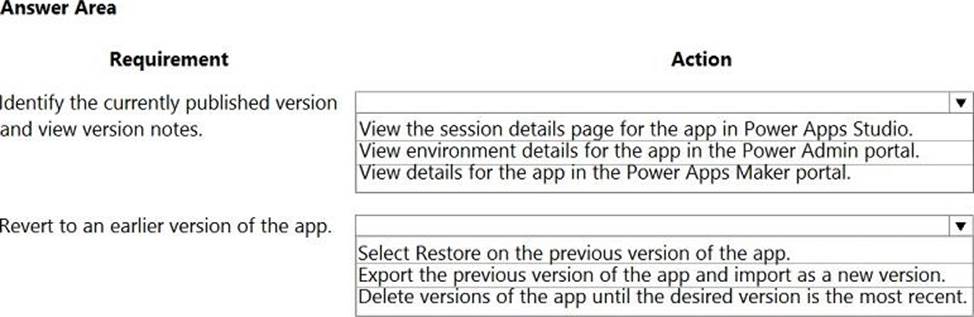
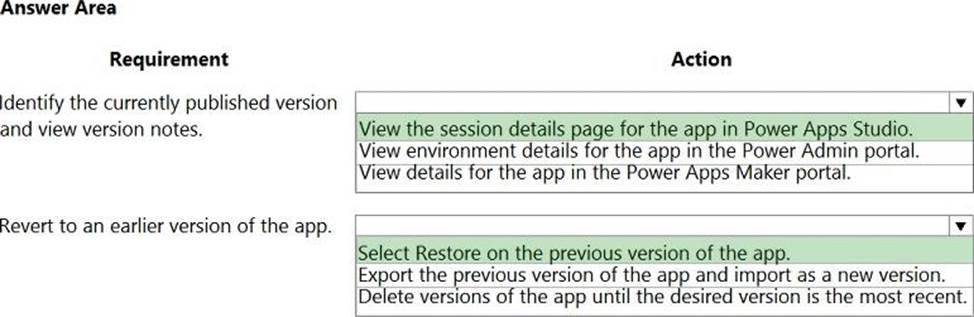
You need to roll back the mobile app to an earlier version.
What should you do? To answer, select the appropriate options in the answer area. NOTE: Each correct selection is worth one point.


Answer:


Explanation:
Box 1: View the sessions details page for the app in Power Apps Studio
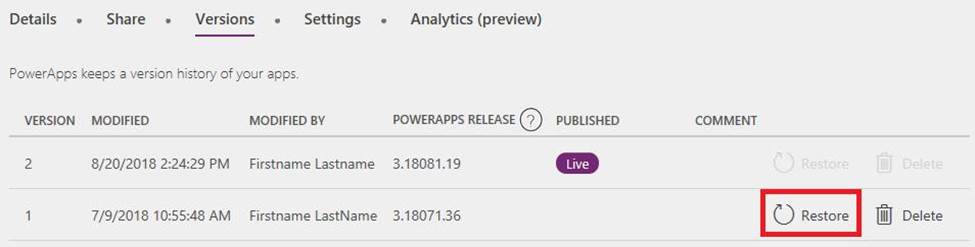
Use PowerApps Studio, select the App, and choose and you will be directed to the app’s Versions tab in PowerApps portal. There should be one version marked Live.


Box 2: Select Restore on the previous version of the app.
Restore an app from your account
✑ Open powerapps.com, and then click or tap Apps in the left navigation bar.
✑ Near the right edge, click or tap the info icon for the app that you want to restore.
✑ Click or tap the Versions tab, and then click or tap Restore for the version that you want to restore.


Question 21 Selectable Answer
You need to resolve the instructor's issue and ensure that the same issue does not occur again.
What should you use?

Answer:
Question 22 Selectable Answer
You need to set the value for a global variable named RunningTotal to 5 and navigate to the previous screen named MainScreen.
Which formula should you use?

Answer:
Explanation:
You set the value of the global variable with the Set function. Set( MyVar, 1 ) sets the global variable MyVar to a value of 1.
Use the Back and Navigate function to change which screen is displayed.
Reference:
https://docs.microsoft.com/en-us/powerapps/maker/canvas-apps/working-with-variables
https://docs.microsoft.com/en-us/powerapps/maker/canvas-apps/functions/function-navigate
Question 23 Written Answer
DRAG DROP
A company is creating Power Apps apps for their customer service team.
You must create a final released solution to export to their test environment that cannot be changed in the new environment.
You need to determine the types of solutions to use.
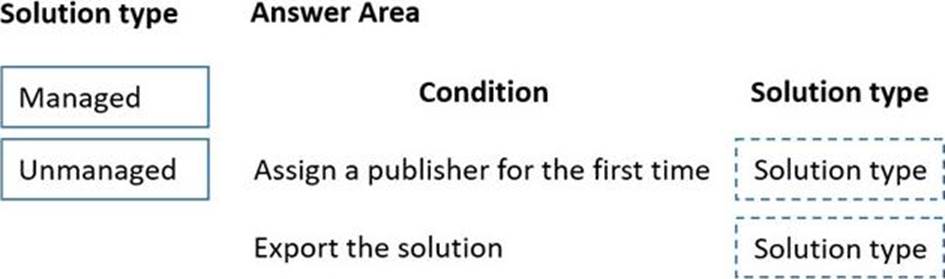
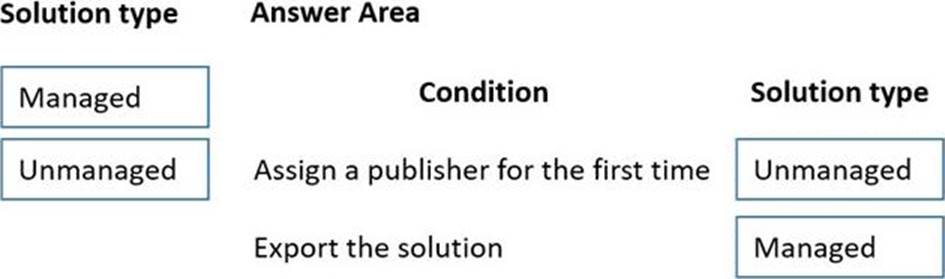
Which type of solution should you use? To answer, drag the appropriate solution types to the correct conditions. Each solution type may be used once, more than once, or not at all. You may need to drag the split bar between panes or scroll to view content. NOTE: Each correct selection is worth one point.


Answer:


Explanation:
Graphical user interface, application
Description automatically generated
Box 1: Unmanaged
Unmanaged solutions are used in development environments while you make changes to your application.
Box 2: Managed
Managed solutions are used to deploy to any environment that isn't a development environment for that solution.
Question 24 Written Answer
DRAG DROP
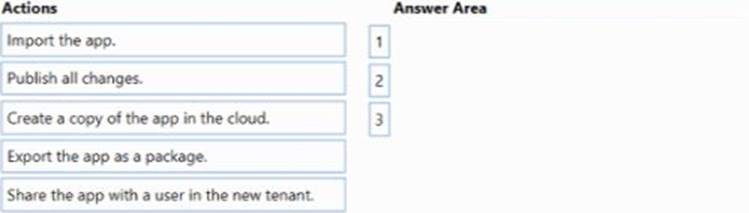
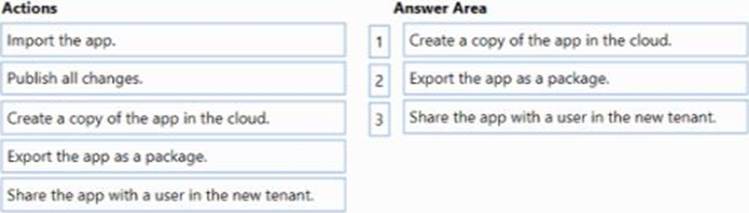
A company is migrating to a new Microsoft 365 tenant. You create an expense management canvas app and cloud flow in the old Microsoft 365 tenant.
You need to move the latest version of the canvas app and cloud flow to the new tenant.
Which three actions should you perform in sequence? To answer, move the appropriate actions from the list of actions to the answer area and arrange them in the correct order.


Answer:

Question 25 Written Answer
Topic 3, Culinary Arts CollegeCase Study

A culinary arts college trains world class chefs by offering a blend of theoretical and practical education. The culinary arts program enrolls two hundred students per term. The instructors split the students in groups of five to seven students, depending on the specialty selected. Each instructor is in charge of one group of students.
The college uses several systems to manage the student classroom activities. The college plans to implement a Microsoft Power Platform solution to replace the existing system. The goal is to align the cooking curriculum to the taste preferences of their subscribers and automate as much as possible to reduce administrative overhead. The college has two revenue streams:
• student enrollment fees and work placement brokerage
• lunch catering to businesses, school cafeterias and other consumers via subscriptions Subscribers place orders from a menu published by the instructors. The menu displays all the dishes and quantities that students will create during a cooking lesson.
The college partners with food banks to offer healthy meals to people in need. Students participate in the packaging and safe storage of any leftovers meals and notify the food banks about available meals. If 85 percent of the meals produced during a week sell out the college makes the remaining 15 percent available to food banks only.

Current system
• The college manages subscribers and their dish preferences by using a SQL Server-based app that is hosted in the college's on-premises datacenter. Each week, data is extracted as a Microsoft Excel workbook and distributed to instructors.
• Recipes are stored as Microsoft Word documents in SharePoint libraries. Access to recipes is restricted to instructors and students.
• The college uses Microsoft 365 for emails, classroom and kitchen bookings, and document management.
• Students will use a Microsoft Outlook calendar to see their group's schedule and to collaborate with instructors and other students.

Current processes
• Instructors use Microsoft Excel workbooks to capture class attendance information for cooking classes
• Instructors develop the culinary arts program and refine it periodically.
• Instructors are responsible for monitoring kitchen processes
• Instructors order the ingredients in bulk from food distributors. The instructors define threshold quantities that trigger inventory replenishment.
• Students self-organize in teams and brainstorm to produce new recipes.
• Students earn credits faster if they create new recipes in their specialty and the new recipe gains enough votes from subscribers

Cooking classes
• Each cooking class has a start date, a start and end time, a minimum and a maximum number of participants, and a cuisine specialty.
• Students select one main cuisine to specialize in when applying for enrollment
• Students participating in a cooking class can participate as a chef or as a helper. There is only one chef per session. Everyone else is a helper
• Instructors select the chef and recipe for each cooking class and distribute a link to the recipe document before each class.
• Each instructor performs quality checks on dishes that are offered for sale and evaluates both the chef and the helper.

Subscriptions
• The college offers the following types of subscriptions based on a client's commitment to order
• Public - lunch orders placed between 1(h00 AM and noon from an open menu, subject to availability. Most occasional and high-volume subscribers became fans of the college after ordering from the public subscription,
o Occasional subscribers - a fixed number of meals, either monthly or weekly, o High volume - businesses that provide their staff free lunches every workday.
• A group of 25 business subscribers each order an average of 2.OO0 meals per day.
• The number of occasional subscribers varies daily.
• The college generates a QR code for high-volume subscribers to allow staff to vote for their favorite dishes.

Class management
• The solution must track credits earned by the students.
• Students require a fixed number of credits in the chefs role to gain the cuisine specialization. Students can acquire credits by using any of the following methods: o number of hours in practical sessions as helpers
o number of hours as chefs
o popular votes from dishes prepared as chefs o marks from the class instructor
• Students must confirm their attendance by selecting Start at the beginning of each class and selecting Done at the end of the class.
• The student s total number of practice hours and credits earned must display in the app
• Students team up together to create new recipes and must keep their recipes confidential.
• The instructors photograph dishes that pass quality checks and upload the photographs to the daily menu that is made available to subscribers.
• Dish votes are counted based on the number of people who marked the dish as a favorite.
• The college requires a lively visual that displays marketing data on their public-facing website.

Subscriptions
• The subscriber administrators must approve the credit terms for high-volume subscribers.
• Occasional and high-volume subscribers must be able to place orders online.
• Subscribers should be able to mark a dish as favorite directly from their order.

Food management
• Instructors must be able to reserve the quantities of ingredients that they require for cooking sessions.
• Each ingredient has a primary unit of measure for bulk ordering and a second unit of measure for using in a recipe. (For example, flour in pounds when ordering and in cups for use in a recipe).
• The app must display the current inventory and reserved quantities for each ingredient needed for a recipe. The display must be consistent for appropriate roles.
• Food banks must be able to access the food pool online and place their orders from a filtered list based on their location.
• The college must replace the food bank notifications with an automated system that food bank users can access directly from the college s public website.
• The app must use a chatbot to replace the food bank notifications so that food bank users
can see food available for pickup by food banks.

Food management
• One instructor discovers discrepancies in the ingredient inventory and requests the standardization of the units of measures for all ingredients. Each time an ingredient is used in a recipe, the secondary unit of measure must be populated and be read only.
• Students report that they are not able to see their total practice hours in the app.

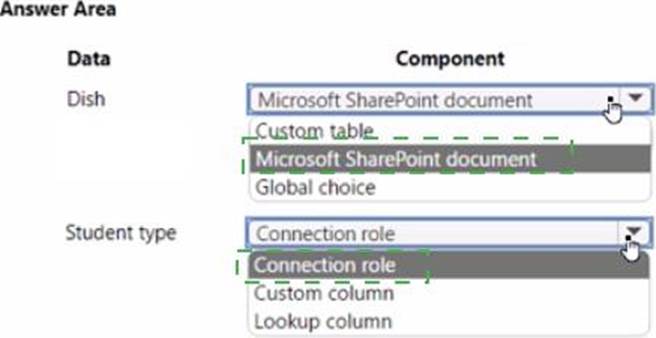
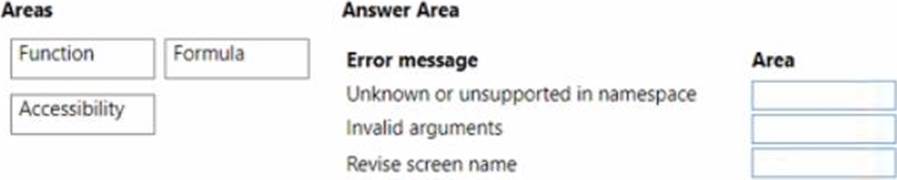
HOTSPOT
You need to design the data model for the cooking classes.
What should you use? To answer, select the appropriate options in the answer area. NOTE: Each correct selection is worth one point.

Answer:

Question 26 Selectable Answer
You need to provide the app to Tailwind Traders.
What should you do?

Answer:
Explanation:
Scenario: The completed app and all supporting components must be provided to Tailwind Traders. Tailwind Traders must not be able to make changes to any of the components.
Managed Solution: A managed solution is a finalized solution that can be distributed and installed. They are created by exporting an unmanaged solution by setting restrictions to prevent any further customizations. The whole point of Managed is locking down the Component states so they cannot be edited. Deleting the Managed Solution will remove all its customisations as well as data contained. Managed Solutions become read only once deployed so they cannot be manipulated.
Reference: https://powerusers.microsoft.com/t5/Power-Apps-Pro-Dev-ISV/Managed-vs-Unmanaged/td-p/495685
Question 27 Selectable Answer
You are designing an interactive report for a model-driven app. The report will use more than five million records. The query that retrieves data for the report requires more than five minutes to complete. You need to create the report.
Which option should you use?

Answer:
Question 28 Selectable Answer
A company uses Power Apps.
The company creates a solution that contains the following items:
• environment setting
• flow that accesses Microsoft Dataverse
• plug-in with an unsecure configuration
• environment variable with a default value
The company plans to import solutions manually.
You need to document the solution component type that prompts for user input.
Which component type should you document?

Answer:
Question 29 Selectable Answer
Note: This question is part of a series of questions that present the same scenario. Each question in the series contains a unique solution that might meet the stated goals. Some question sets might have more than one correct solution, while others might not have a correct solution.
After you answer a question in this section, you will NOT be able to return to it. As a result, these questions will not appear in the review screen.
A company is deploying Microsoft Power Platform components to streamline a job candidate screening process.
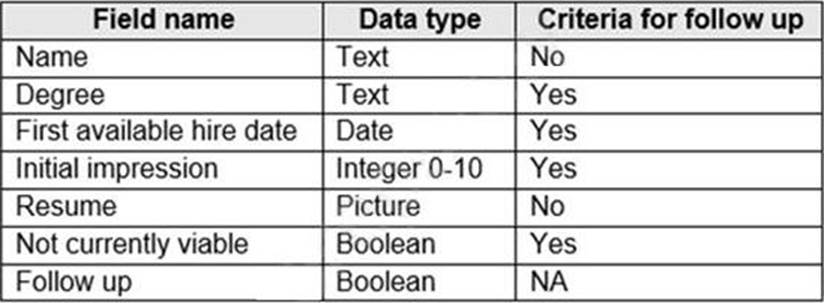
The human resources (HR) representatives of the company plan to attend school career fairs. The HR representatives must qualify and enter potential job candidates into a Power Apps app.
The HR representatives must enter the following information for each candidate:


If a candidate is currently unqualified for a job position but would eventually qualify based on follow-up criteria, the follow-up checkbox must be selected or cleared in the system immediately.
The company plans to create a similar Power Apps app that will contain the same business use case, but for internal employees and promotions.
You need to create a Power Apps app solution to automatically mark the candidate for follow up.
Proposed solution: Create a Power Automate flow with conditions that use entered data as default data.
Does the solution meet the goal?

Answer:
Explanation:
Instead use Common Data Service workflow with a PowerQuery on the data entity.
Note: Process (Workflow) table/entity reference is a set of logical rules that define the steps necessary to automate a specific business process, task, or set of actions to be performed. Common Data Service workflow support: Filter triggers based on which attributes change - You can control which field changes trigger your automated flows. For example, trigger your flow only when the status field changes while ignoring all other fields that may change.
Reference: https://docs.microsoft.com/en-us/business-applications-release-notes/april19/microsoft-flow/automated-parity-classic-common-data-service-workflows
Question 30 Selectable Answer
Note: This question is part of a series of questions that present the same scenario. Each question in the series contains a unique solution that might meet the stated goals. Some question sets might have more than one correct solution, while others might not have a correct solution.
After you answer a question in this section, you will NOT be able to return to it. As a result, these questions will not appear in the review screen.
You are developing a model-driven app that uses a Common Data Service database. App users will have a variety of different security roles.
Development and testing must be performed using production data. Multiple testers must be used at each testing stage.
You need to provision and configure new environments for development and testing.
Solution:
✑ Provision sandbox environments named S1 and S2.
✑ Copy the production environment to both S1 and S2.
✑ Use S1 for development and S2 for testing.
Does the solution meet the goal?

Answer:
Explanation:
A sandbox environment is any non-production environment of Microsoft Dataverse. Isolated from production, a sandbox environment is the place to safely develop and test application changes with low risk.
Reference: https://docs.microsoft.com/en-us/power-platform/admin/environments-overview
Showing page 2 of 10