Test Online Free Microsoft DP-300 Exam Questions and Answers
Practice a live sample before buying full access. This page keeps the free DP-300 question set organized by page so visitors and search engines can reach the canonical -questions.html URL directly.
Note: This question is part of a series of questions that present the same scenario. Each question in the series contains a unique solution that might meet the stated goals. Some question sets might have more than one correct solution, while others might not have a correct solution.
After you answer a question in this section, you will NOT be able to return to it. As a result, these questions will not appear in the review screen.
You have an Azure Synapse Analytics dedicated SQL pool that contains a table named Table1.
You have files that are ingested and loaded into an Azure Data Lake Storage Gen2 container named container1.
You plan to insert data from the files into Table1 and transform the data. Each row of data in the files will produce one row in the serving layer of Table1.
You need to ensure that when the source data files are loaded to container1, the DateTime is stored as an additional column in Table1.
Solution: You use a dedicated SQL pool to create an external table that has an additional DateTime column.
Does this meet the goal?
Answer: Explanation:
Instead use a serverless SQL pool to create an external table with the extra column. Note: In dedicated SQL pools you can only use Parquet native external tables. Native external tables are generally available in serverless SQL pools.
Reference: https://docs.microsoft.com/en-us/azure/synapse-analytics/sql/create-use-external-tables
Question 17Written Answer
DRAG DROP
You have an Azure SQL Database instance named DatabaseA on a server named Server1.
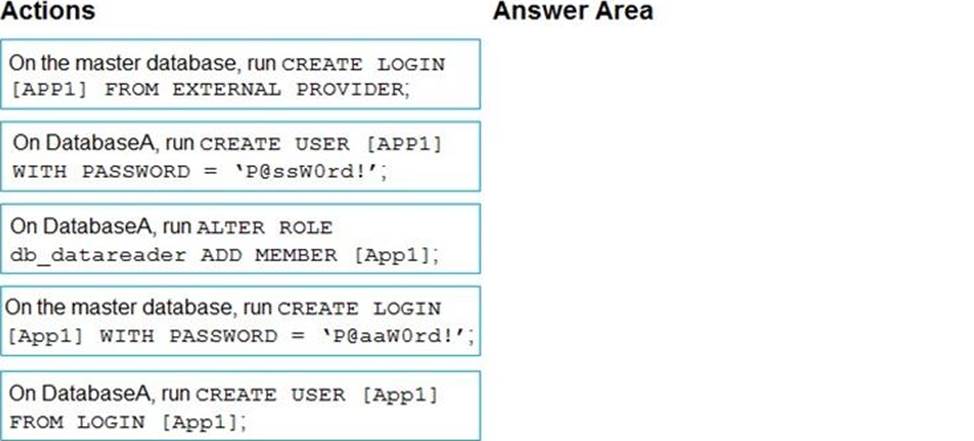
You plan to add a new user named App1 to DatabaseA and grant App1 db_datacenter permissions. App1 will use SQL Server Authentication.
You need to create App1. The solution must ensure that App1 can be given access to other databases by using the same credentials.
Which three actions should you perform in sequence? To answer, move the appropriate actions from the list of actions to the answer area and arrange them in the correct order.
Answer:
Explanation:
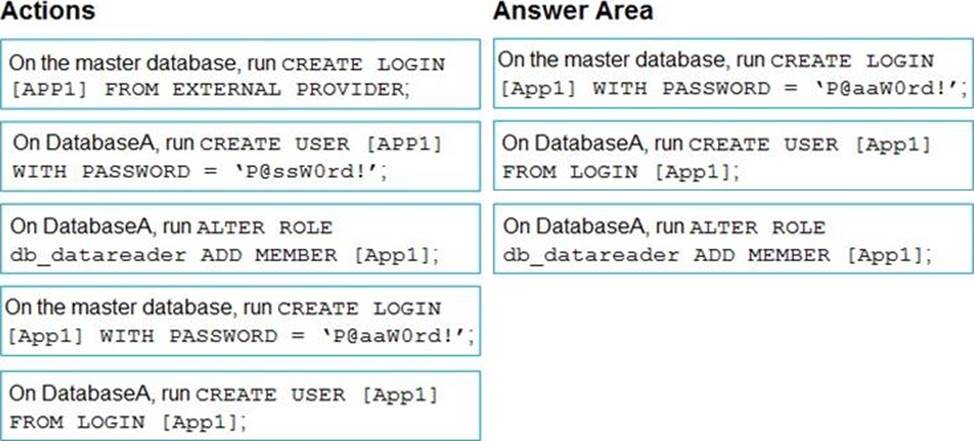
Step 1: On the master database, run CREATE LOGIN [App1] WITH PASSWORD = 'p@aaW0rd!'
Logins are server wide login and password pairs, where the login has the same password across all databases.
Here is some sample Transact-SQL that creates a login:
CREATE LOGIN readonlylogin WITH password='1231!#ASDF!a';
You must be connected to the master database on SQL Azure with the administrative login (which you get from the SQL Azure portal) to execute the CREATE LOGIN command.
Step 2: On DatabaseA, run CREATE USER [App1] FROM LOGIN [App1]
Users are created per database and are associated with logins. You must be connected to the database in where you want to create the user. In most cases, this is not the master database.
Here is some sample Transact-SQL that creates a user:
CREATE USER readonlyuser FROM LOGIN readonlylogin;
Step 3: On DatabaseA run ALTER ROLE db_datareader ADD Member [App1]
Just creating the user does not give them permissions to the database. You have to grant them access. In the Transact-SQL example below the readonlyuser is given read only permissions to the database via the db_datareader role.
EXEC sp_addrolemember 'db_datareader', 'readonlyuser';
Question 18Written Answer
HOTSPOT
You have an Azure SQL database named DB 1 in the General Purpose service tier.
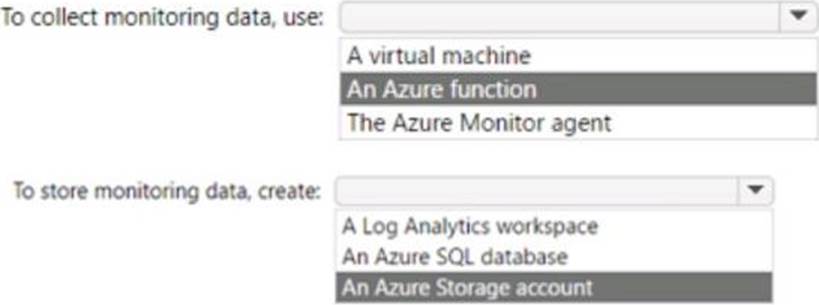
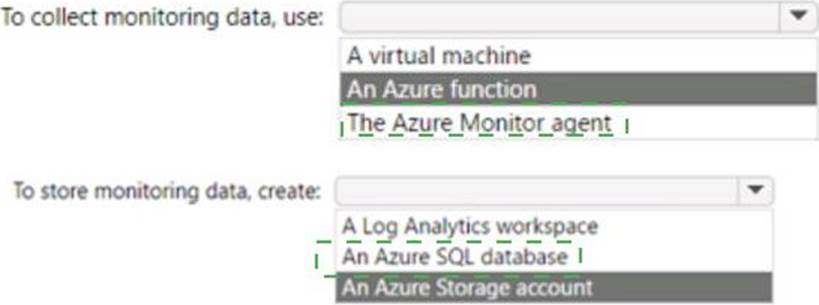
You need to monitor DB 1 by using SQL Insights.
What should you include in the solution? To answer, select the appropriate options in the answer area. NOTE: Each correct selection is worth one point.
HOTSPOT
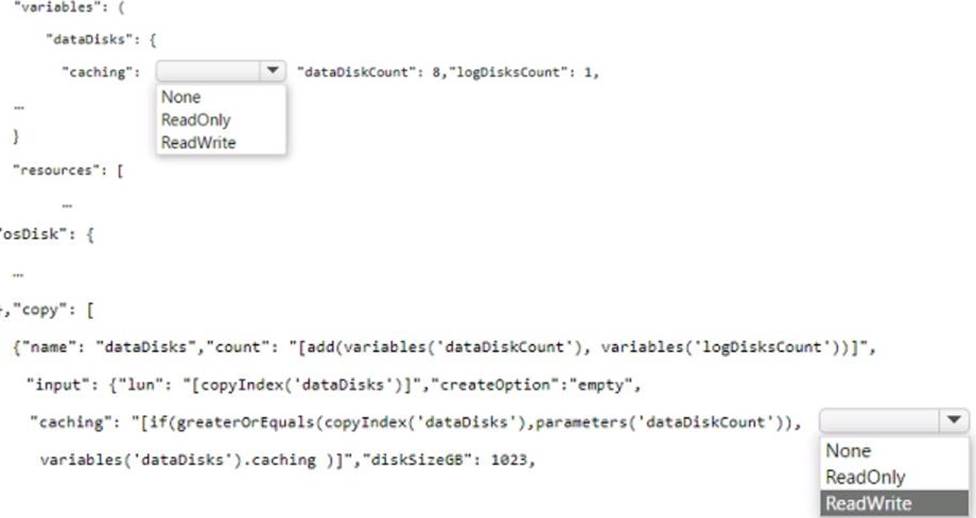
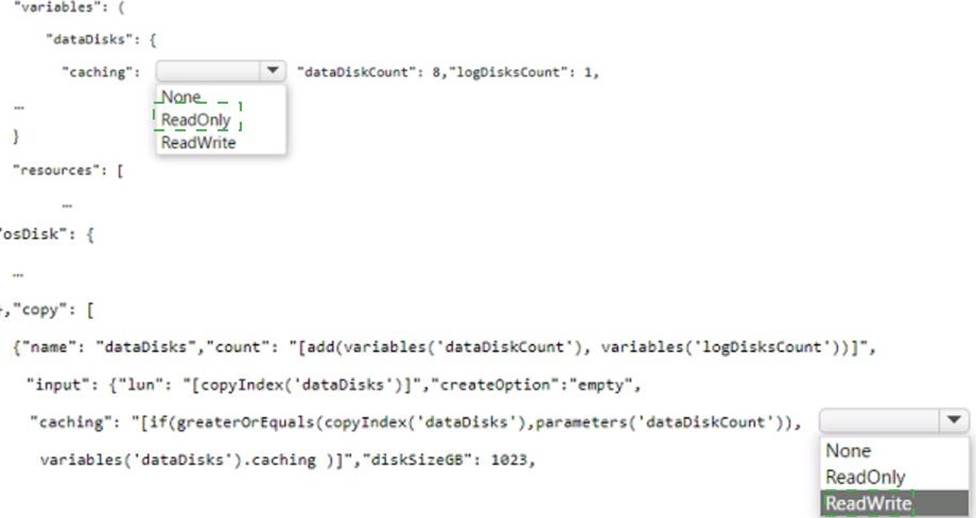
You need to use an Azure Resource Manager ARM) template to deploy an Azure virtual machine that will host a Microsoft SQL Server instance. The solution must maximize disk I/O performance for the SQL Server database and log files.
How should you complete the template? To answer, select the appropriate options in the answer area. NOTE: Each correct selection is worth one point.
Answer:
Explanation:
Read onlyReadWrite
Question 20Written Answer
HOTSPOT
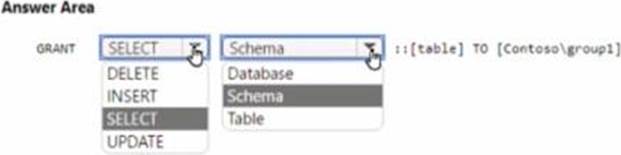
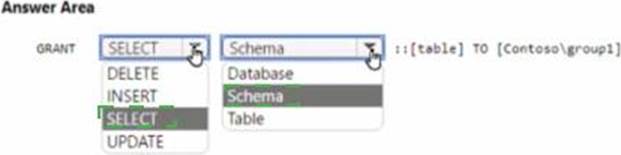
You have an Azure subscription that contains a group named Group1 and an Azure SQL managed instance that hosts a database named 081. You need to ensure that Group 1 has read access to new tables created m 06I The solution must use the principle of least privilege.
How should you complete the Transact-SQL statement? To answer, select the appropriate options in the answer area. NOTE: Each correct selection is worth one point.
Answer:
Question 21Selectable Answer
You have SQL Server 2019 on an Azure virtual machine that runs Windows Server 2019.
The virtual machine has 4 vCPUs and 28 GB of memory.
You scale up the virtual machine to 16 vCPUSs and 64 GB of memory.
You need to provide the lowest latency for tempdb.
What is the total number of data files that tempdb should contain?
Answer: Explanation:
The number of files depends on the number of (logical) processors on the machine. As a general rule, if the number of logical processors is less than or equal to eight, use the same number of data files as logical processors. If the number of logical processors is greater than eight, use eight data files and then if contention continues, increase the number of data files by multiples of 4 until the contention is reduced to acceptable levels or make changes to the workload/code.
Reference: https://docs.microsoft.com/en-us/sql/relational-databases/databases/tempdb-database
Question 22Written Answer
HOTSPOT
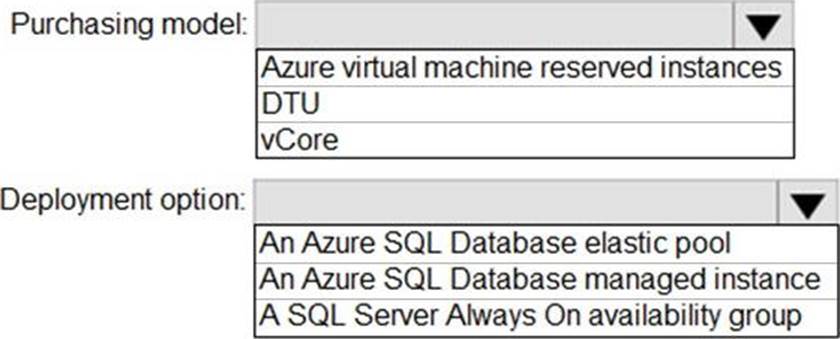
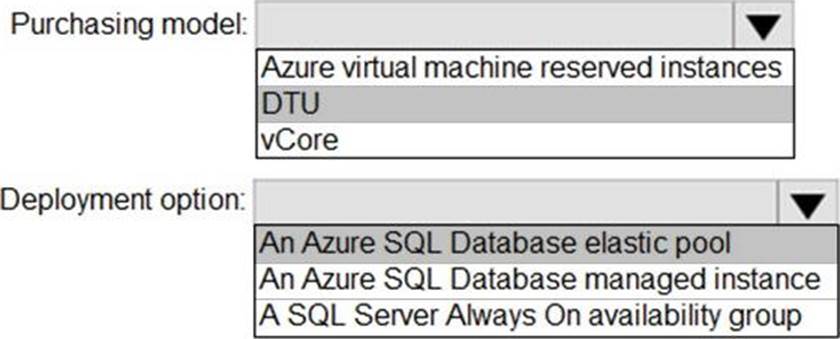
You need to recommend the appropriate purchasing model and deployment option for the 30 new databases. The solution must meet the technical requirements and the business requirements.
What should you recommend? To answer, select the appropriate options in the answer area. NOTE: Each correct selection is worth one point.
Answer:
Explanation:
Box 1: DTU
Scenario:
✑ The 30 new databases must scale automatically.
✑ Once all requirements are met, minimize costs whenever possible.
You can configure resources for the pool based either on the DTU-based purchasing model or the vCore-based purchasing model.
In short, for simplicity, the DTU model has an advantage. Plus, if you’re just getting started with Azure SQL Database, the DTU model offers more options at the lower end of performance, so you can get started at a lower price point than with vCore.
Box 2: An Azure SQL database elastic pool
Azure SQL Database elastic pools are a simple, cost-effective solution for managing and scaling multiple databases that have varying and unpredictable usage demands. The databases in an elastic pool are on a single server and share a set number of resources at a set price. Elastic pools in Azure SQL Database enable SaaS developers to optimize the price performance for a group of databases within a prescribed budget while delivering performance elasticity for each database.
Question 23Selectable Answer
Note: This question is part of a series of questions that present the same scenario. Each question in the series contains a unique solution that might meet the stated goals. Some question sets might have more than one correct solution, while others might not have a correct solution.
After you answer a question in this section, you will NOT be able to return to it. As a result, these questions will not appear in the review screen.
You have an Azure Synapse Analytics dedicated SQL pool that contains a table named Table1.
You have files that are ingested and loaded into an Azure Data Lake Storage Gen2 container named container1.
You plan to insert data from the files into Table1 and transform the data. Each row of data in the files will produce one row in the serving layer of Table1.
You need to ensure that when the source data files are loaded to container1, the DateTime is stored as an additional column in Table1.
Solution: You use an Azure Synapse Analytics serverless SQL pool to create an external table that has an additional DateTime column.
Does this meet the goal?
Answer: Explanation:
In dedicated SQL pools you can only use Parquet native external tables. Native external tables are generally available in serverless SQL pools.
Reference: https://docs.microsoft.com/en-us/azure/synapse-analytics/sql/create-use-external-tables
Question 24Selectable Answer
You have an Azure SQL database named db1 on a server named server1.
The Intelligent Insights diagnostics log identifies queries that cause performance issues due to tempDB contention.
You need to resolve the performance issues.
What should you do?
You have SQL Server on an Azure virtual machine that contains a database named DB1.
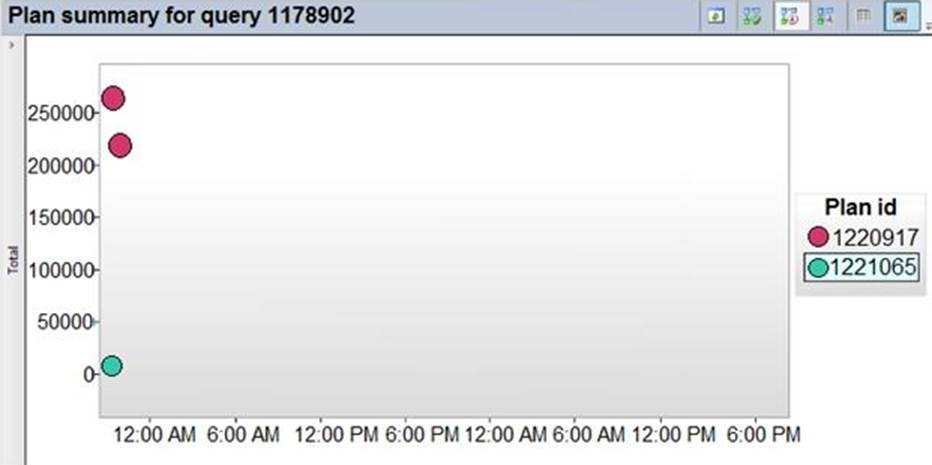
You view a plan summary that shows the duration in milliseconds of each execution of query 1178902 as shown in the following exhibit:
What should you do to ensure that the query uses the execution plan which executes in the least amount of time?
You have an on-premises app named App1 that stores data in an on-premises Microsoft SQL Server 2016 database named DB1.
You plan to deploy additional instances of App1 to separate Azure regions. Each region will have a separate instance of App1 and DB1. The separate instances of DB1 will sync by using Azure SQL Data Sync.
You need to recommend a database service for the deployment. The solution must minimize administrative effort.
What should you include in the recommendation?
Answer: Explanation:
Azure SQL Database single database supports Data Sync.
Reference: https://docs.microsoft.com/en-us/azure/azure-sql/database/features-comparison
Question 27Selectable Answer
You are developing an application that uses Azure Data Lake Storage Gen 2.
You need to recommend a solution to grant permissions to a specific application for a limited time period.
What should you include in the recommendation?
Answer: Explanation:
A shared access signature (SAS) provides secure delegated access to resources in your storage account. With a SAS, you have granular control over how a client can access your data. For example:
What resources the client may access.
What permissions they have to those resources.
How long the SAS is valid.
Note: Data Lake Storage Gen2 supports the following authorization mechanisms:
✑ Shared Key authorization
✑ Shared access signature (SAS) authorization
✑ Role-based access control (Azure RBAC)
✑ Access control lists (ACL) Data Lake Storage Gen2 supports the following authorization mechanisms:
✑ Shared Key authorization
✑ Shared access signature (SAS) authorization
✑ Role-based access control (Azure RBAC)
✑ Access control lists (ACL)
Reference: https://docs.microsoft.com/en-us/azure/storage/common/storage-sas-overview
Question 28Selectable Answer
You are designing a security model for an Azure Synapse Analytics dedicated SQL pool that will support multiple companies.
You need to ensure that users from each company can view only the data of their respective company.
Which two objects should you include in the solution? Each correct answer presents part of the solution. NOTE: Each correct selection is worth one point.
Answer: Explanation:
Azure RBAC is used to manage who can create, update, or delete the Synapse workspace and its SQL pools, Apache Spark pools, and Integration runtimes.
Define and implement network security configurations for resources related to your dedicated SQL pool with Azure Policy.
Reference:
https://docs.microsoft.com/en-us/azure/synapse-analytics/security/synapse-workspace-synapse-rbac
https://docs.microsoft.com/en-us/security/benchmark/azure/baselines/synapse-analytics-security-baseline
Question 29Selectable Answer
You need to provide an implementation plan to configure data retention for ResearchDB1.
The solution must meet the security and compliance requirements.
What should you include in the plan?
HOTSPOT
You have an Azure SQL database.
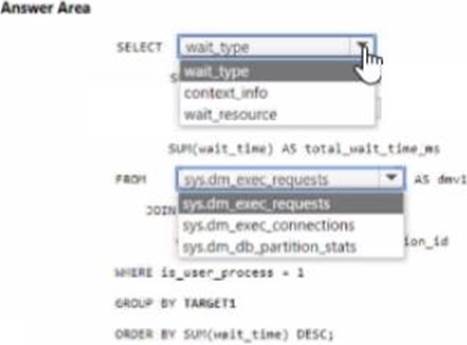
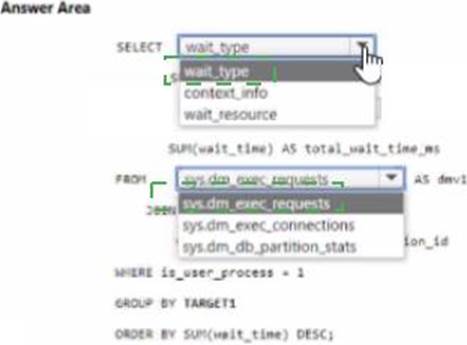
You need to identify whether a delayed query execution is associated to a RESOURCE wait.
How should you complete the Transact CSQL statement? To answer, select the appropriate option in the answer area. NOTE: Each correct selection is worth one point.