Test Online Free HP HPE6-A85 Exam Questions and Answers
Practice a live sample before buying full access. This page keeps the free HPE6-A85 question set organized by page so visitors and search engines can reach the canonical -questions.html URL directly.
You need to troubleshoot an Aruba CX 6200 4-node VSF stack switch that fails to boot correctly Select the option that allows you to access the switch and see the boot options available for OS images and ServiceOS.
Answer:
Question 17Selectable Answer
Based on the "snow ip route" output on an AruDaCX 8400. what type of route is "10.1 20 0/24, vrf default via 10.1.12.2. [1/0]"?
Answer: Explanation:
A static route is a route that is manually configured on a router or switch and does not change unless it is modified by an administrator. Static routes are used to specify how traffic should reach specific destinations that are not directly connected to the device or that are not reachable by dynamic routing protocols. In Aruba CX switches, static routes can be configured using the ip route command in global configuration mode. Based on the “show ip route” output on an Aruba CX 8400 switch, the route “10.1 20 0/24, vrf default via 10.1.12.2, [1/0]” is a static route because it has an administrative distance of 1 and a metric of 0, which are typical values for static routes.
References:
https://en.wikipedia.org/wiki/Static_routing
https://www.arubanetworks.com/techdocs/AOS-CX_10_04/NOSCG/Content/cx-noscg/ip-routing/static-routes.h
Question 18Written Answer
Please match the use case to the appropriate authentication technology
Answer:
Explanation:
- Add certificates to Android devices with the Aruba Onboard Application in the Google Play store that will be used for wireless authentication A) ClearPass Policy Manager
- Authenticate users on corporate-owned Chromebook devices using 802.1X and context gathered from the network devices that they log into B) Cloud Authentication and Policy
- Leverage unbound Mum Pre-Shared Keys (MPSK) managed by Aruoa Central to the end-users and client devices B) Cloud Authentication and Policy
- Validate devices exist in a Mobile Device Management (MDM) database before authenticating BYOD users with corporate Active Directory using certificates A) ClearPass Policy Manager
https://www.arubanetworks.com/techdocs/ClearPass/6.11/PolicyManager/Content/CPPM_UserGuide/About%2
https://www.arubanetworks.com/products/security/network-access-control/
Question 19Written Answer
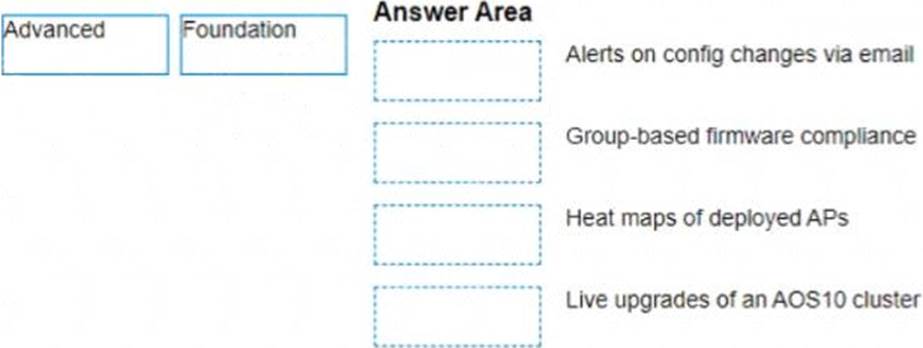
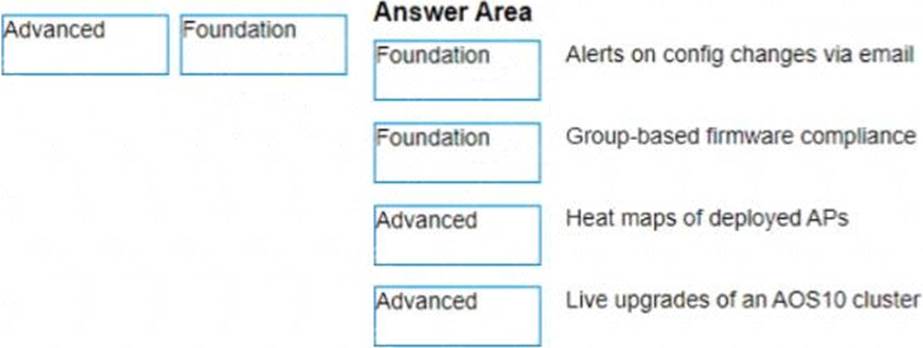
A network administrator with existing IAP-315 access points is interested in Aruba Central and needs to know which license is required for specific features Please match the required license per feature (Matches may be used more than once.)
Answer:
Explanation:
a) Alerts on config changes via email - Foundation
b) Group-based firmware compliance - Foundation
c) Heat maps of deployed APs - Advanced
d) Live upgrades of an AOS10 cluster - Advanced
According to the Aruba Central Licensing Guide1, the Foundation License provides basic device management features such as configuration, monitoring, alerts, reports, firmware management, etc. The Advanced License provides additional features such as AI insights, WLAN services, NetConductor Fabric, heat maps, live upgrades, etc.
https://www.arubanetworks.com/techdocs/central/2.5.3/content/pdfs/licensing-guide.pdf
Question 20Selectable Answer
What is the correct command to add a static route to a class-c-network 10.2.10.0 via a gateway of 172.16.1.1?
Answer: Explanation:
The correct command to add a static route to a class-c-network 10.2.10.0 via a gateway of 172.16.1.1 is ip-route 10.2.10.0/24 172.16.1.1. This command specifies the destination network address (10.2.10.0) and prefix length (/24) and the next-hop address (172.16.1 .1) for reaching that network from the switch. The other commands are either incorrect syntax or incorrect parameters for adding a static route.
References: https://www.arubanetworks.com/techdocs/AOS-CX_10_04/NOSCG/Content/cx-noscg/ip-routing/sta