Test Online Free CompTIA CS0-003 Exam Questions and Answers
Practice a live sample before buying full access. This page keeps the free CS0-003 question set organized by page so visitors and search engines can reach the canonical -questions.html URL directly.
Which of the following tools would work best to prevent the exposure of PII outside of an organization?
Answer: Explanation:
Data loss prevention (DLP) is a tool that can prevent the exposure of PII outside of an organization by monitoring, detecting, and blocking sensitive data in motion, in use, or at rest.
Question 32Selectable Answer
An incident response team receives an alert to start an investigation of an internet outage. The outage is preventing all users in multiple locations from accessing external SaaS resources. The team determines the organization was impacted by a DDoS attack.
Which of the following logs should the team review first?
Answer: Explanation:
A distributed denial-of-service (DDoS) attack is a type of cyberattack that aims to overwhelm a target’s network or server with a large volume of traffic from multiple sources. A common technique for launching a DDoS attack is to compromise DNS servers, which are responsible for resolving domain names into IP addresses. By flooding DNS servers with malicious requests, attackers can disrupt the normal functioning of the internet and prevent users from accessing external SaaS
resources.
Reference: https://www.eccouncil.org/cybersecurity-exchange/threat-intelligence/cyber-kill-chain-seven-steps-cyberattack/
Question 33Selectable Answer
The Chief Information Security Officer wants to eliminate and reduce shadow IT in the enterprise. Several high-risk cloud applications are used that increase the risk to the organization.
Which of the following solutions will assist in reducing the risk?
Answer: Explanation:
A cloud access security broker (CASB) is a tool that can help reduce the risk of shadow IT in the enterprise by providing visibility and control over cloud applications and services. A CASB can enable policy enforcement by blocking unauthorized or risky cloud applications, enforcing data loss prevention rules, encrypting sensitive data, and detecting anomalous user behavior.
Question 34Selectable Answer
An incident response analyst notices multiple emails traversing the network that target only the administrators of the company. The email contains a concealed URL that leads to an unknown website in another country.
Which of the following best describes what is happening? (Choose two.)
Answer: Explanation:
A social engineering attack is a type of cyberattack that relies on manipulating human psychology rather than exploiting technical vulnerabilities. A social engineering attack may involve deceiving, persuading, or coercing users into performing actions that benefit the attacker, such as clicking on malicious links, divulging sensitive information, or granting access to restricted resources. An obfuscated link is a link that has been disguised or altered to hide its true destination or purpose. Obfuscated links are often used by attackers to trick users into visiting malicious websites or downloading malware. In this case, an incident response analyst notices multiple emails traversing the network that target only the administrators of the company. The email contains a concealed URL that leads to an unknown website in another country. This indicates that the analyst is witnessing a social engineering attack using obfuscated links.
Question 35Selectable Answer
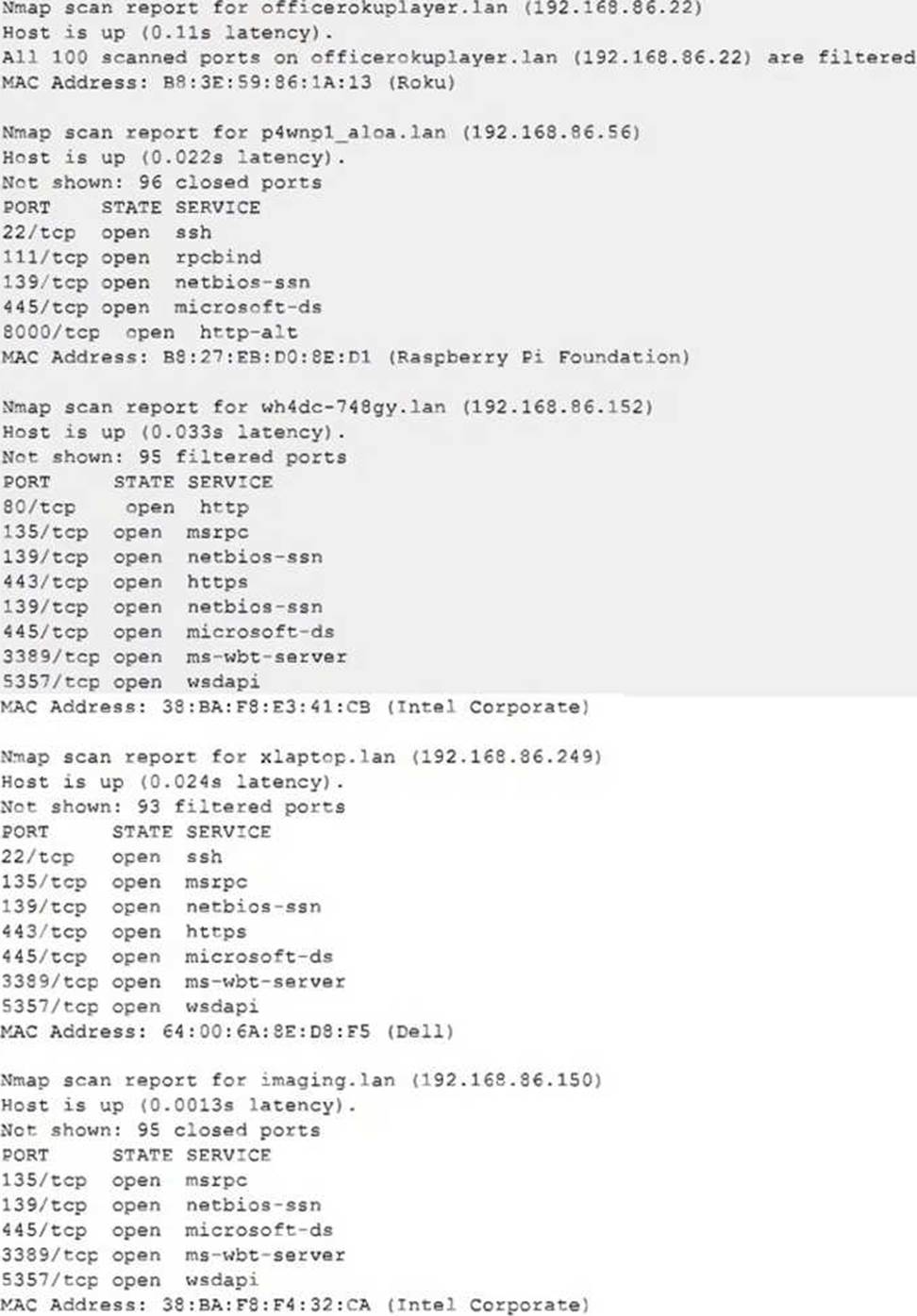
Due to reports of unauthorized activity that was occurring on the internal network, an analyst is performing a network discovery. The analyst runs an Nmap scan against a corporate network to evaluate which devices were operating in the environment.
Given the following output:
Which of the following choices should the analyst look at first?
Answer: Explanation:
The analyst should look at p4wnp1_aloa.lan (192.168.86.56) first, as this is the most suspicious device on the network. P4wnP1 ALOA is a tool that can be used to create a malicious USB device that can perform various attacks, such as keystroke injection, network sniffing, man-in-the-middle, or backdoor creation. The presence of a device with this name on the network could indicate that an attacker has plugged in a malicious USB device to a system and gained access to the network.
Reference: https://github.com/mame82/P4wnP1_aloa
Question 36Selectable Answer
An organization has experienced a breach of customer transactions.
Under the terms of PCI DSS, which of the following groups should the organization report the breach to?
Answer: Explanation:
Under the terms of PCI DSS, an organization that has experienced a breach of customer transactions should report the breach to the card issuer. The card issuer is the financial institution that issues the payment cards to the customers and that is responsible for authorizing and processing the transactions. The card issuer may have specific reporting requirements and procedures for the organization to follow in the event of a breach. The organization should also notify other parties that may be affected by the breach, such as customers, law enforcement, or regulators, depending on the nature and scope of the breach.
Reference: https://www.pcisecuritystandards.org/
Question 37Selectable Answer
Which of the following is the best way to begin preparation for a report titled "What We Learned" regarding a recent incident involving a cybersecurity breach?
Answer: Explanation:
The best way to begin preparation for a report titled “What We Learned” regarding a recent incident involving a cybersecurity breach is to determine the sophistication of the audience that the report is meant for. The sophistication of the audience refers to their level of technical knowledge, understanding, or interest in cybersecurity topics. Determining the sophistication of the audience can help tailor the report content, language, tone, and format to suit their needs and expectations. For example, a report for executive management may be more concise, high-level, and business-oriented than a report for technical staff or peers.
Question 38Selectable Answer
A new cybersecurity analyst is tasked with creating an executive briefing on possible threats to the organization.
Which of the following will produce the data needed for the briefing?
Answer: Explanation:
Indicators of compromise (IoCs) are pieces of data or evidence that suggest a system or network has been compromised by an attacker or malware. IoCs can include IP addresses, domain names, URLs, file hashes, registry keys, network traffic patterns, user behaviors, or system anomalies. IoCs can be used to detect, analyze, and respond to security incidents, as well as to share threat intelligence with other organizations or authorities. IoCs can produce the data needed for an executive briefing on possible threats to the organization, as they can provide information on the source, nature, scope, impact, and mitigation of the threats.
Question 39Selectable Answer
A security program was able to achieve a 30% improvement in MTTR by integrating security controls into a SIEM. The analyst no longer had to jump between tools.
Which of the following best describes what the security program did?
Answer: Explanation:
A single pane of glass is a term that describes a unified view or interface that integrates multiple tools or data sources into one dashboard or console. A single pane of glass can help improve security operations by providing visibility, correlation, analysis, and alerting capabilities across various security controls and systems. A single pane of glass can also help reduce complexity, improve efficiency, and enhance decision making for security analysts. In this case, a security program was able to achieve a 30% improvement in MTTR by integrating security controls into a SIEM, which provides a single pane of glass for security operations.
Reference: https://www.eccouncil.org/cybersecurity-exchange/threat-intelligence/cyber-kill-chain-seven-steps-cyberattack
Question 40Selectable Answer
An older CVE with a vulnerability score of 7.1 was elevated to a score of 9.8 due to a widely available exploit being used to deliver ransomware.
Which of the following factors would an analyst most likely communicate as the reason for this escalation?
Answer: Explanation:
Weaponization is a factor that describes how an adversary develops or acquires an exploit or payload that can take advantage of a vulnerability and deliver a malicious effect. Weaponization can increase the severity or impact of a vulnerability, as it makes it easier or more likely for an attacker to exploit it successfully and cause damage or harm. Weaponization can also indicate the level of sophistication or motivation of an attacker, as well as the availability or popularity of an exploit or payload in the cyber threat landscape. In this case, an older CVE with a vulnerability score of 7.1 was elevated to a score of 9.8 due to a widely available exploit being used to deliver ransomware. This indicates that weaponization was the reason for this escalation.
Question 41Selectable Answer
Which of the following is the best metric for an organization to focus on given recent investments in SIEM, SOAR, and a ticketing system?
Answer: Explanation:
Mean time to detect (MTTD) is the best metric for an organization to focus on given recent investments in SIEM, SOAR, and a ticketing system. MTTD is a metric that measures how long it takes to detect a security incident or threat from the time it occurs. MTTD can be improved by using tools and processes that can collect, correlate, analyze, and alert on security data from various sources. SIEM, SOAR, and ticketing systems are examples of such tools and processes that can help reduce MTTD and enhance security operations.
Reference: https://www.eccouncil.org/cybersecurity-exchange/threat-intelligence/cyber-kill-chain-seven-steps-cyberattack
Question 42Selectable Answer
Which of the following is the best action to take after the conclusion of a security incident to improve incident response in the future?
Answer: Explanation:
One of the best actions to take after the conclusion of a security incident to improve incident response in the future is to schedule a review with all teams to discuss what occurred, what went well, what went wrong, and what can be improved. This review is also known as a lessons learned session or an after-action report. The purpose of this review is to identify the root causes of the incident, evaluate the effectiveness of the incident response process, document any gaps or weaknesses in the security controls, and recommend corrective actions or preventive measures for future incidents.
Reference: https://www.eccouncil.org/cybersecurity-exchange/threat-intelligence/cyber-kill-chain-seven-steps-cyberattack/
Question 43Selectable Answer
The Company shall prioritize patching of publicly available systems and services over patching of
internally available system.
According to the security policy, which of the following vulnerabilities should be the highest priority to patch?
A)
B)
C)
D)
Answer: Explanation:
According to the security policy, the company shall use the CVSSv3.1 Base Score Metrics to prioritize the remediation of security vulnerabilities. Option C has the highest CVSSv3.1 Base Score of 9.8, which indicates a critical severity level. The company shall also prioritize confidentiality of data over availability of systems and data, and option C has a high impact on confidentiality (C:H). Finally, the company shall prioritize patching of publicly available systems and services over patching of internally available systems, and option C affects a public-facing web server.
Reference: https://www.first.org/cvss/
Question 44Selectable Answer
A security analyst is trying to identify anomalies on the network routing.
Which of the following functions can the analyst use on a shell script to achieve the objective most accurately?
Answer: Explanation:
The function that can be used on a shell script to identify anomalies on the network routing most accurately is:
function x() { info=(dig(dig -x $1 | grep PTR | tail -n 1 | awk -F “.in-addr” ’{print $1} ').origin.asn.cymru.com TXT +short) && echo “$1 | $info” }
This function takes an IP address as an argument and performs two DNS lookups using the dig command. The first lookup uses the -x option to perform a reverse DNS lookup and get the hostname associated with the IP address. The second lookup uses the origin.asn.cymru.com domain to get the
autonomous system number (ASN) and other information related to the IP address. The function then prints the IP address and the ASN information, which can help identify any routing anomalies or inconsistencies
Question 45Selectable Answer
A company is in the process of implementing a vulnerability management program, and there are concerns about granting the security team access to sensitive data.
Which of the following scanning methods can be implemented to reduce the access to systems while providing the most accurate vulnerability scan results?
Answer: Explanation:
Agent-based scanning is a method that involves installing software agents on the target systems or networks that can perform local scans and report the results to a central server or console. Agent-based scanning can reduce the access to systems, as the agents do not require any credentials or permissions to scan the local system or network. Agent-based scanning can also provide the most accurate vulnerability scan results, as the agents can scan continuously or on-demand, regardless of the system or network status or location.