Free Demo Questions

Test Online Free Microsoft AZ-400 Exam Questions and Answers

Practice a live sample before buying full access. This page keeps the free AZ-400 question set organized by page so visitors and search engines can reach the canonical -questions.html URL directly.

Updated Apr 24, 2026 263 Questions 18 Pages
Page 2 of 18
Question 16 Selectable Answer
You need to perform the GitHub code migration. The solution must support the planned changes for the DevOps environment.
What should you use?

Answer:
Explanation:
Woodgrove Bank plans to implement the following changes to the DevOps environment:
✑ Migrate all the source code from TFS1 to GitHub.
The Git-TFS tool is a two-way bridge between Team Foundation Version Control and Git, and can be used to perform a migration.
Reference: https://docs.microsoft.com/en-us/devops/develop/git/migrate-from-tfvc-to-git
Question 17 Selectable Answer
You have a build pipeline in Azure Pipelines that uses different jobs to compile an application for 10 different architectures.
The build pipeline takes approximately one day to complete.
You need to reduce the time it takes to execute the build pipeline
Which two actions should you perform? Each correct answer presents part of the solution. NOTE: Each correct selection is worth one point

Answer:
Explanation:
Question: I need more hosted build resources.
What can I do?
Answer,The Azure Pipelines pool provides all Azure DevOps organizations with cloud-hosted build agents and free build minutes each month. If you need more Microsoft-hosted build resources, or need to run more jobs in parallel, then you can either: Host your own agents on infrastructure that you manage.
Buy additional parallel jobs.
Reference: https://docs.microsoft.com/en-us/azure/devops/pipelines/agents/pools-queues
Question 18 Selectable Answer
You are developing a multi-tier application. The application will use Azure App Service web apps as the front end and an Azure SQL database as the back end. The application will use Azure functions to write some data to Azure Storage.
You need to send the Azure DevOps team an email message when the front end fails to return a status code of 200.
Which feature should you use?

Answer:
Explanation:
https://docs.microsoft.com/en-us/azure/azure-monitor/app/monitor-web-app-availability
Question 19 Selectable Answer
You create a Microsoft ASP.NET Core application.
You plan to use Azure Key Vault to provide secrets to the application as configuration data.
You need to create a Key Vault access policy to assign secret permissions to the application. The solution must use the principle of least privilege.
Which secret permissions should you use?

Answer:
Explanation:
Application data plane permissions:
✑ Keys: sign
✑ Secrets: get
Reference: https://docs.microsoft.com/en-us/azure/key-vault/key-vault-secure-your-key-vault
Question 20 Selectable Answer
In Azure DevOps, you create Project3.
You need to meet the requirements of the project.
What should you do first?

Answer:
Explanation:
The first thing to do is to declare your Sonar Qube server as a service endpoint in your VSTS/DevOps project settings.
Reference: https://docs.sonarqube.org/display/SCAN/Analyzing+with+SonarQube+Extension+for+vsts-TFS
Question 21 Written Answer
Topic 3, Woodgrove bank

This is a case study. Case studies are not timed separately. You can use as much exam time as you would like to complete each case. However, there may be additional case studies and sections on this exam. You must manage your time to ensure that you are able to complete all questions included on this exam in the time provided.

To answer the questions included in a case study, you will need to reference information that is provided in the case study. Case studies might contain exhibits and other resources that provide more information about the scenario that is described in the case study. Each question is independent of the other questions in this case study.

At the end of this case study, a review screen will appear. This screen allows you to review your answers and to make changes before you move to the next section of the exam. After you begin a new section, you cannot return to this section.

To start the case study
To display the first question in this case study, click the Next button. Use the buttons in the left pane to explore the content of the case study before you answer the questions. Clicking these buttons displays information such as business requirements, existing environment, and problem statements. If the case study has an All Information tab, note that the information displayed is identical to the information displayed on the subsequent tabs. When you are ready to answer a question, click the Question button to return to the question.

Overview
General Overview
Woodgrove Bank is a financial services company that has a main office in the United Kingdom.

Technical Requirements and Planned Changes
Planned Changes
Woodgrove Bank plans to implement the following project management changes:
✑ Implement Azure DevOps for project tracking.
✑ Centralize source code control in private GitHub repositories.
✑ Implement Azure Pipelines for build pipelines and release pipelines.

Woodgrove Bank plans to implement the following changes to the identity environment:
✑ Deploy an Azure AD tenant named woodgrovebank.com.
✑ Sync the Active Directory domain to Azure AD.
✑ Configure App1 to use a service principal.
✑ Integrate GitHub with Azure AD.

Woodgrove Bank plans to implement the following changes to the core apps:
✑ Migrate App1 to ASP.NET Core.
✑ Integrate Azure Pipelines and the third-party build tool used to develop App2.

Woodgrove Bank plans to implement the following changes to the DevOps environment:
✑ Deploy App1 to Azure App Service.
✑ Implement source control for the DB1 schema.
✑ Migrate all the source code from TFS1 to GitHub.
✑ Deploy App2 to an Azure virtual machine named VM1.
✑ Merge the POC branch into the GitHub default branch.
✑ Implement an Azure DevOps dashboard for stakeholders to monitor development progress.

Technical Requirements
Woodgrove Bank identifies the following technical requirements:
✑ The initial databases for new environments must contain both schema and reference data.
✑ An Azure Monitor alert for VM1 must be configured to meet the following requirements:
✑ The commit history of the POC branch must replace the history of the default branch.
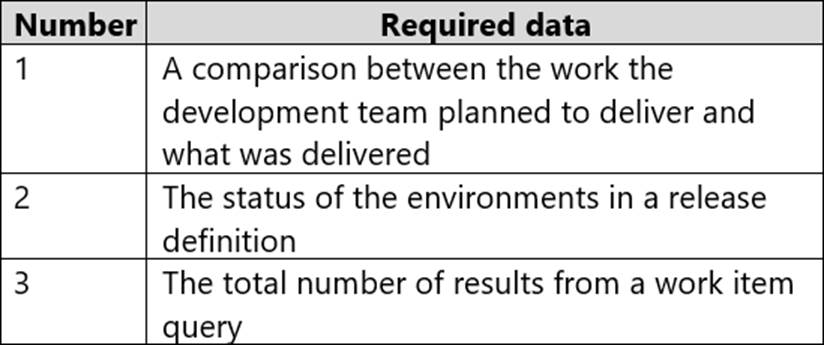
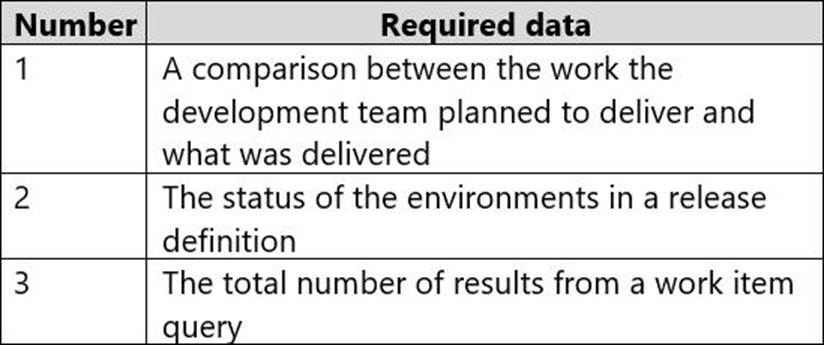
✑ The Azure DevOps dashboard must display the metrics shown in the following table.


✑ Access to Azure DevOps must be restricted to specific IP addresses.
✑ Page load times for App1 must be captured and monitored.
✑ Administrative effort must be minimized.

DRAG DROP
You are configuring the Azure DevOps dashboard. The solution must meet the technical requirements.
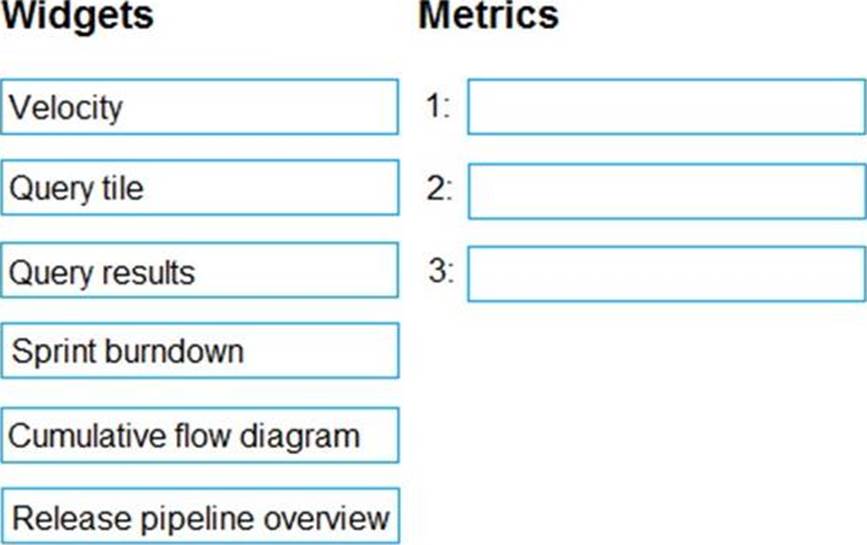
Which widget should you use for each metric? To answer, drag the appropriate widgets to the correct metrics. Each widget may be used once, more than once, or not at all. You may need to drag the split bar between panes or scroll to view content. NOTE: Each correct selection is worth one point.


Answer:


Explanation:
Description automatically generated
Woodgrove Bank identifies the following technical requirements:
✑ The Azure DevOps dashboard must display the metrics shown in the following table:


Box 1: Velocity
Velocity displays your team velocity. It shows what your team delivered as compared to plan.
Box 2: Release pipeline overview
Release pipeline overview shows the status of environments in a release definition.
Box 3: Query tile
Query tile displays the total number of results from a query.
Question 22 Selectable Answer
You are integrating Azure Pipelines and Microsoft Teams.
You install the Azure Pipelines app in Microsoft Teams.
You have an Azure DevOps organization named Contoso that contains a project name Project1.
You subscribe to Project1 in Microsoft Teams.
You need to ensure that you only receive events about failed builds in Microsoft Teams.
What should you do first?

Answer:
Explanation:
To start monitoring all pipelines in a project, use the following command inside a channel:
@azure pipelines subscribe [project url]
The project URL can be to any page within your project (except URLs to pipelines).
For example:
@azure pipelines subscribe https://dev.azure.com/myorg/myproject/
Reference: https://docs.microsoft.com/en-us/azure/devops/pipelines/integrations/microsoft-teams
Question 23 Written Answer
HOTSPOT
You plan to create alerts that will be triggered based on the page load performance of a home page.
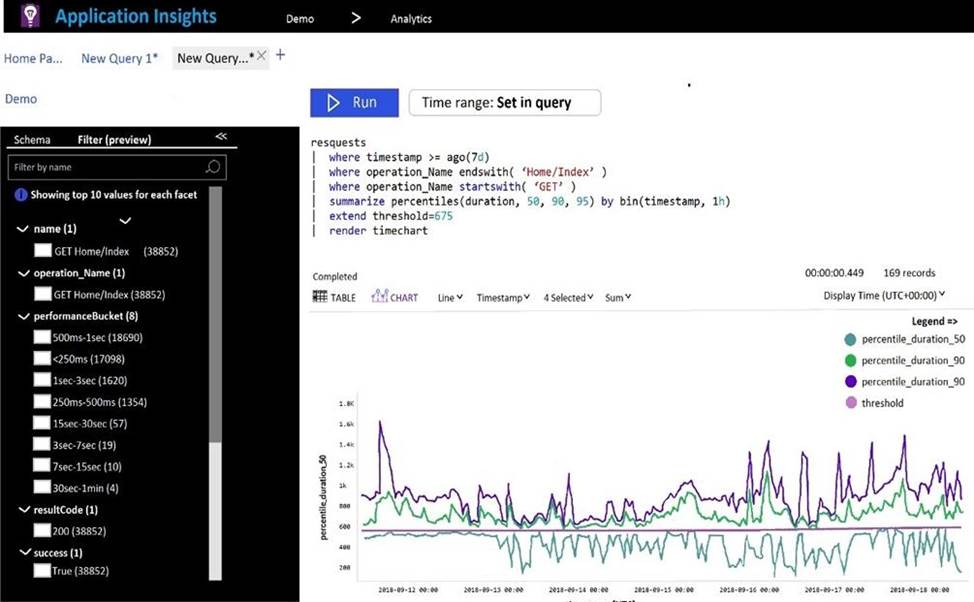
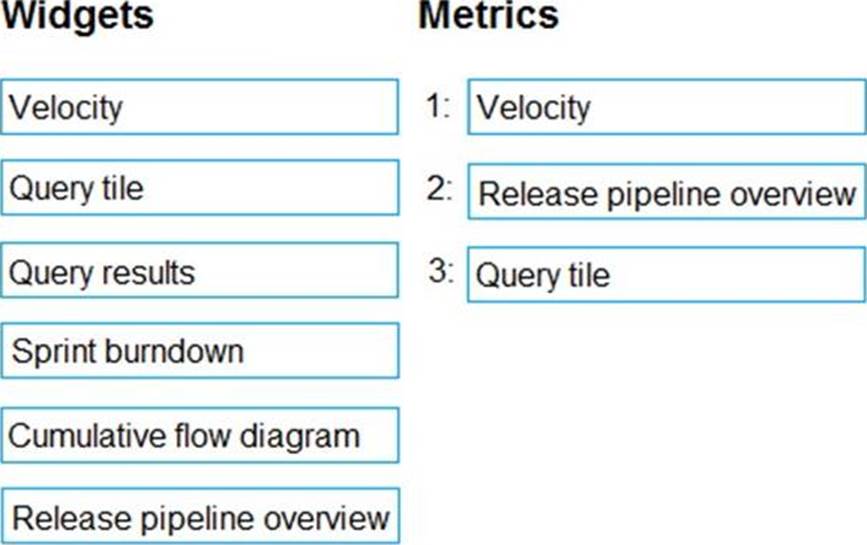
You have the Application Insights log query shown in the following exhibit.


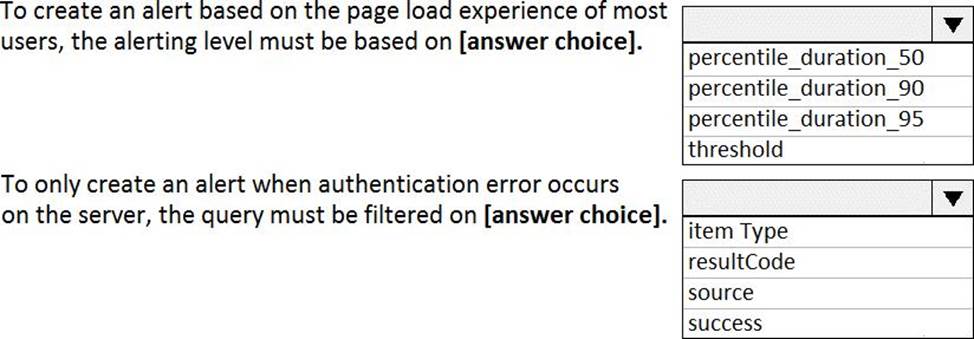
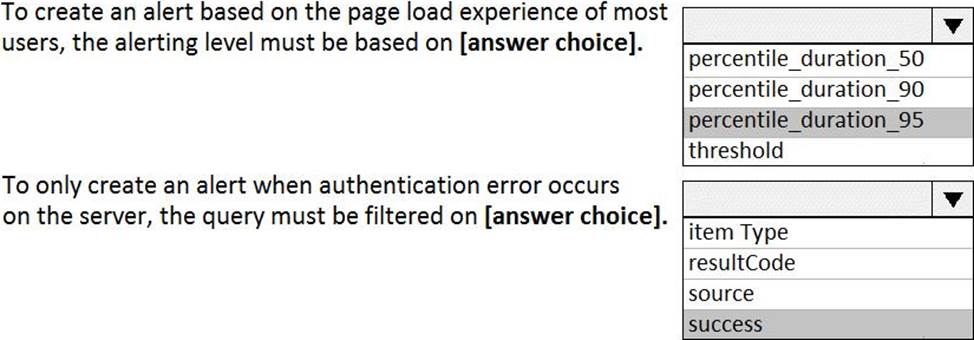
Use the drop-down menus to select the answer choice that completes each statement based on the information presented in the graphic. NOTE: Each correct selection is worth one point.

Answer:


Explanation:
Timeline
Description automatically generated with low confidence
Box 1: percentile_duration_95
Box 2: success
For example C
requests
| project name, url, success
| where success == "False"
This will return all the failed requests in my App Insights within the specified time range.
Question 24 Selectable Answer
You have an Azure DevOps project that contains a release pipeline and a Git repository.
When a new code revision is committed to the repository, a build and release is triggered.
You need to ensure that release information for the pipeline is added automatically to the work items associated to the Get commit.
What should you do?

Answer:
Explanation:
Service hooks in Azure DevOps allow you to trigger actions in other tools based on events that occur in your Azure DevOps project. To automatically add release information to work items associated with a Get commit, you would need to configure a service hook that listens for commit events in your Get repository, and then sends the release information to the appropriate work items.
Here's the steps you can follow to set up a service hook for this purpose:
✑ In your Azure DevOps project, navigate to the project settings by clicking on the gear icon in the top right corner of the page.
✑ Select "Service Hooks" from the left-hand menu.
✑ Click on the "New Subscription" button to create a new service hook.
✑ In the "Event" drop-down menu, select "Code pushed" to trigger the service hook when a new code revision is committed to the repository.
✑ In the "Actions" section, select the action that you want to take place when the service hook is triggered. For example, you might use the "Link work items to commits" action to automatically associate work items with the relevant commits.
✑ Configure the remaining settings as needed, and then click on the "Create" button to create the service hook.
You can find more information on Service hooks in Azure DevOps by following this link https://docs.microsoft.com/en-us/azure/devops/service-hooks/overview?view=azure-devops
Question 25 Selectable Answer
Note: This question is part of a series of questions that present the same scenario. Each question in the series contains a unique solution that might meet the stated goals. Some question sets might have more than one correct solution, while others might not have a correct solution.
After you answer a question in this section, you will NOT be able to return to it. As a result, these questions will not appear in the review screen.
You plan to create a release pipeline that will deploy Azure resources by using Azure Resource Manager templates.
The release pipeline will create the following resources:
✑ Two resource groups
✑ Four Azure virtual machines in one resource group
✑ Two Azure SQL databases in other resource group
You need to recommend a solution to deploy the resources.
Solution: Create two standalone templates, each of which will deploy the resources in its respective group.
Does this meet the goal?

Answer:
Explanation:
References: https://docs.microsoft.com/en-us/azure/azure-resource-manager/resource-group-linked-templates
Question 26 Selectable Answer
Note: This question is part of a series of questions that present the same scenario. Each question in the series contains a unique solution that might meet the stated goals. Some question sets might have more than one correct solution, while others might not have a correct solution.
After you answer a question in this section, you will NOT be able to return to it. As a result, these questions will not appear in the review screen.
The lead developer at your company reports that adding new application features takes longer than expected due to a large accumulated technical debt.
You need to recommend changes to reduce the accumulated technical debt.
Solution: You recommend increasing the code duplication.
Does this meet the goal?

Answer:
Explanation:
Instead reduce the code complexity.
Reference: https://dzone.com/articles/fight-through-the-pain-how-to-deal-with-technical
Question 27 Selectable Answer
You have an on-premises app named App1 that accesses Azure resources by using credentials stored in a configuration file.
You plan to upgrade App1 to use an Azure service principal.
What is required for App1 to programmatically sign in to Azure Active Directory (Azure AD)?

Answer:
Explanation:
https://docs.microsoft.com/en-us/azure/active-directory/develop/app-objects-and-service-principals "When you've completed the app registration, you've a globally unique instance of the app (the application object) which lives within your home tenant or directory. You also have a globally unique ID for your app (the app or client ID). In the portal, you can then add secrets or certificates and scopes to make your app work, customize the branding of your app in the sign-in dialog, and more."
Question 28 Selectable Answer
You have a brand policy in a project in Azure DevOps. The policy requires that code always builds successfully.
You need to ensure that a specific user can always merge change to the master branch, even if the code fails to compile. The solution must use the principle of least privilege.
What should you do?

Answer:
Explanation:
In some cases, you need to bypass policy requirements so you can push changes to the branch directly or complete a pull request even if branch policies are not satisfied. For these situations, grant the desired permission from the previous list to a user or group. You can scope this permission to an entire project, a repo, or a single branch. Manage this permission along the with other Git permissions.
References: https://docs.microsoft.com/en-us/azure/devops/repos/git/branch-policies
Question 29 Selectable Answer
You administer an Azure DevOps project that includes package feeds.
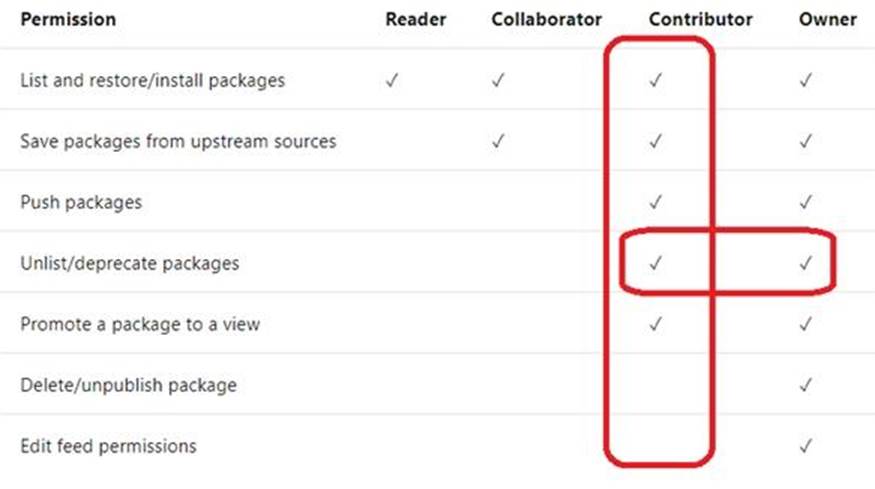
You need to ensure that developers can unlist and deprecate packages. The solution must use the principle of least privilege.
Which access level should you grant to the developers?

Answer:
Explanation:
Feeds have four levels of access: Owners, Contributors, Collaborators, and Readers.
Owners can add any type of identity-individuals, teams, and groups-to any access level.


Reference: https://docs.microsoft.com/en-us/azure/devops/artifacts/feeds/feed-permissions
Question 30 Selectable Answer
You need to implement Project4.
What should you do first?

Answer:
Explanation:
Scenario: Implement Project4 and configure the project to push Docker images to Azure Container Registry.


You use Azure Container Registry Tasks commands to quickly build, push, and run a Docker container image natively within Azure, showing how to offload your "inner-loop" development cycle to the cloud. ACR Tasks is a suite of features within Azure Container Registry to help you manage and modify container images across the container lifecycle.
Reference: https://docs.microsoft.com/en-us/azure/container-registry/container-registry-quickstart-task-cli
Showing page 2 of 18