
Free Demo Questions

Test Online Free Microsoft AZ-204 Exam Questions and Answers

Practice a live sample before buying full access. This page keeps the free AZ-204 question set organized by page so visitors and search engines can reach the canonical -questions.html URL directly.

Updated Jan 22, 2026 117 Questions 8 Pages
Page 7 of 8
Question 91 Selectable Answer
1. Topic 1, Windows Server 2016 virtual machine

Case study
This is a case study. Case studies are not timed separately. You can use as much exam time as you would like to complete each case. However, there may be additional case studies and sections on this exam. You must manage your time to ensure that you are able to complete all questions included on this exam in the time provided.

To answer the questions included in a case study, you will need to reference information that is provided in the case study. Case studies might contain exhibits and other resources that provide more information about the scenario that is described in the case study. Each question is independent of the other questions in this case study.

At the end of this case study, a review screen will appear. This screen allows you to review your answers and to make changes before you move to the next section of the exam. After you begin a new section, you cannot return to this section.

To start the case study
To display the first question in this case study, click the Next button. Use the buttons in the left pane to explore the content of the case study before you answer the questions. Clicking these buttons displays information such as business requirements, existing environment, and problem statements. If the case study has an All Information tab, note that the information displayed is identical to the information displayed on the subsequent tabs. When you are ready to answer a question, click the Question button to return to the question.

Current environment
Windows Server 2016 virtual machine
This virtual machine (VM) runs BizTalk Server 2016. The VM runs the following workflows:
- Ocean Transport C This workflow gathers and validates container information including container contents and arrival notices at various shipping ports.
- Inland Transport C This workflow gathers and validates trucking information including fuel usage, number of stops, and routes.

The VM supports the following REST API calls:
- Container API C This API provides container information including weight, contents, and other attributes.
- Location API C This API provides location information regarding shipping ports of call and trucking stops.
- Shipping REST API C This API provides shipping information for use and display on the shipping website.

Shipping Data
The application uses MongoDB JSON document storage database for all container and transport information.

Shipping Web Site
The site displays shipping container tracking information and container contents. The site is located at http://shipping.wideworldimporters.com/

Proposed solution
The on-premises shipping application must be moved to Azure. The VM has been migrated to a new Standard_D16s_v3 Azure VM by using Azure Site Recovery and must remain running in Azure to complete the BizTalk component migrations. You create a Standard_D16s_v3 Azure VM to host BizTalk Server.
The Azure architecture diagram for the proposed solution is shown below:
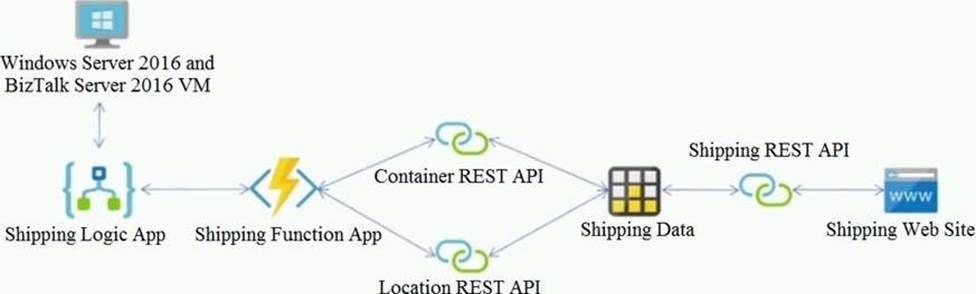


Requirements
Shipping Logic app
The Shipping Logic app must meet the following requirements:
- Support the ocean transport and inland transport workflows by using a Logic App.
- Support industry-standard protocol X12 message format for various messages including vessel content details and arrival notices.
- Secure resources to the corporate VNet and use dedicated storage resources with a fixed costing model.
- Maintain on-premises connectivity to support legacy applications and final BizTalk migrations.

Shipping Function app
Implement secure function endpoints by using app-level security and include Azure Active Directory (Azure AD).

REST APIs
The REST API’s that support the solution must meet the following requirements:
- Secure resources to the corporate VNet.
- Allow deployment to a testing location within Azure while not incurring additional costs.
- Automatically scale to double capacity during peak shipping times while not causing application downtime.
- Minimize costs when selecting an Azure payment model.

Shipping data
Data migration from on-premises to Azure must minimize costs and downtime.

Shipping website
Use Azure Content Delivery Network (CDN) and ensure maximum performance for dynamic content while minimizing latency and costs.

Issues
Windows Server 2016 VM
The VM shows high network latency, jitter, and high CPU utilization. The VM is critical and has not been backed up in the past. The VM must enable a quick restore from a 7-day snapshot to include in-place restore of disks in case of failure.

Shipping website and REST APIs
The following error message displays while you are testing the website:
Failed to load http://test-shippingapi.wideworldimporters.com/: No 'Access-Control-Allow-Origin' header is present on the requested resource. Origin 'http://test.wideworldimporters.com/' is therefore not allowed access.

You need to support the requirements for the Shipping Logic App.
What should you use?

Answer:
Explanation:
Before you can connect to on-premises data sources from Azure Logic Apps, download and install the on-premises data gateway on a local computer. The gateway works as a bridge that provides quick data transfer and encryption between data sources on premises (not in the cloud) and your logic apps.
The gateway supports BizTalk Server 2016.
Note: Microsoft have now fully incorporated the Azure BizTalk Services capabilities into Logic Apps and Azure App Service Hybrid Connections.
Logic Apps Enterprise Integration pack bring some of the enterprise B2B capabilities like AS2 and X12, EDI standards support
Scenario: The Shipping Logic app must meet the following requirements:
✑ Support the ocean transport and inland transport workflows by using a Logic App.
✑ Support industry-standard protocol X12 message format for various messages
including vessel content details and arrival notices.
✑ Secure resources to the corporate VNet and use dedicated storage resources with a fixed costing model.
✑ Maintain on-premises connectivity to support legacy applications and final BizTalk migrations.
Explanation:
Reference: https://docs.microsoft.com/en-us/azure/logic-apps/logic-apps-gateway-install

Question 92 Written Answer
HOTSPOT
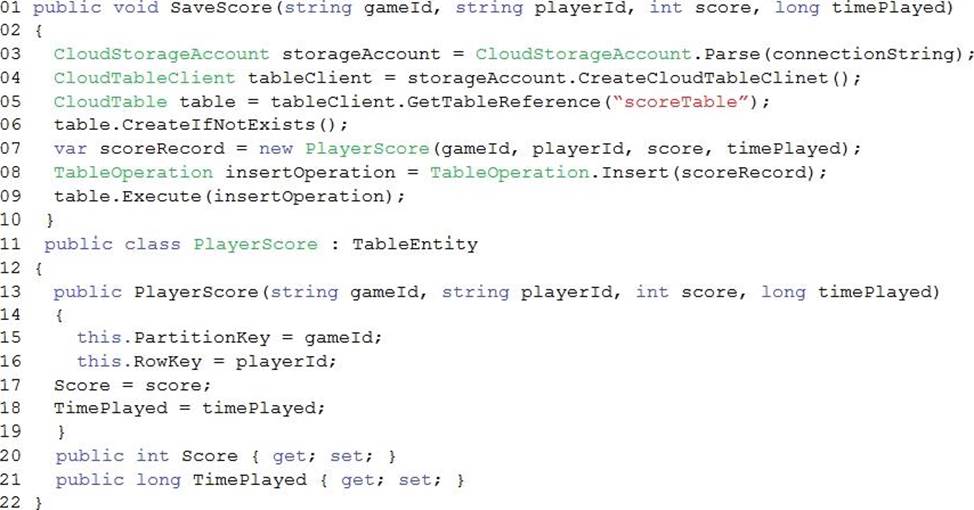
You have an app that stores player scores for an online game. The app stores data in Azure tables using a class named PlayerScore as the table entity. The table is populated with 100,000 records.
You are reviewing the following section of code that is intended to retrieve 20 records where the player score exceeds 15,000. (Line numbers are included for reference only.)


You have the following code. (Line numbers are included for reference only.)


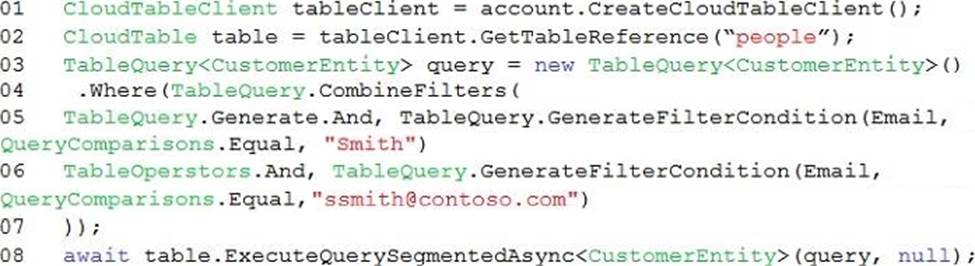
You store customer information in an Azure Cosmos database.
The following data already exists in the database:


You develop the following code. (Line numbers are included for reference only.)


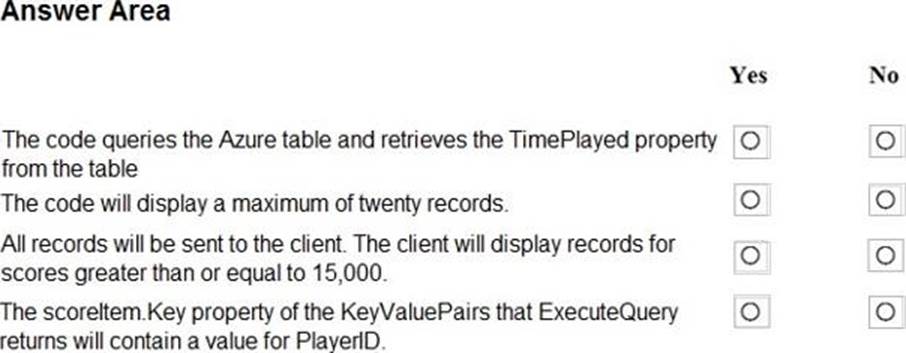
For each of the following statements, select Yes if the statement is true. Otherwise, select No. NOTE: Each correct selection is worth one point.


Answer:


Explanation:
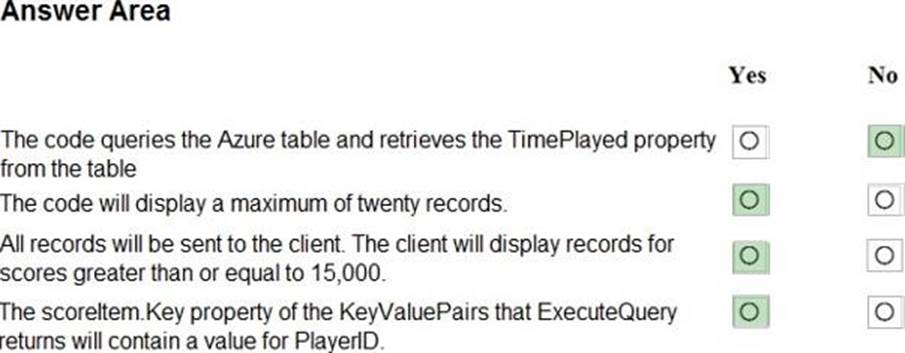
Box 1: No
Box 2: Yes
The TableQuery.Take method defines the upper bound for the number of entities the query
returns.
Example:
query.Take(10);
Box 3: Yes
Box 4: Yes
References: https://www.vkinfotek.com/azureqa/how-do-i-query-azure-table-storage-using-tablequery-class.html
Question 93 Written Answer
HOTSPOT
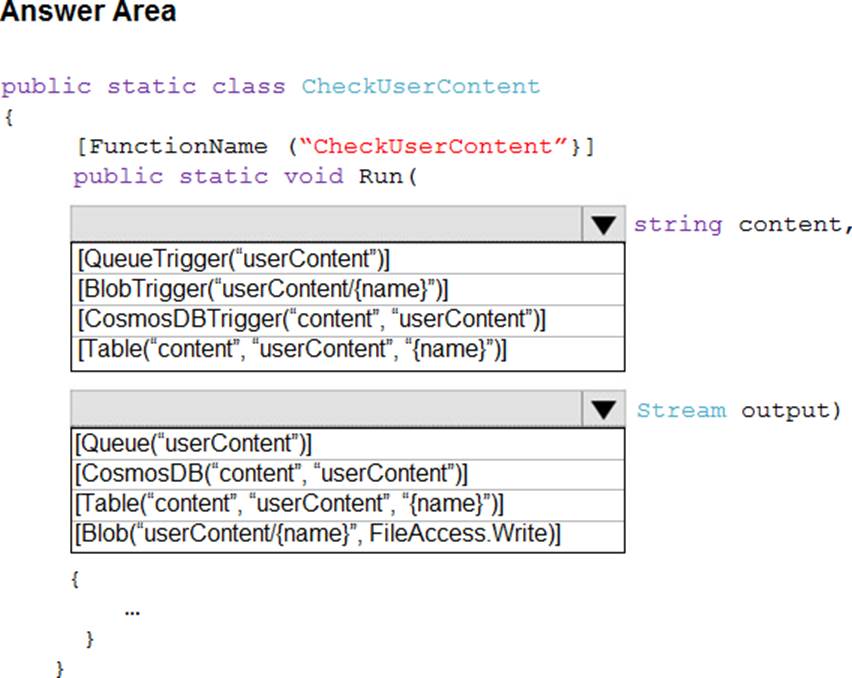
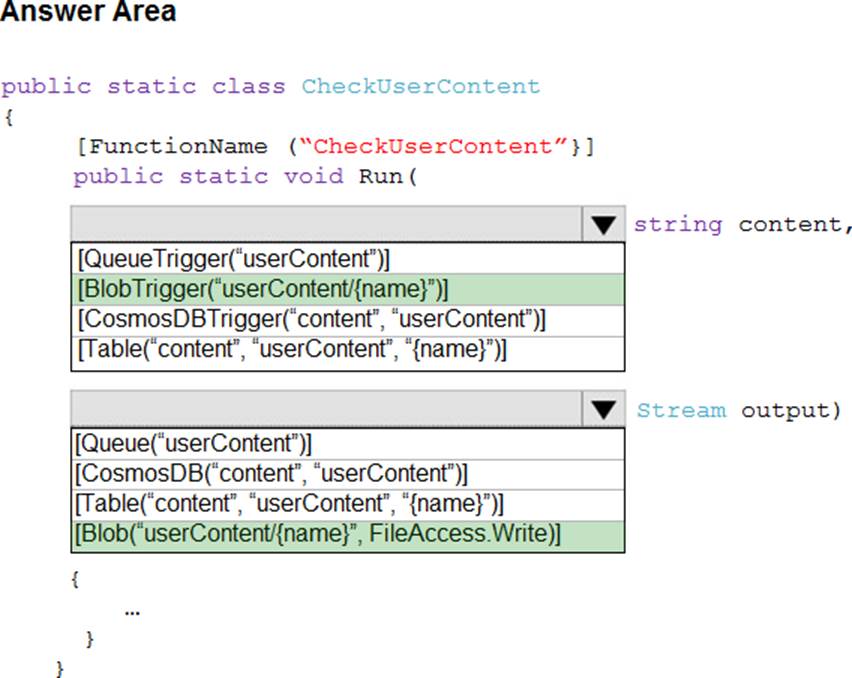
You need to implement the bindings for the CheckUserContent function.
How should you complete the code segment? To answer, select the appropriate options in the answer area. NOTE: Each correct selection is worth one point.


Answer:


Explanation:
Box 1: [BlobTrigger(..)]
Box 2: [Blob(..)]
Azure Blob storage output binding for Azure Functions. The output binding allows you to modify and delete blob storage data in an Azure Function.
The attribute's constructor takes the path to the blob and a FileAccess parameter indicating read or write, as shown in the following example:
[FunctionName("ResizeImage")]
public static void Run(
[BlobTrigger("sample-images/{name}")] Stream image,
[Blob("sample-images-md/{name}", FileAccess.Write)] Stream
imageSmall)
{
...
}
Scenario: You must create an Azure Function named CheckUserContent to perform the content checks.
The company’s data science group built ContentAnalysisService which accepts user generated content as a string and returns a probable value for inappropriate content. Any values over a specific threshold must be reviewed by an employee of Contoso, Ltd.
Reference: https://docs.microsoft.com/en-us/azure/azure-functions/functions-bindings-storage-blob-output
Question 94 Written Answer
HOTSPOT
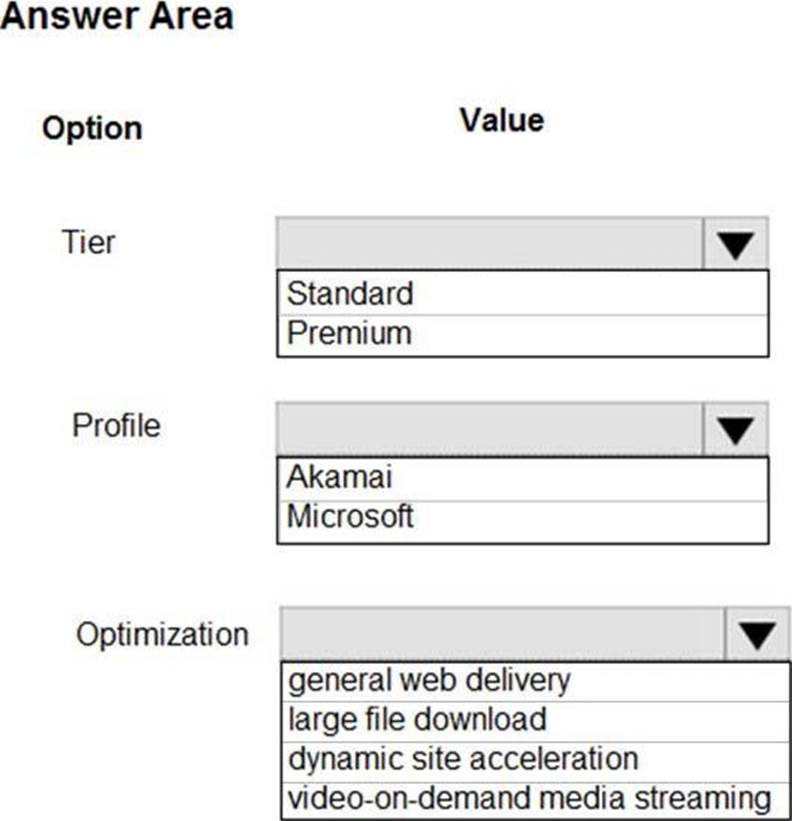
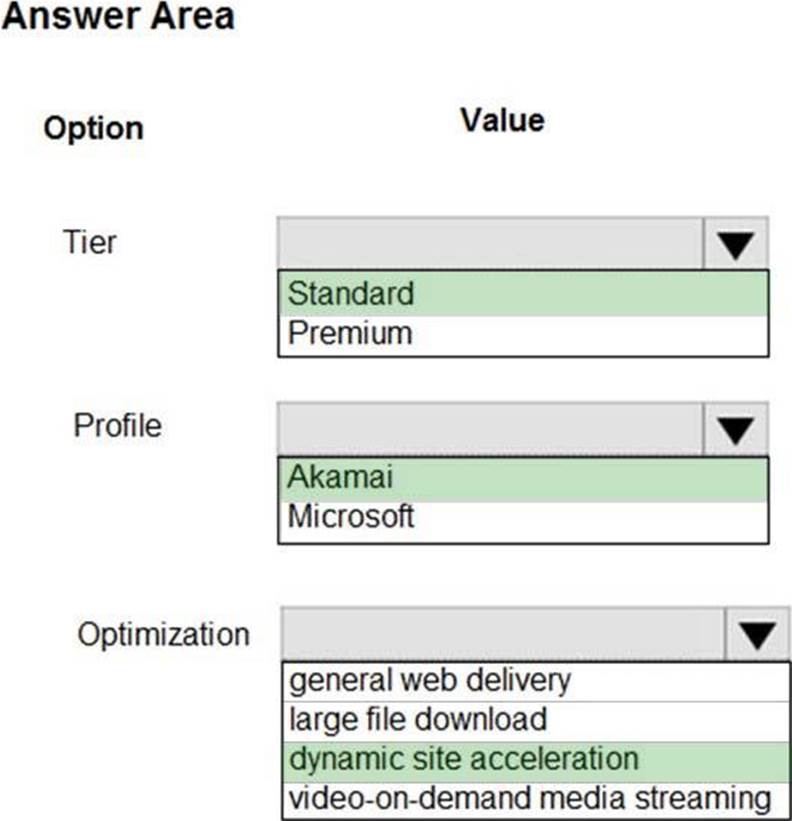
You need to configure Azure CDN for the Shipping web site.
Which configuration options should you use? To answer, select the appropriate options in the answer area. NOTE: Each correct selection is worth one point.


Answer:


Explanation:
Scenario: Shipping website
Use Azure Content Delivery Network (CDN) and ensure maximum performance for dynamic content while minimizing latency and costs.
Tier: Standard
Profile: Akamai
Optimization: Dynamic site acceleration
Dynamic site acceleration (DSA) is available for Azure CDN Standard from Akamai, Azure CDN Standard from Verizon, and Azure CDN Premium from Verizon profiles.
DSA includes various techniques that benefit the latency and performance of dynamic content. Techniques include route and network optimization, TCP optimization, and more.
You can use this optimization to accelerate a web app that includes numerous responses
that aren't cacheable. Examples are search results, checkout transactions, or real-time data. You can continue to use core Azure CDN caching capabilities for static data.
Question 95 Written Answer
DRAG DROP
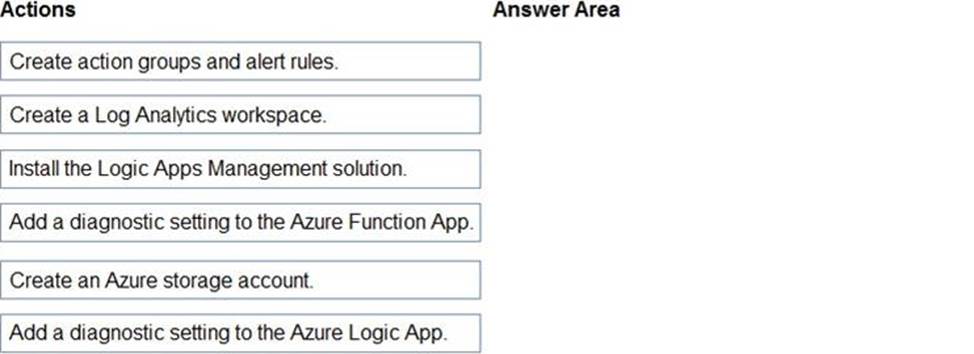
You develop and deploy an Azure Logic App that calls an Azure Function app. The Azure Function App includes an OpenAPI (Swagger) definition and uses an Azure Blob storage account. All resources are secured by using Azure Active Directory (Azure AD).
The Logic App must use Azure Monitor logs to record and store information about runtime data and events. The logs must be stored in the Azure Blob storage account.
You need to set up Azure Monitor logs and collect diagnostics data for the Azure Logic App.
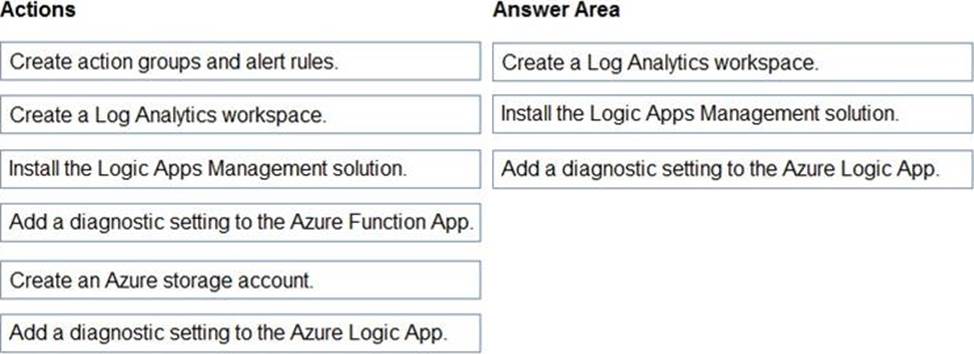
Which three actions should you perform in sequence? To answer, move the appropriate actions from the list of actions to the answer area and arrange them in the correct order.


Answer:


Explanation:
Text
Description automatically generated
Step 1: Create a Log Analytics workspace
Before you start, you need a Log Analytics workspace.
Step 2: Install the Logic Apps Management solution
To set up logging for your logic app, you can enable Log Analytics when you create your logic app, or you can install the Logic Apps Management solution in your Log Analytics workspace for existing logic apps.
Step 3: Add a diagnostic setting to the Azure Logic App
Set up Azure Monitor logs
✑ In the Azure portal, find and select your logic app.
✑ On your logic app menu, under Monitoring, select Diagnostic settings > Add diagnostic setting.
Question 96 Written Answer
HOTSPOT
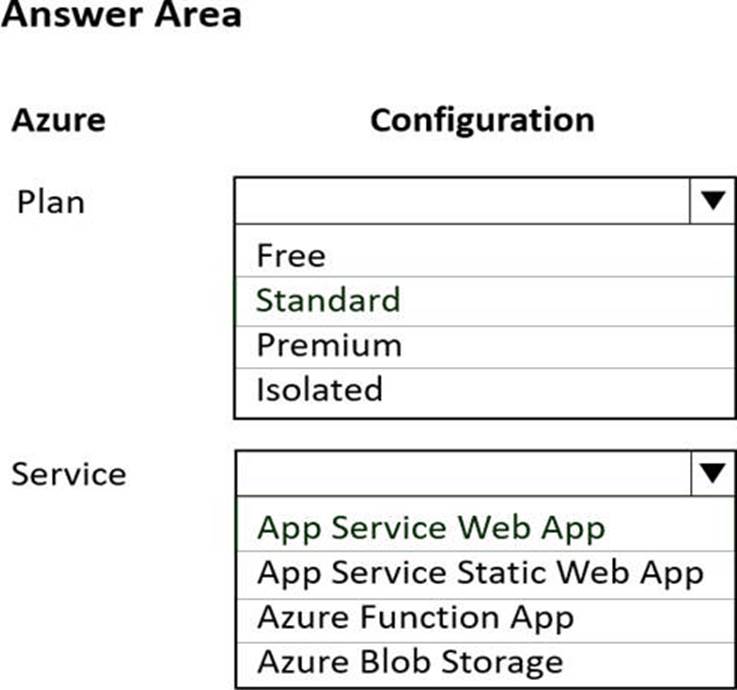
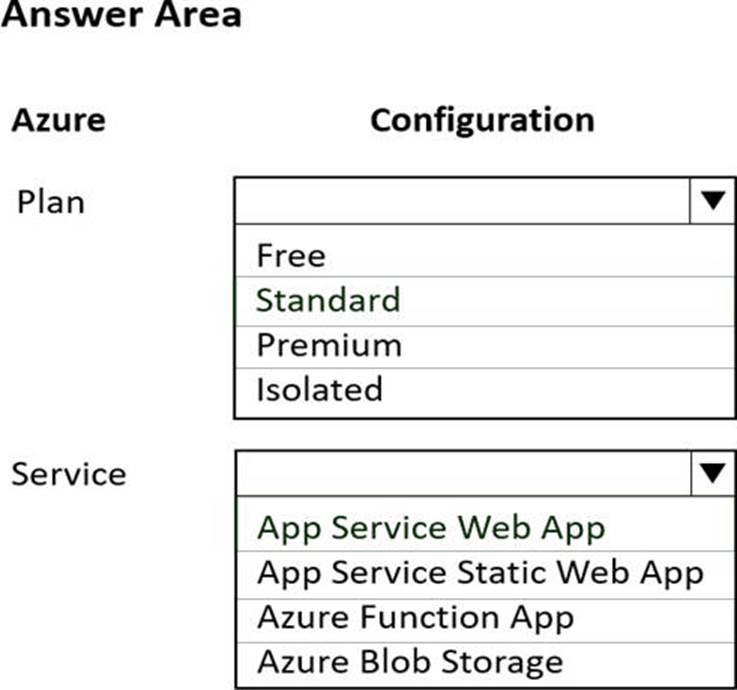
You need to implement the corporate website.
How should you configure the solution?


Answer:

Question 97 Selectable Answer
You develop and deploy an Azure Logic app that calls an Azure Function app. The Azure Function app includes an OpenAPl (Swagger) definition and uses an Azure Blob storage account. All resources are secured by using Azure Active Directory (Azure AD).
The Azure Logic app must securely access the Azure Blob storage account. Azure AD resources must remain if the Azure Logic app is deleted.
You need to secure the Azure Logic app.
What should you do?

Answer:
Explanation:
To give a managed identity access to an Azure resource, you need to add a role to the target resource for that identity.
Note: To easily authenticate access to other resources that are protected by Azure Active Directory (Azure AD) without having to sign in and provide credentials or secrets, your logic app can use a managed identity (formerly known as Managed Service Identity or MSI). Azure manages this identity for you and helps secure your credentials because you don't have to provide or rotate secrets.
If you set up your logic app to use the system-assigned identity or a manually created, user-assigned identity, the function in your logic app can also use that same identity for authentication.
Reference:
https://docs.microsoft.com/en-us/azure/logic-apps/create-managed-service-identity
https://docs.microsoft.com/en-us/azure/api-management/api-management-howto-mutual-certificates-for-clients
Question 98 Written Answer
HOTSPOT
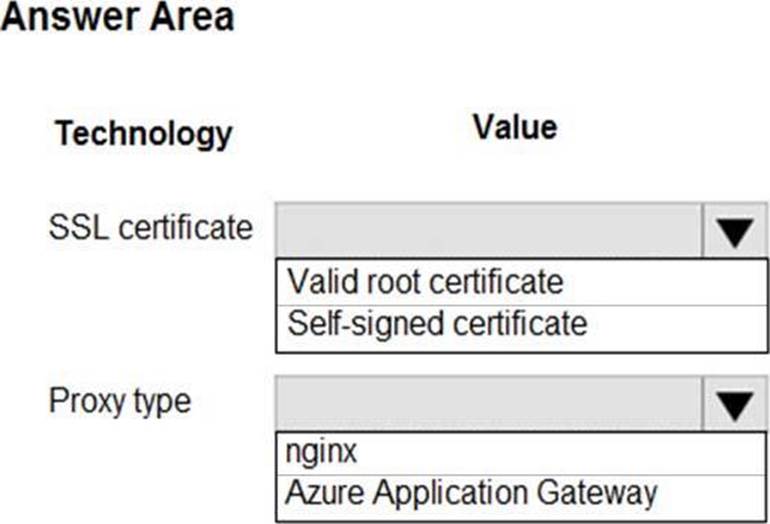
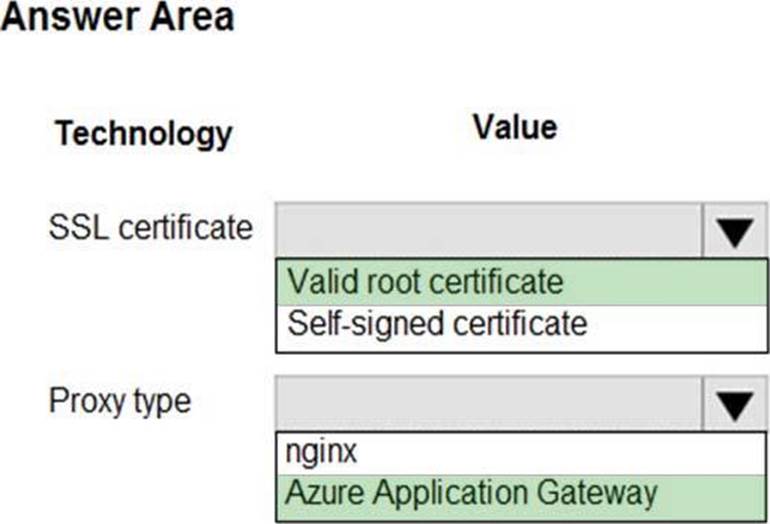
You need to ensure that network security policies are met.
How should you configure network security? To answer, select the appropriate options in the answer area. NOTE: Each correct selection is worth one point.


Answer:


Explanation:
Box 1: Valid root certificate
Scenario: All websites and services must use SSL from a valid root certificate authority.
Box 2: Azure Application Gateway
Scenario:
✑ Any web service accessible over the Internet must be protected from cross site scripting attacks.
✑ All Internal services must only be accessible from Internal Virtual Networks (VNets)
✑ All parts of the system must support inbound and outbound traffic restrictions.
Azure Web Application Firewall (WAF) on Azure Application Gateway provides centralized protection of your web applications from common exploits and vulnerabilities. Web applications are increasingly targeted by malicious attacks that exploit commonly known vulnerabilities. SQL injection and cross-site scripting are among the most common attacks.
Application Gateway supports autoscaling, SSL offloading, and end-to-end SSL, a web application firewall (WAF), cookie-based session affinity, URL path-based routing, multisite hosting, redirection, rewrite HTTP headers and other features.
Note: Both Nginx and Azure Application Gateway act as a reverse proxy with Layer 7 loadbalancing features plus a WAF to ensure strong protection against common web vulnerabilities and exploits.
You can modify Nginx web server configuration/SSL for X-XSS protection. This helps to prevent cross-site scripting exploits by forcing the injection of HTTP headers with X-XSS protection.
Question 99 Written Answer
HOTSPOT
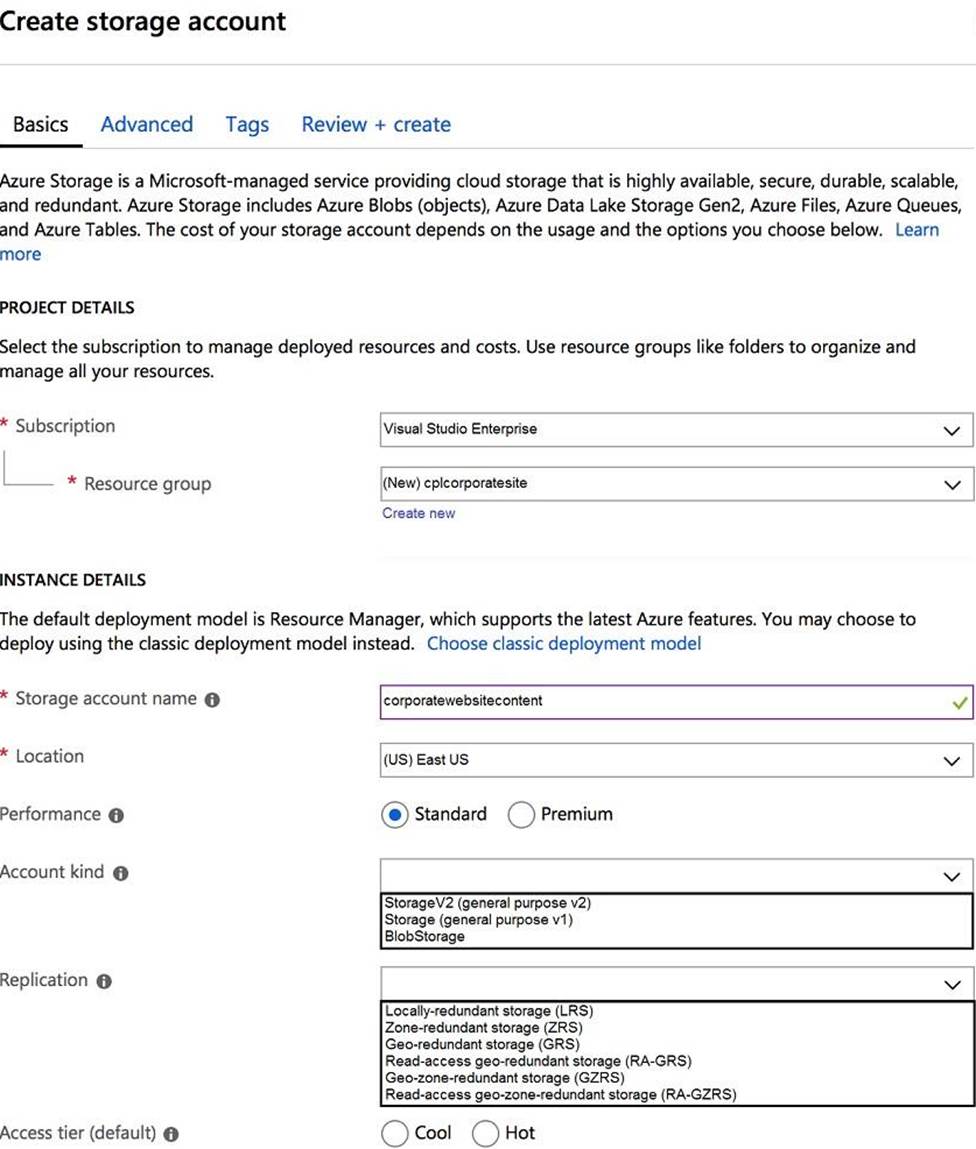
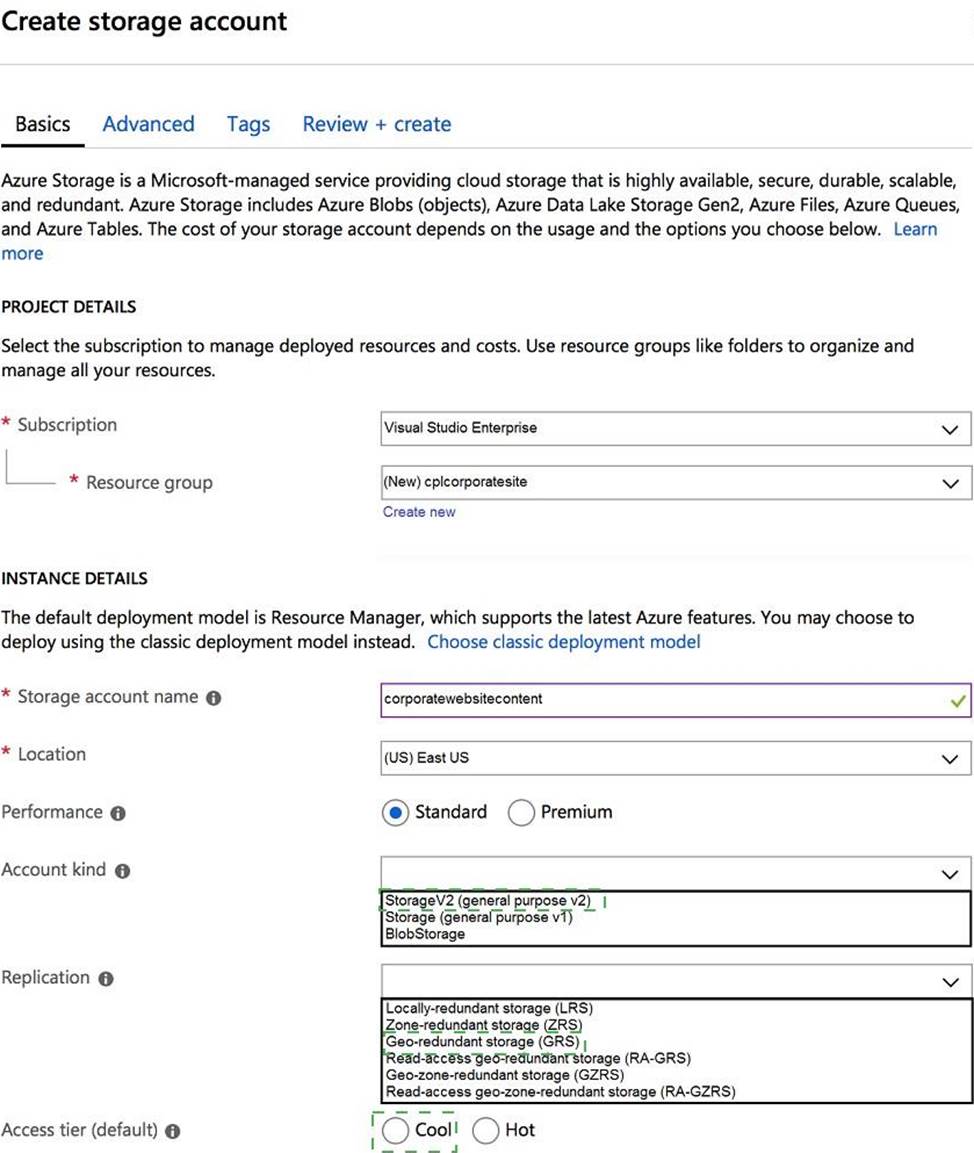
You need to configure the Account Kind, Replication, and Storage tier options for the corporate website’s Azure Storage account.
How should you complete the configuration? To answer, select the appropriate options in the dialog box in the answer area. NOTE: Each correct selection is worth one point.


Answer:


Explanation:
Account Kind: StorageV2 (general-purpose v2)
Scenario: Azure Storage blob will be used (refer to the exhibit). Data storage costs must be minimized.
General-purpose v2 accounts: Basic storage account type for blobs, files, queues, and tables. Recommended for most scenarios using Azure Storage.
Question 100 Selectable Answer
You deploy an Azure App Service web app. You create an app registration for the app in Azure Active Directory (Azure AD) and Twitter. the app must authenticate users and must use SSL for all communications. The app must use Twitter as the identity provider. You need to validate the Azure AD request in the app code.
What should you validate?

Answer:
Question 101 Written Answer
DRAG DROP
You need to implement the Log policy.
How should you complete the Azure Event Grid subscription? To answer, drag the appropriate JSON segments to the correct locations. Each JSON segment may be used once, more than once, or not at all. You may need to drag the split bar between panes to view content. NOTE: Each correct selection is worth one point.


Answer:


Explanation:
Box 1: WebHook
Scenario: If an anomaly is detected, an Azure Function that emails administrators is called by using an HTTP WebHook.
endpointType: The type of endpoint for the subscription (webhook/HTTP, Event Hub, or queue).
Box 2: SubjectBeginsWith
Box 3: Microsoft.Storage.BlobCreated
Scenario: Log Policy
All Azure App Service Web Apps must write logs to Azure Blob storage. All log files should be saved to a container named logdrop. Logs must remain in the container for 15 days.
Example subscription schema
{
"properties": {
"destination": {
"endpointType": "webhook",
"properties": {
"endpointUrl":
"https://example.azurewebsites.net/api/HttpTriggerCSharp1?code=VXbGWce53l48Mt8wuo
tr0GPmyJ/nDT4hgdFj9DpBiRt38qqnnm5OFg=="
}
},
"filter": {
"includedEventTypes": [ "Microsoft.Storage.BlobCreated", "Microsoft.Storage.BlobDeleted" ],
"subjectBeginsWith": "blobServices/default/containers/mycontainer/log",
"subjectEndsWith": ".jpg",
"isSubjectCaseSensitive ": "true"
}
}
}
Question 102 Selectable Answer
You need to resolve the log capacity issue.
What should you do?

Answer:
Explanation:
Scenario, the log capacity issue: Developers report that the number of log message in the trace output for the processor is too high, resulting in lost log messages.
Sampling is a feature in Azure Application Insights. It is the recommended way to reduce telemetry traffic and storage, while preserving a statistically correct analysis of application data. The filter selects items that are related, so that you can navigate between items when you are doing diagnostic investigations. When metric counts are presented to you in the portal, they are renormalized to take account of the sampling, to minimize any effect on the statistics.
Sampling reduces traffic and data costs, and helps you avoid throttling.
Reference: https://docs.microsoft.com/en-us/azure/azure-monitor/app/sampling
Question 103 Written Answer
Topic 4, Proseware, Inc

Case study
This is a case study. Case studies are not timed separately. You can use as much exam time as you would like to complete each case. However, there may be additional case studies and sections on this exam. You must manage your time to ensure that you are able to complete all questions included on this exam in the time provided.

To answer the questions included in a case study, you will need to reference information that is provided in the case study. Case studies might contain exhibits and other resources that provide more information about the scenario that is described in the case study. Each question is independent of the other questions in this case study.

At the end of this case study, a review screen will appear. This screen allows you to review your answers and to make changes before you move to the next section of the exam. After you begin a new section, you cannot return to this section.

To start the case study
To display the first question in this case study, click the Next button. Use the buttons in the left pane to explore the content of the case study before you answer the questions. Clicking these buttons displays information such as business requirements, existing environment, and problem statements. When you are ready to answer a question, click the Question button to return to the question.

Background
You are a developer for Proseware, Inc. You are developing an application that applies a set of governance policies for Proseware’s internal services, external services, and applications. The application will also provide a shared library for common functionality.

Requirements
Policy service
You develop and deploy a stateful ASP.NET Core 2.1 web application named Policy service to an Azure App Service Web App. The application reacts to events from Azure Event Grid and performs policy actions based on those events.
The application must include the Event Grid Event ID field in all Application Insights telemetry.
Policy service must use Application Insights to automatically scale with the number of policy actions that it is performing.

Policies
Log policy
All Azure App Service Web Apps must write logs to Azure Blob storage. All log files should be saved to a container named logdrop. Logs must remain in the container for 15 days.

Authentication events
Authentication events are used to monitor users signing in and signing out. All authentication events must be processed by Policy service. Sign outs must be processed as quickly as possible.

PolicyLib
You have a shared library named PolicyLib that contains functionality common to all ASP.NET Core web services and applications.
The PolicyLib library must:
✑ Exclude non-user actions from Application Insights telemetry.
✑ Provide methods that allow a web service to scale itself.
✑ Ensure that scaling actions do not disrupt application usage.

Other
Anomaly detection service
You have an anomaly detection service that analyzes log information for anomalies. It is implemented as an Azure Machine Learning model. The model is deployed as a web service. If an anomaly is detected, an Azure Function that emails administrators is called by using an HTTP WebHook.

Health monitoring
All web applications and services have health monitoring at the /health service endpoint.

Issues
Policy loss
When you deploy Policy service, policies may not be applied if they were in the process of being applied during the deployment.

Performance issue
When under heavy load, the anomaly detection service undergoes slowdowns and rejects connections.

Notification latency
Users report that anomaly detection emails can sometimes arrive several minutes after an anomaly is detected.

App code
EventGridController.cs
Relevant portions of the app files are shown below. Line numbers are included for reference only and include a two-character prefix that denotes the specific file to which they belong.


LoginEvent.cs
Relevant portions of the app files are shown below. Line numbers are included for reference only and include a two-character prefix that denotes the specific file to which they belong.


DRAG DROP
You need to ensure that PolicyLib requirements are met.
How should you complete the code segment? To answer, drag the appropriate code segments to the correct locations. Each code segment may be used once, more than once, or not at all. You may need to drag the split bar between panes or scroll to view content. NOTE: Each correct selection is worth one point.


Answer:


Explanation:
Scenario: You have a shared library named PolicyLib that contains functionality common to all ASP.NET Core web services and applications.
The PolicyLib library must:
✑ Exclude non-user actions from Application Insights telemetry.
✑ Provide methods that allow a web service to scale itself.
✑ Ensure that scaling actions do not disrupt application usage.
Box 1: ITelemetryInitializer
Use telemetry initializers to define global properties that are sent with all telemetry; and to override selected behavior of the standard telemetry modules.
Box 2: Initialize
Box 3: Telemetry.Context
Box 4: ((EventTelemetry)telemetry).Properties["EventID"]
Question 104 Written Answer
HOTSPOT
You are implementing a software as a service (SaaS) ASP.NET Core web service that will run as an Azure Web App. The web service will use an on-premises SQL Server database for storage. The web service also includes a WebJob that processes data updates.
Four customers will use the web service.
• Each instance of the WebJob processes data for a single customer and must run as a singleton instance.
• Each deployment must be tested by using deployment slots prior to serving production data.
• Azure costs must be minimized.
• Azure resources must be located in an isolated network.
You need to configure the App Service plan for the Web App.
How should you configure the App Service plan? To answer, select the appropriate settings in the answer area. NOTE: Each correct selection is worth one point.


Answer:


Explanation:
Number of VM instances: 4
You are not charged extra for deployment slots.
Pricing tier: Isolated
The App Service Environment (ASE) is a powerful feature offering of the Azure App Service that gives network isolation and improved scale capabilities. It is essentially a deployment of the Azure App Service into a subnet of a customer’s Azure Virtual Network (VNet).
References: https://azure.microsoft.com/sv-se/blog/announcing-app-service-isolated-more-power-scale-and-ease-of-use/
Question 105 Written Answer
DRAG DROP
You are developing an application to securely transfer data between on-premises file systems and Azure Blob storage. The application stores keys, secrets, and certificates in Azure Key Vault. The application uses the Azure Key Vault APIs.
The application must allow recovery of an accidental deletion of the key vault or key vault objects. Key vault objects must be retained for 90 days after deletion.
You need to protect the key vault and key vault objects.
Which Azure Key Vault feature should you use? To answer, drag the appropriate features to the correct actions. Each feature may be used once, more than once, or not at all. You may need to drag the split bar between panes or scroll to view content. NOTE: Each correct selection is worth one point.


Answer:


Explanation:
Box 1: Soft delete
When soft-delete is enabled, resources marked as deleted resources are retained for a specified period (90 days by default). The service further provides a mechanism for recovering the deleted object, essentially undoing the deletion.
Box 2: Purge protection
Purge protection is an optional Key Vault behavior and is not enabled by default. Purge protection can only be enabled once soft-delete is enabled.
When purge protection is on, a vault or an object in the deleted state cannot be purged until the retention period has passed. Soft-deleted vaults and objects can still be recovered, ensuring that the retention policy will be followed.
Showing page 7 of 8