Test Online Free Microsoft AZ-204 Exam Questions and Answers
Practice a live sample before buying full access. This page keeps the free AZ-204 question set organized by page so visitors and search engines can reach the canonical -questions.html URL directly.
QUESTION 1
You need to correct the RequestUserApproval Function app error.
What should you do?
Answer: Explanation:
Async operation tracking
The HTTP response mentioned previously is designed to help implement long-running HTTP async APIs with Durable Functions. This pattern is sometimes referred to as the polling consumer pattern.
Both the client and server implementations of this pattern are built into the Durable Functions HTTP APIs.
Function app
You perform local testing for the RequestUserApproval function. The following error message displays:
'Timeout value of 00:10:00 exceeded by function: RequestUserApproval'
The same error message displays when you test the function in an Azure development environment when you run the following Kusto query: FunctionAppLogs
| where FunctionName = = "RequestUserApproval"
References: https://docs.microsoft.com/en-us/azure/azure-functions/durable/durable-functions-http-features
Question 47Written Answer
DRAG DROP
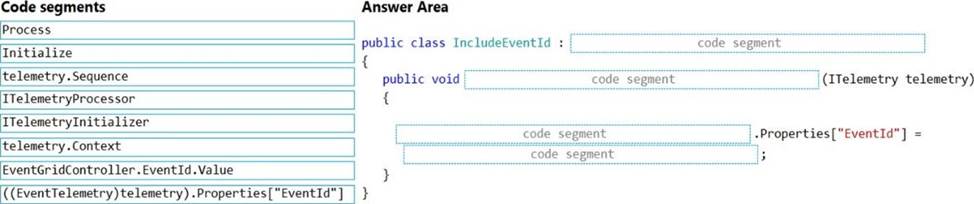
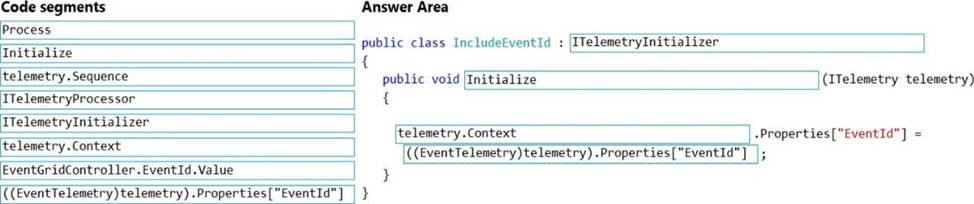
You need to ensure that PolicyLib requirements are met.
How should you complete the code segment? To answer, drag the appropriate code segments to the correct locations. Each code segment may be used once, more than once, or not at all. You may need to drag the split bar between panes or scroll to view content. NOTE: Each correct selection is worth one point.
Answer:
Explanation:
Scenario: You have a shared library named PolicyLib that contains functionality common to all ASP.NET Core web services and applications.
The PolicyLib library must:
✑ Exclude non-user actions from Application Insights telemetry.
✑ Provide methods that allow a web service to scale itself.
✑ Ensure that scaling actions do not disrupt application usage.
Box 1: ITelemetryInitializer
Use telemetry initializers to define global properties that are sent with all telemetry; and to override selected behavior of the standard telemetry modules.
Box 2: Initialize
Box 3: Telemetry.Context
Box 4: ((EventTelemetry)telemetry).Properties["EventID"]
Question 48Written Answer
DRAG DROP
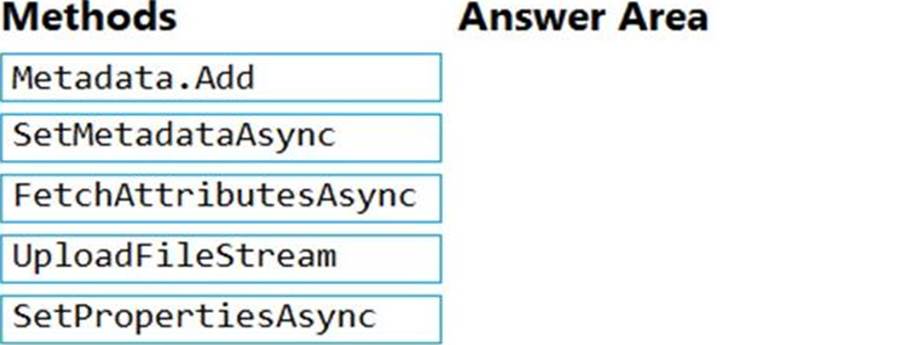
You have an application that uses Azure Blob storage.
You need to update the metadata of the blobs.
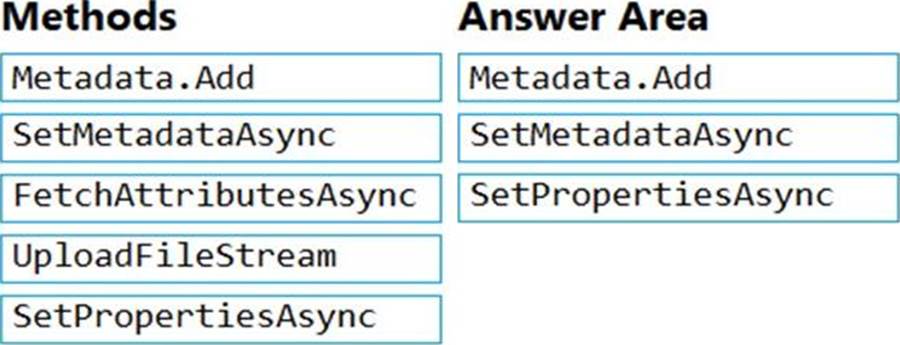
Which three methods should you use to develop the solution? To answer, move the appropriate methods from the list of methods to the answer area and arrange them in the correct order.
Answer:
Explanation:
Metadata.Add example:
// Add metadata to the dictionary by calling the Add method metadata.Add("docType", "textDocuments");
SetMetadataAsync example:
// Set the blob's metadata.
await blob.SetMetadataAsync(metadata);
// Set the blob's properties. await blob.SetPropertiesAsync();
Question 49Written Answer
HOTSPOT
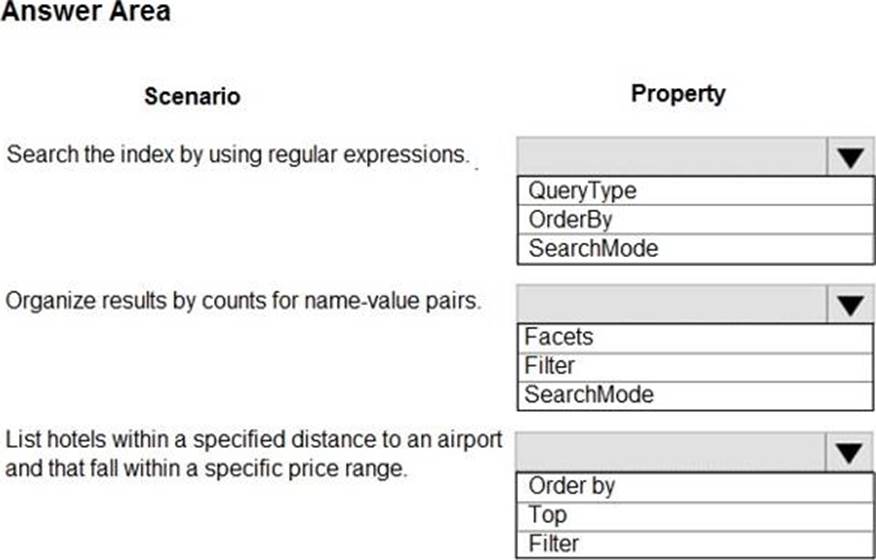
You are developing a .NET Core MVC application for customers to research hotels. The application will use Azure Search. The application will search the index by using various criteria to locate documents related to hotels. The index will include search fields for rate, a list of amenities, and distance to the nearest airport.
The application must support the following scenarios for specifying search criteria and organizing results:
• Search the index by using regular expressions.
• Organize results by counts for name-value pairs.
• List hotels within a specified distance to an airport and that fall within a specific price
range.
You need to configure the SearchParameters class.
Which properties should you configure? To answer, select the appropriate options in the answer area. NOTE: Each correct selection is worth one point.
Answer:
Explanation:
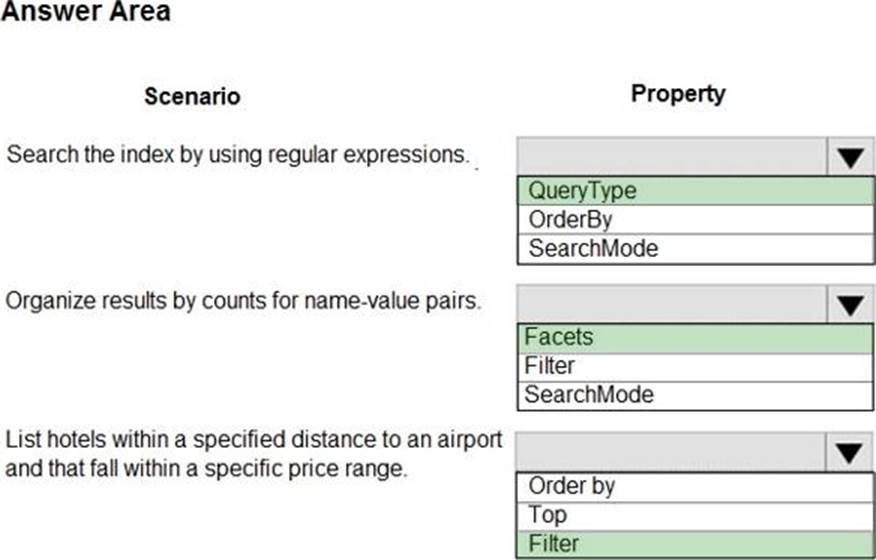
Box 1: QueryType
The SearchParameters.QueryType Property gets or sets a value that specifies the syntax
of the search query. The default is 'simple'. Use 'full' if your query uses the Lucene query syntax.
You can write queries against Azure Search based on the rich Lucene Query Parser syntax for specialized query forms: wildcard, fuzzy search, proximity search, regular expressions are a few examples.
Box 2: Facets
The facets property gets or sets the list of facet expressions to apply to the search query. Each facet expression contains a field name, optionally followed by a comma-separated list of name:value pairs.
Box 3: Filter
The Filter property gets or sets the OData $filter expression to apply to the search query.
References:
https://docs.microsoft.com/en-us/dotnet/api/microsoft.azure.search.models.searchparameters
https://docs.microsoft.com/en-us/azure/search/query-lucene-syntax
https://docs.microsoft.com/en-us/dotnet/api/microsoft.azure.search.models.searchparameters.querytype
Question 50Selectable Answer
You need to ensure receipt processing occurs correctly.
What should you do?
Answer: Explanation:
You can create a snapshot of a blob. A snapshot is a read-only version of a blob that's taken at a point in time. Once a snapshot has been created, it can be read, copied, or deleted, but not modified. Snapshots provide a way to back up a blob as it appears at a moment in time.
Scenario: Processing is performed by an Azure Function that uses version 2 of the Azure Function runtime. Once processing is completed, results are stored in Azure Blob Storage and an Azure SQL database. Then, an email summary is sent to the user with a link to the processing report. The link to the report must remain valid if the email is forwarded to another user.
Explanation:
Reference: https://docs.microsoft.com/en-us/rest/api/storageservices/creating-a-snapshot-of-a-blob
Question 51Written Answer
HOTSPOT
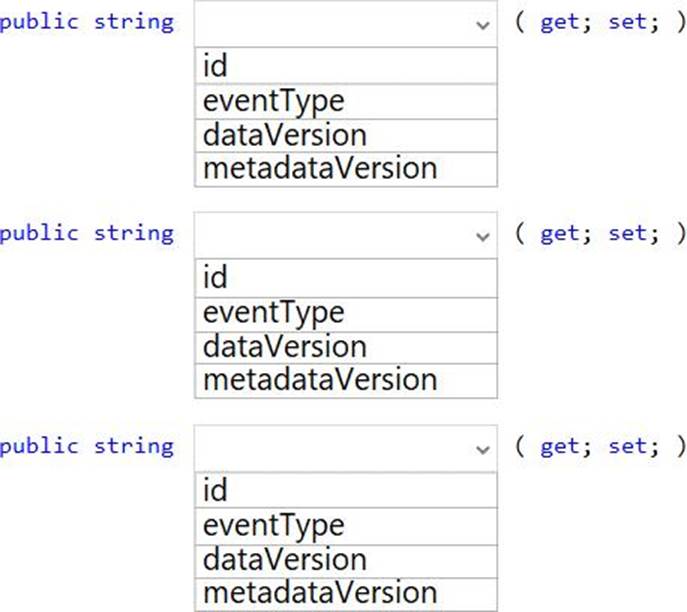
You need to insert code at line LE03 of LoginEvent.cs to ensure that all authentication events are processed correctly.
How should you complete the code? To answer, select the appropriate options in the answer area. NOTE: Each correct selection is worth one point.
Answer:
Explanation:
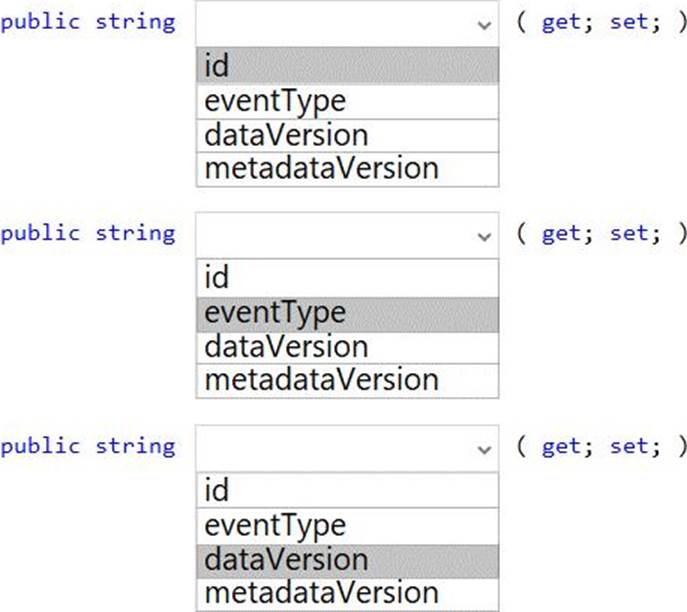
Box 1: id
id is a unique identifier for the event.
Box 2: eventType
eventType is one of the registered event types for this event source.
Box 3: dataVersion
dataVersion is the schema version of the data object. The publisher defines the schema version.
Scenario: Authentication events are used to monitor users signing in and signing out. All authentication events must be processed by Policy service. Sign outs must be processed as quickly as possible.
The following example shows the properties that are used by all event publishers:
[
{
"topic": string,
"subject": string,
"id": string,
"eventType": string,
"eventTime": string,
"data":{
object-unique-to-each-publisher
},
"dataVersion": string,
"metadataVersion": string
}
]
Question 52Selectable Answer
You ate developing an application that allows users to find musicians that ate looking for work. The application must store information about musicians, the instruments that they play, and other related data.
The application must also allow users to determine which musicians have played together, including groups of three or more musicians that have performed together at a specific location.
Which Azure Cosmos D6 API should you use for the application?
Answer:
Question 53Written Answer
HOTSPOT
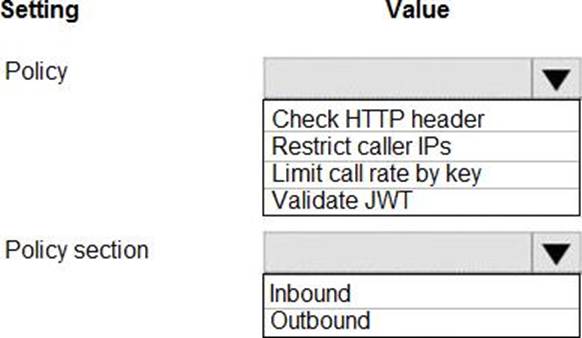
You need to configure API Management for authentication.
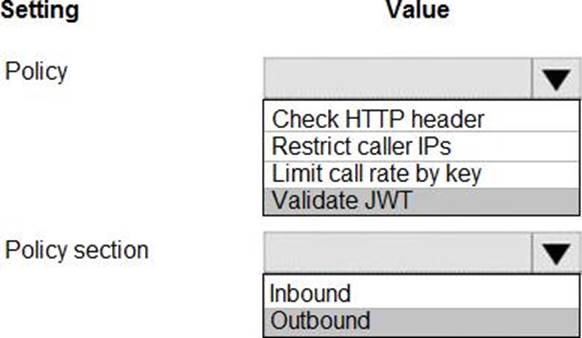
Which policy values should you use? To answer, select the appropriate options in the answer area. NOTE: Each correct selection is worth one point.
Answer:
Explanation:
Box 1: Validate JWT
The validate-jwt policy enforces existence and validity of a JWT extracted from either a specified HTTP Header or a specified query parameter.
Scenario: User authentication (see step 5 below)
The following steps detail the user authentication process:
✑ The user selects Sign in in the website.
✑ The browser redirects the user to the Azure Active Directory (Azure AD) sign in page.
✑ The user signs in.
✑ Azure AD redirects the user’s session back to the web application. The URL includes an access token.
✑ The web application calls an API and includes the access token in the authentication header. The application ID is sent as the audience (‘aud’) claim in the access token.
✑ The back-end API validates the access token.
Box 2: Outbound
Question 54Written Answer
HOTSPOT
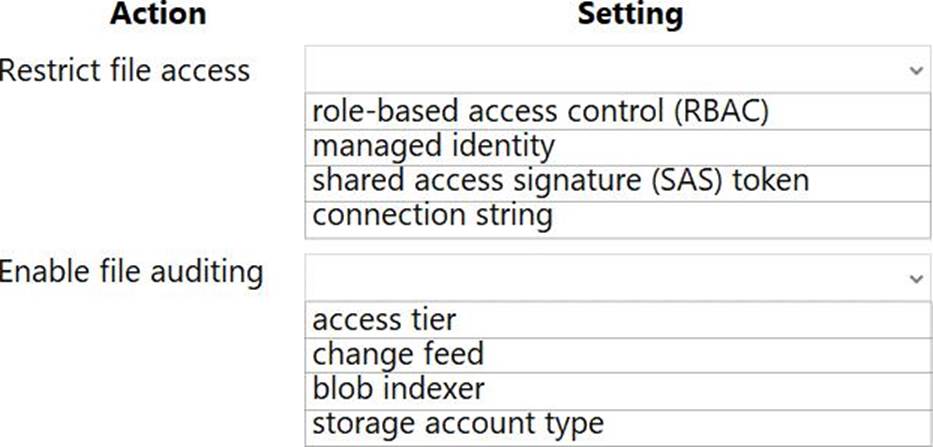
You need to configure security and compliance for the corporate website files.
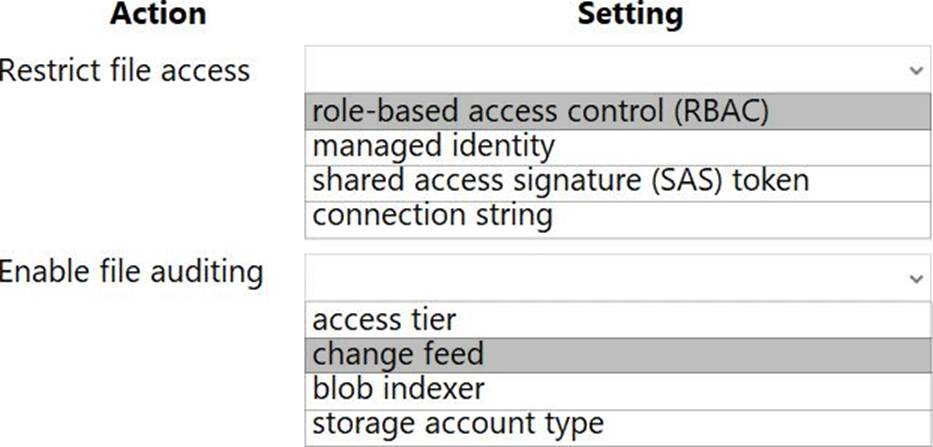
Which Azure Blob storage settings should you use? To answer, select the appropriate options in the answer area. NOTE: Each correct selection is worth one point.
Answer:
Explanation:
Box 1: role-based access control (RBAC)
Azure Storage supports authentication and authorization with Azure AD for the Blob and Queue services via Azure role-based access control (Azure RBAC).
Scenario: File access must restrict access by IP, protocol, and Azure AD rights.
Box 2: change feed
The purpose of the change feed is to provide transaction logs of all the changes that occur to the blobs and the blob metadata in your storage account.
The file updates must be read-only, stored in the order in which they occurred, include only create, update, delete, and copy operations, and be retained for compliance reasons.
Question 55Written Answer
HOTSPOT
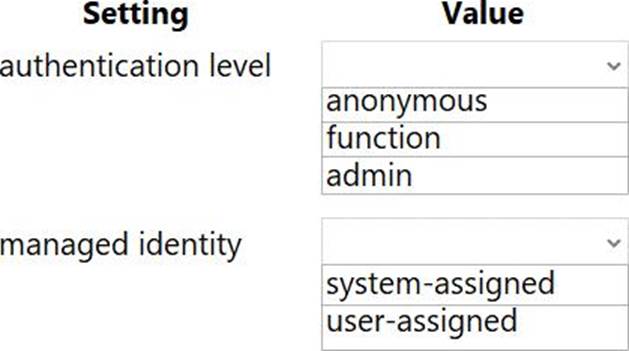
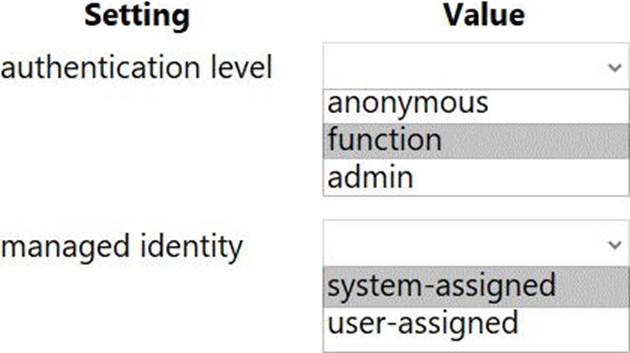
You need to correct the Azure Logic app error message.
Which configuration values should you use? To answer, select the appropriate options in the answer area. NOTE: Each correct selection is worth one point.
Answer:
Explanation:
Scenario: You test the Logic app in a development environment.
The following error message displays:
'400 Bad Request'
Troubleshooting of the error shows an HttpTrigger action to call the RequestUserApproval function.
NOTE: If the inbound call's request body doesn't match your schema, the trigger returns an HTTP 400 Bad Request error.
Box 1: function
If you have an Azure function where you want to use the system-assigned identity, first enable authentication for Azure functions.
Box 2: system-assigned
Your logic app or individual connections can use either the system-assigned identity or a single user-assigned identity, which you can share across a group of logic apps, but not both.
Question 56Selectable Answer
You develop a gateway solution for a public facing news API. The news API back end is implemented as a RESTful service and uses an OpenAPI specification.
You need to ensure that you can access the news API by using an Azure API Management service instance.
Which Azure PowerShell command should you run?
Answer: Explanation:
New-AzureRmApiManagementBackendProxy creates a new Backend Proxy Object which can be piped when creating a new Backend entity.
Example: Create a Backend Proxy In-Memory Object
PS C:\>$secpassword = ConvertTo-SecureString "PlainTextPassword" -AsPlainText - Force
PS C:\>$proxyCreds = New-Object System.Management.Automation.PSCredential ("foo", $secpassword)
PS C:\>$credential = New-AzureRmApiManagementBackendProxy -Url "http://12.168.1.1:8080" -ProxyCredential $proxyCreds
PS C:\>$apimContext = New-AzureRmApiManagementContext -ResourceGroupName "Api-Default-WestUS" -ServiceName "contoso"
PS C:\>$backend = New-AzureRmApiManagementBackend -Context $apimContext - BackendId 123 -Url 'https://contoso.com/awesomeapi' -Protocol http -Title "first backend" - SkipCertificateChainValidation $true -Proxy $credential -Description "backend with proxy server"
Creates a Backend Proxy Object and sets up Backend
Question 57Selectable Answer
You are developing applications for a company. You plan to host the applications on Azure App Services.
The company has the following requirements:
✑ Every five minutes verify that the websites are responsive.
✑ Verify that the websites respond within a specified time threshold. Dependent requests such as images and JavaScript files must load properly.
✑ Generate alerts if a website is experiencing issues.
✑ If a website fails to load, the system must attempt to reload the site three more times.
You need to implement this process with the least amount of effort.
What should you do?
Answer: Explanation:
You can monitor a recorded sequence of URLs and interactions with a website via multi-step web tests.
Reference: https://docs.microsoft.com/en-us/azure/azure-monitor/app/availability-multistep
Question 58Written Answer
DRAG DROP
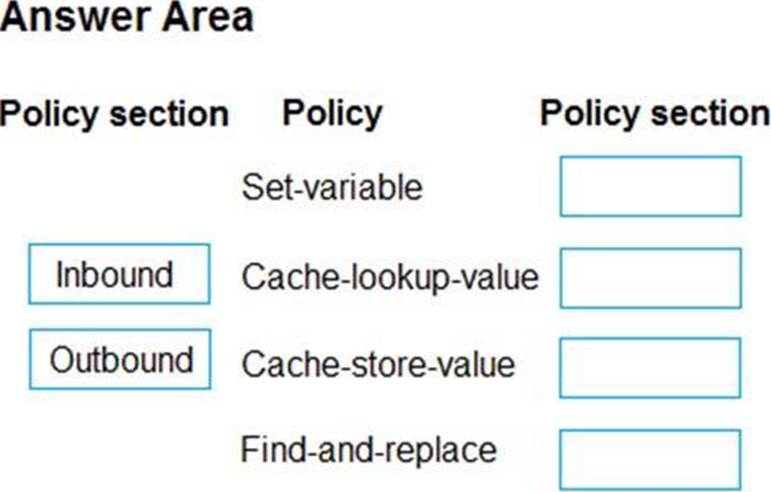
Contoso, Ltd. provides an API to customers by using Azure API Management (APIM). The API authorizes users with a JWT token.
You must implement response caching for the APIM gateway. The caching mechanism must detect the user ID of the client that accesses data for a given location and cache the response for that user ID.
You need to add the following policies to the policies file:
• a set-variable policy to store the detected user identity
• a cache-lookup-value policy
• a cache-store-value policy
• a find-and-replace policy to update the response body with the user profile information
To which policy section should you add the policies? To answer, drag the appropriate sections to the correct policies. Each section may be used once, more than once, or not at all. You may need to drag the split bar between panes or scroll to view content
NOTE: Each correct selection is worth one point
Answer:
Explanation:
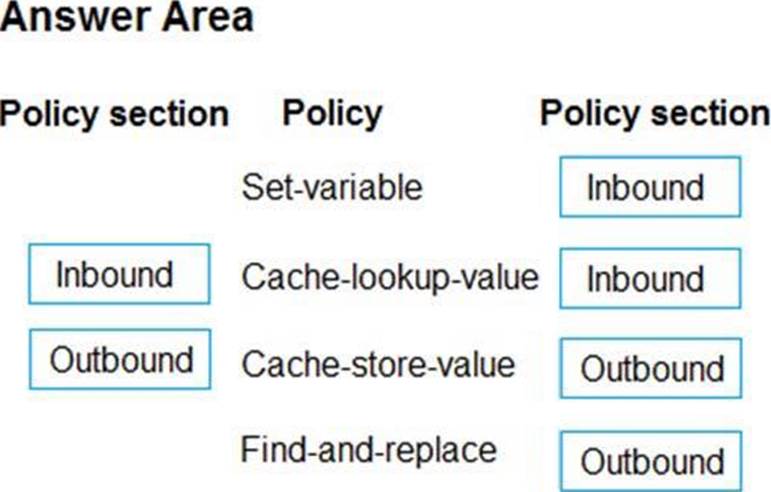
Box 1: Inbound.
A set-variable policy to store the detected user identity.
Example:
<policies>
<inbound>
<!-- How you determine user identity is application dependent -->
<set-variable
name="enduserid"
value="@(context.Request.Headers.GetValueOrDefault("Authorization","").Split('
')[1].AsJwt()?.Subject)" />
Box 2: Inbound
A cache-lookup-value policy
Example:
<inbound>
<base />
<cache-lookup vary-by-developer="true | false"
vary-by-developer-groups="true | false"
downstream-caching-type="none | private | public"
must-revalidate="true | false">
<vary-by-query-parameter>parameter name</vary-by-query-parameter>
<!-- optional, can repeated several times -->
</cache-lookup>
</inbound>
Box 3: Outbound
A cache-store-value policy.
Example:
<outbound>
<base />
<cache-store duration="3600" />
</outbound>
Box 4: Outbound
A find-and-replace policy to update the response body with the user profile information.
Example:
<outbound>
<!-- Update response body with user profile-->
<find-and-replace
from='"$userprofile$"'
to="@((string)context.Variables["userprofile"])" />
<base />
</outbound>
Reference:
https://docs.microsoft.com/en-us/azure/api-management/api-management-caching-policies
https://docs.microsoft.com/en-us/azure/api-management/api-management-sample-cache-by-key
Question 59Written Answer
DRAG DROP
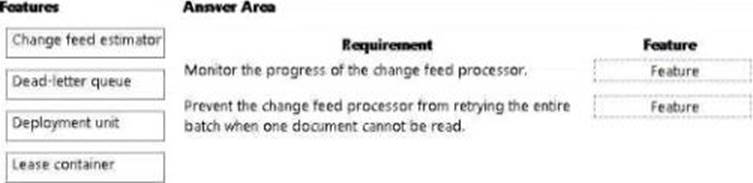
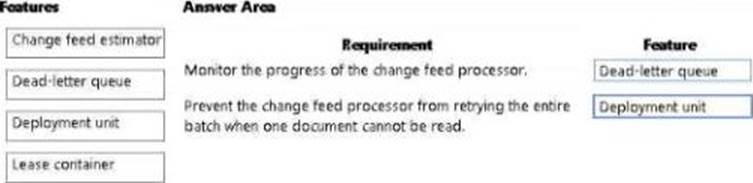
You are Implementing an Azure solution that uses Azure Cosmos DB and the latest Azure Cosmos DB SDK. You add a change feed processor to a new container instance.
You attempt to lead a batch of 100 documents. The process falls when reading one of the documents. The solution must monitor the progress of the change feed processor instance on the new container as the change feed is read. You must prevent the change feed processor from retrying the entire batch when one document cannot be read.
You need to implement the change feed processor to read the documents.
Which features should you use? To answer, drag the appropriate features to the correct requirements. Each feature may be used once, More than once, or not at all. You may need to drag The split bat between panes or scroll to view content
Each correct selection is worth one point
Answer:
Explanation:
Text, letter
Description automatically generated
Question 60Written Answer
DRAG DROP
You need to implement the Log policy.
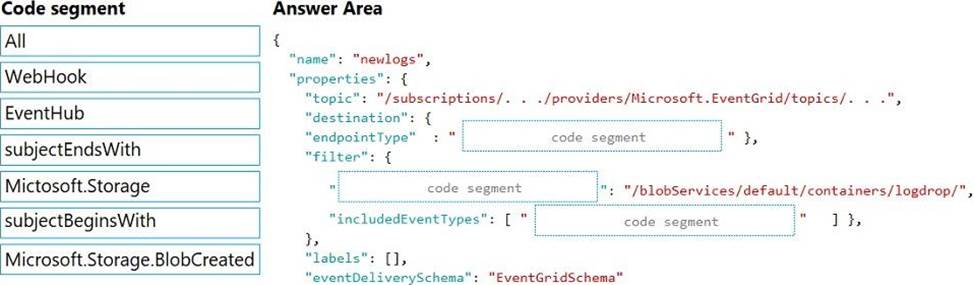
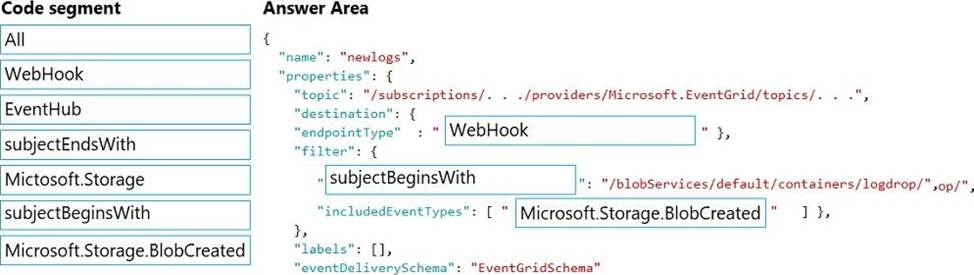
How should you complete the Azure Event Grid subscription? To answer, drag the appropriate JSON segments to the correct locations. Each JSON segment may be used once, more than once, or not at all. You may need to drag the split bar between panes to view content. NOTE: Each correct selection is worth one point.
Answer:
Explanation:
Box 1: WebHook
Scenario: If an anomaly is detected, an Azure Function that emails administrators is called by using an HTTP WebHook.
endpointType: The type of endpoint for the subscription (webhook/HTTP, Event Hub, or queue).
Box 2: SubjectBeginsWith
Box 3: Microsoft.Storage.BlobCreated
Scenario: Log Policy
All Azure App Service Web Apps must write logs to Azure Blob storage. All log files should be saved to a container named logdrop. Logs must remain in the container for 15 days.
Example subscription schema
{
"properties": {
"destination": {
"endpointType": "webhook",
"properties": {
"endpointUrl":
"https://example.azurewebsites.net/api/HttpTriggerCSharp1?code=VXbGWce53l48Mt8wuo
tr0GPmyJ/nDT4hgdFj9DpBiRt38qqnnm5OFg=="
}
},
"filter": {
"includedEventTypes": [ "Microsoft.Storage.BlobCreated", "Microsoft.Storage.BlobDeleted" ],
"subjectBeginsWith": "blobServices/default/containers/mycontainer/log",
"subjectEndsWith": ".jpg",
"isSubjectCaseSensitive ": "true"
}
}
}