

What Does the LLM-ACP Exam Cover? Domains, Skills and Preparation Tips
Edina 10-16-2026
Preparing for the Alibaba Cloud Certified LLM Engineer (Professional) certification requires a solid understanding of large language model development, prompt engineering, RAG, fine-tuning, AI agents, and production deployment. To help candidates prepare effectively, PassQuestion's most valid LLM-ACP Exam Guide with Practice Test Questions provides focused preparation based on the key knowledge areas covered by the exam. The practice questions can help you review important concepts, identify knowledge gaps, and become more familiar with the types of scenarios you may encounter during your certification preparation.
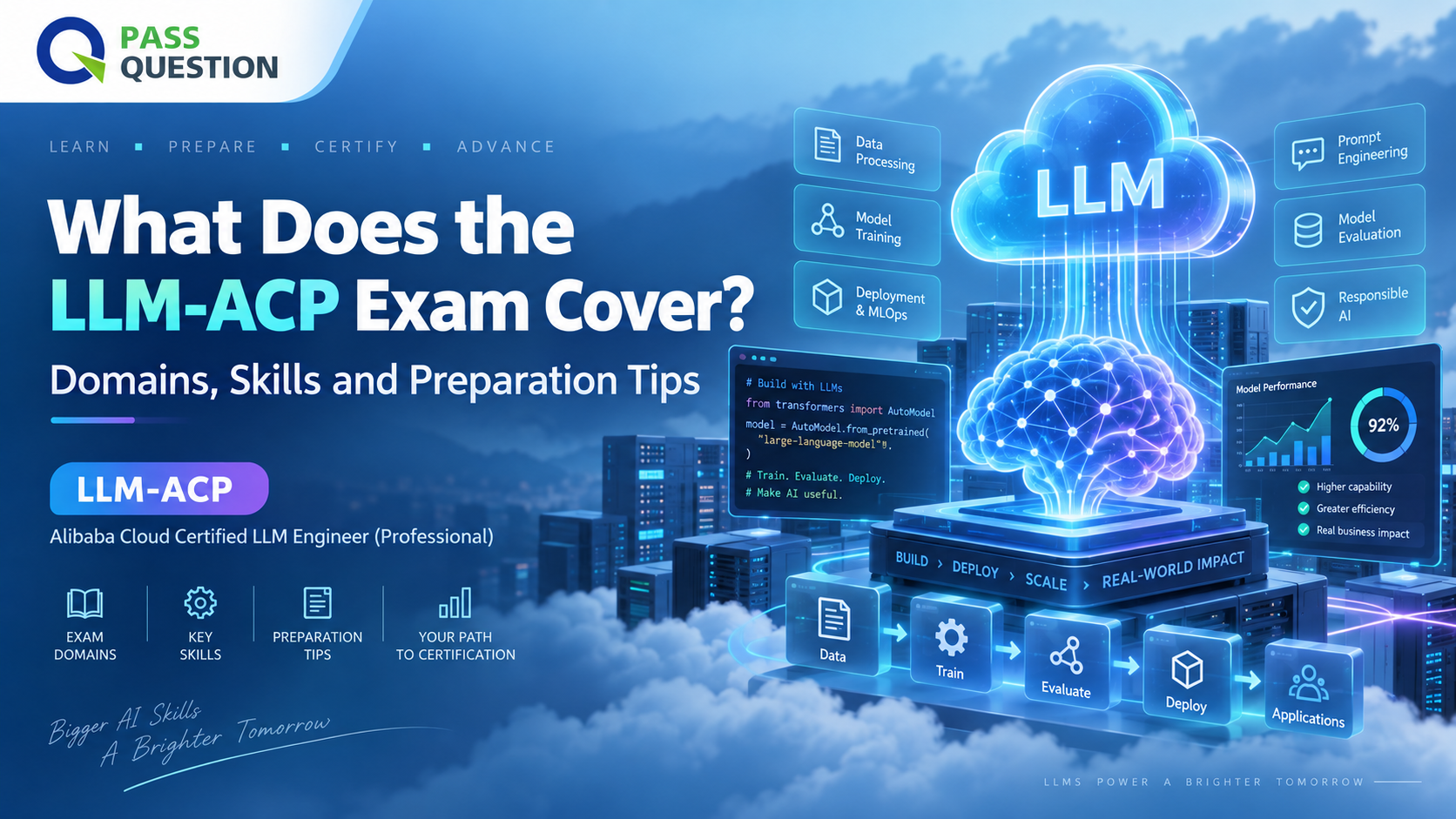
What Is the Alibaba Cloud Certified LLM Engineer (Professional) Certification?
The Alibaba Cloud Certified LLM Engineer (Professional) certification is designed for generative AI enthusiasts and application developers who have a programming foundation. According to the provided certification materials, the program focuses on developing the ability to design and implement large language model-driven solutions for complex business scenarios.
The certification covers the complete lifecycle of LLM applications, from accessing model services and designing effective prompts to building RAG systems, fine-tuning models, developing AI agents, and deploying applications in production environments.
LLM-ACP Exam Overview
The LLM-ACP exam is identified by the exam code LLM-ACP and evaluates candidates across six major areas of LLM engineering.
| Exam Detail | Information |
|---|---|
| Certification | Alibaba Cloud Certified LLM Engineer (Professional) |
| Exam Code | LLM-ACP |
| Exam Duration | 120 minutes |
| Number of Questions | 75 questions |
| Passing Score | 80 out of 100 points |
| Language | English |
| Test Type | Offline or online test |
Candidates can choose the available examination format through the designated exam platform.
LLM-ACP Exam Domains and Weighting
The exam syllabus is divided into six knowledge areas. Understanding their weighting can help candidates organize their study time more efficiently.
| Exam Domain | Weight |
|---|---|
| LLM Application Development | 17% |
| LLM Prompt Engineering | 15% |
| LLM Retrieval-Augmented Generation | 20% |
| LLM Fine-Tuning | 16% |
| AI Agent Applications | 16% |
| Production Practices and Security Compliance | 16% |
LLM Retrieval-Augmented Generation carries the highest weighting at 20%, while the remaining domains each account for 15–17% of the exam.
LLM Application Development
This domain covers the fundamentals of building applications that interact with large language models through APIs.
Candidates should understand:
- Calling LLMs through APIs
- Basic API parameters such as model, temperature, and top_p
- Batch and streaming generation
- Message structures
- Conversation history
The goal is to understand how LLM services can be integrated into practical applications and how different API settings influence application behavior.
LLM Prompt Engineering
Prompt engineering focuses on creating effective instructions that help LLMs produce useful and consistent responses.
Key areas include:
- Prompt frameworks
- Prompt elements and separators
- Prompt templates
- System prompts
- Designing prompts for specific application scenarios
- Using LLMs for tasks such as batch classification, document review, and automatic revision
Candidates should be able to select appropriate prompting techniques according to different business requirements.
LLM Retrieval-Augmented Generation
RAG is one of the most important areas in the LLM-ACP exam, accounting for 20% of the exam.
The syllabus emphasizes building and optimizing RAG systems, including:
- File parsing
- Text chunking
- Retrieval
- Reranking
- Sentence-window retrieval
- Auto-merging retrieval
- Continuous RAG optimization
- Text parsing and content enhancement
- RAG evaluation
Candidates should understand how different retrieval strategies affect the quality and reliability of LLM-generated responses.
LLM Fine-Tuning
This domain evaluates knowledge of fine-tuning concepts, requirements, experiments, and evaluation.
Important topics include:
- Purpose of fine-tuning
- Fine-tuning prerequisites
- Basic fine-tuning steps
- Common fine-tuning algorithms
- Dataset construction
- Parameter configuration
- Model evaluation
A strong understanding of when fine-tuning is appropriate can help candidates distinguish it from approaches such as prompt engineering and RAG.
AI Agent Applications
The AI Agent Applications domain focuses on building more capable AI applications using agents and tools.
The syllabus includes:
- Building agents with Model Studio APIs
- Complex workflows
- Multi-agent applications
- Alibaba Cloud AI solutions
- AI applications in areas such as healthcare, education, and entertainment
Candidates should understand how agents can combine models, tools, and workflows to perform more complex tasks than a simple LLM interaction.
Production Practices and Security Compliance
The final domain focuses on moving LLM applications from development into production while considering performance, cost, stability, and security.
Key topics include:
- Deploying fine-tuned models on Alibaba Cloud
- Model deployment with vLLM
- Elastic Compute Service (ECS)
- Platform for AI (PAI)
- Model Studio
- Publishing AI assistants
- Function Compute (FC)
- Performance and cost balancing
- Application stability
- Security and compliance
This domain is particularly important for understanding the practical considerations involved in operating LLM applications in real-world environments.
What Knowledge and Skills Does LLM-ACP Validate?
The certification materials indicate that candidates should be able to:
- Build AI applications using large model service APIs
- Apply effective prompt engineering techniques
- Extend LLM knowledge using RAG
- Expand model capabilities through plugins and tools
- Improve model performance through fine-tuning
- Evaluate LLM applications using engineering-level methods
- Apply production practices to large language model applications
These capabilities represent a progression from LLM application development to production-ready generative AI solutions.
How to Prepare for the LLM-ACP Exam
1. Build a Strong LLM Foundation
Start with the fundamentals of LLM application development, including API calls, model parameters, message structures, and streaming or batch generation.
2. Give Extra Attention to RAG
Because RAG represents 20% of the exam, spend sufficient time reviewing retrieval pipelines, chunking, reranking, retrieval optimization, and evaluation methods.
3. Practice Prompt Engineering and Fine-Tuning
Understand how prompt design and fine-tuning can improve model performance. Focus on the situations where each approach is appropriate rather than memorizing isolated concepts.
4. Study AI Agents and Production Scenarios
Review agent workflows, tools, multi-agent applications, and Alibaba Cloud AI services. Also understand deployment, performance, cost, stability, and security considerations.
5. Use LLM-ACP Practice Test Questions
After reviewing the syllabus, use LLM-ACP Practice Test Questions from PassQuestion to check your understanding across all six domains. Scenario-based questions can help you practice applying LLM concepts to realistic application-development and deployment situations.
Prepare for Success in the LLM-ACP Exam
The Alibaba Cloud Certified LLM Engineer (Professional) certification covers much more than basic knowledge of large language models. It evaluates a broad set of skills spanning application development, prompt engineering, RAG, fine-tuning, AI agents, and production practices.
A structured preparation strategy is therefore essential. Combine Alibaba Cloud's learning resources with hands-on practice and the LLM-ACP Exam Guide with Practice Test Questions from PassQuestion to systematically review the exam objectives, strengthen weak areas, and build greater confidence before taking the certification exam.
- TOP 50 Exam Questions
-
Exam
All copyrights reserved 2026 PassQuestion NETWORK CO.,LIMITED. All Rights Reserved.
Passquestion doesn't offer Real Microsoft, Amazon, Cisco Exam Questions. All Passquestion content is sourced from the Internet.