

SC-730 Cybersecurity Business Professional Exam: Complete Preparation Guide
Edina 06-01-2026
Preparing for the SC-730 Cybersecurity Business Professional exam is a smart step for non-technical business users who want to understand everyday cybersecurity risks and protect organizational data more effectively. To help candidates prepare with confidence, the most valid Cybersecurity Business Professional SC-730 Practice Test Questions from PassQuestion provide focused coverage of the latest exam objectives, including cybersecurity awareness, phishing detection, privacy expectations, data protection, access control, incident reporting, and basic response actions. These practice questions help you become familiar with the exam format, strengthen role-relevant security knowledge, identify weak areas, and improve your readiness to pass the SC-730 exam more easily.
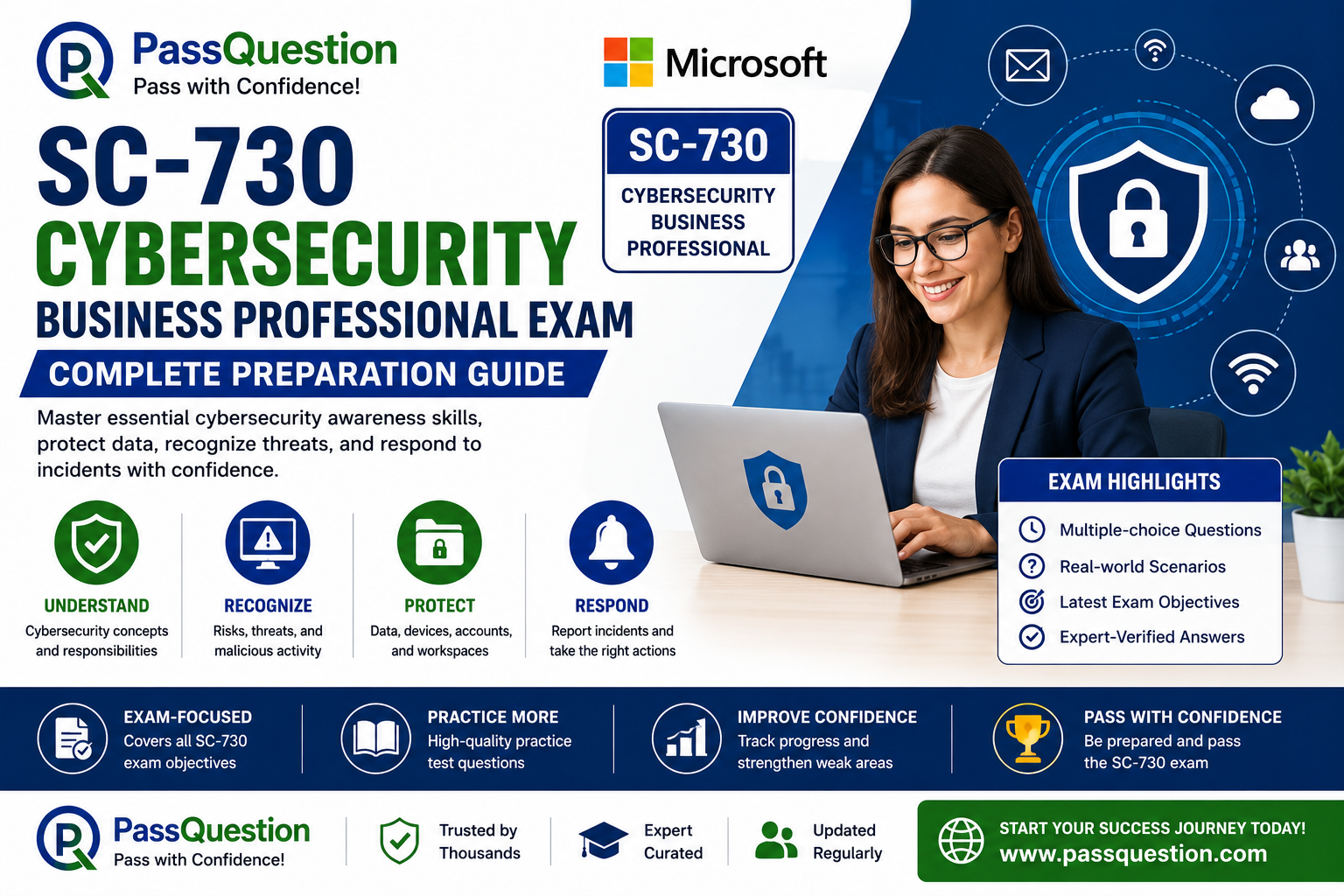
SC-730 Cybersecurity Business Professional Exam Overview
The SC-730: Cybersecurity Business Professional exam is designed for business professionals who use digital tools, cloud services, collaboration platforms, mobile devices, and connected systems in their daily work but are not cybersecurity specialists. Microsoft describes the target candidate as someone who works in roles such as administration, analysis, project management, marketing, or sales and regularly handles sensitive data while collaborating across networks.
This Microsoft Certified: Cybersecurity Business Professional certification focuses on practical cybersecurity awareness rather than deep technical security operations. Candidates need to understand common threats, basic protection methods, privacy responsibilities, safe data-handling practices, and when to report suspicious activity.
Who Should Take the SC-730 Exam?
The SC-730 exam is ideal for professionals who rely on digital systems every day but have limited formal cybersecurity training. Suitable candidates include:
- Administrative staff
- Business analysts
- Project managers
- Sales professionals
- Marketing professionals
- Operations staff
- Team leads and business users
- Anyone who handles sensitive business or customer data
This exam is especially valuable for professionals who want to mitigate cyber risks, adhere to company security policies correctly, and enhance their ability to identify suspicious activity.
Key Skills Measured in the SC-730 Exam
Understand cybersecurity concepts (25–30%)
Explain roles and responsibilities in cybersecurity
- Explain the cybersecurity shared responsibility model
- Identify activities that demonstrate employee participation in security awareness initiatives within an organization
- Describe accountability practices
- Identify activities that enhance security
Apply simple organizational policies and data-handling standards
- Understand security and privacy policies applicable to work tasks
- Identify types of data that shouldn’t be shared with AI tools
- Describe the benefits of using a password manager to protect credentials
Describe security benefits and risk awareness
- Describe the security benefits of using multifactor authentication
- Identify business processes that may be targeted or infiltrated by threat actors
- Describe the risks of working in a remote environment
- Understand the importance of required software updates and security patches
- Describe the impact of security events, such as ransomware
Define cybersecurity concepts and emerging threats
- Define the terms vulnerability, threat, risk, encryption, and exploit
- Describe what deepfakes are
Understand cybersecurity risks and threats (30–35%)
Identify common cybersecurity risks
- Describe the risks associated with using public Wi-Fi networks
- Describe psychological social engineering techniques, such as phishing, pretexting, and baiting
Detect indicators of malicious activity
- Identify indicators of malware
- Identify potential indicators of insider threats
- Describe abnormal system behavior or infection symptoms
Evaluate and verify digital communications
- Identify suspicious emails, malicious links, and unexpected attachments
- Identify potential privacy and security risks
- Verify the legitimacy of requests for access, payments, or sensitive data
Apply access controls
- Identify appropriate controls to limit access to systems and data
Apply basic security policies to protect the organization (25–30%)
Understand the basics of securing devices, accounts, and workspaces
- Understand the basics of securing remote and mobile devices and workspaces, including using strong passwords, multifactor authentication, and other essential security practices
Understand how to protect sensitive and proprietary data
- Recognize and classify sensitive data
- Understand the different types of document sensitivity labeling and when to apply each
- Understand rights management
Understand safe internet and data-handling practices
- Apply proper data-handling techniques
- Understand how to collect, use, transfer, store, retain, and destroy data
Understand backup and recovery measures
- Understand how to help ensure that data is backed up to support recovery from incidents
- Identify and follow basic recovery measures for data loss or system issues
Report and respond to security incidents (10–15%)
Report on security incidents and policy violations
- Identify situations that require reporting (for example, a phishing attempt, a lost device, or unauthorized access)
- Select the correct information to include in a report (for example, the date, type of incident, and affected data)
- Choose the appropriate reporting channel (for example, email, help desk, or incident form)
Take appropriate action during data breaches
- Follow basic steps when a breach occurs (for example, stop sharing data, disconnect devices, and notify IT)
- Recognize when escalation is required (for example, sensitive data exposure or a ransomware incident)
Best Preparation Strategies for the SC-730 Exam
Start by reviewing the SC-730 skills outline and focusing on the highest-weighted domain: Understand cybersecurity risks and threats, which accounts for 30–35% of the exam. Microsoft's study guide explains that the exam is designed to help candidates focus on covered topics and understand what to expect.
Next, practice with updated SC-730 Practice Test Questions from PassQuestion to understand the question style and reinforce important concepts. Pay attention to scenario-based questions involving phishing emails, suspicious links, sensitive data handling, public Wi-Fi, lost devices, and incident reporting.
You should also review your organization's typical security policies if available, including password rules, MFA requirements, data classification rules, acceptable use policies, and incident reporting channels. The exam focuses on practical business-user behavior, so real workplace examples can help you understand the concepts more clearly.
Prepare Smarter for the SC-730 Cybersecurity Business Professional Exam
The SC-730 Cybersecurity Business Professional exam is a practical Microsoft certification designed for business users who want to enhance their cybersecurity awareness and mitigate daily workplace risks. It validates foundational skills in recognizing threats, protecting sensitive data, following organizational policies, and responding correctly to incidents.
With a clear study plan, regular review of security concepts, and the most valid Cybersecurity Business Professional SC-730 Practice Test Questions from PassQuestion, candidates can prepare more effectively and approach the exam with confidence.
- TOP 50 Exam Questions
-
Exam
All copyrights reserved 2026 PassQuestion NETWORK CO.,LIMITED. All Rights Reserved.
Passquestion doesn't offer Real Microsoft, Amazon, Cisco Exam Questions. All Passquestion content is sourced from the Internet.