

NSE6_FSR_AN-7.6 Exam Questions: Fortinet NSE 6 – FortiSOAR 7.6 Analyst Prep Guide
Edina 10-23-2026
The NSE6_FSR_AN-7.6 Fortinet NSE 6 – FortiSOAR 7.6 Analyst exam validates the practical skills required to develop security automation playbooks, configure modules and connectors, manage incident-handling workflows, and troubleshoot FortiSOAR environments. To help you prepare effectively, the most up-to-date NSE6_FSR_AN-7.6 Exam Guide with Practice Test Questions from PassQuestion provides focused preparation aligned with the exam objectives, covering FortiSOAR architecture and data models, playbook development, incident handling, APIs and connectors, and troubleshooting. By combining scenario-based practice questions with hands-on experience, candidates can strengthen their ability to automate security operations and respond to incidents efficiently.
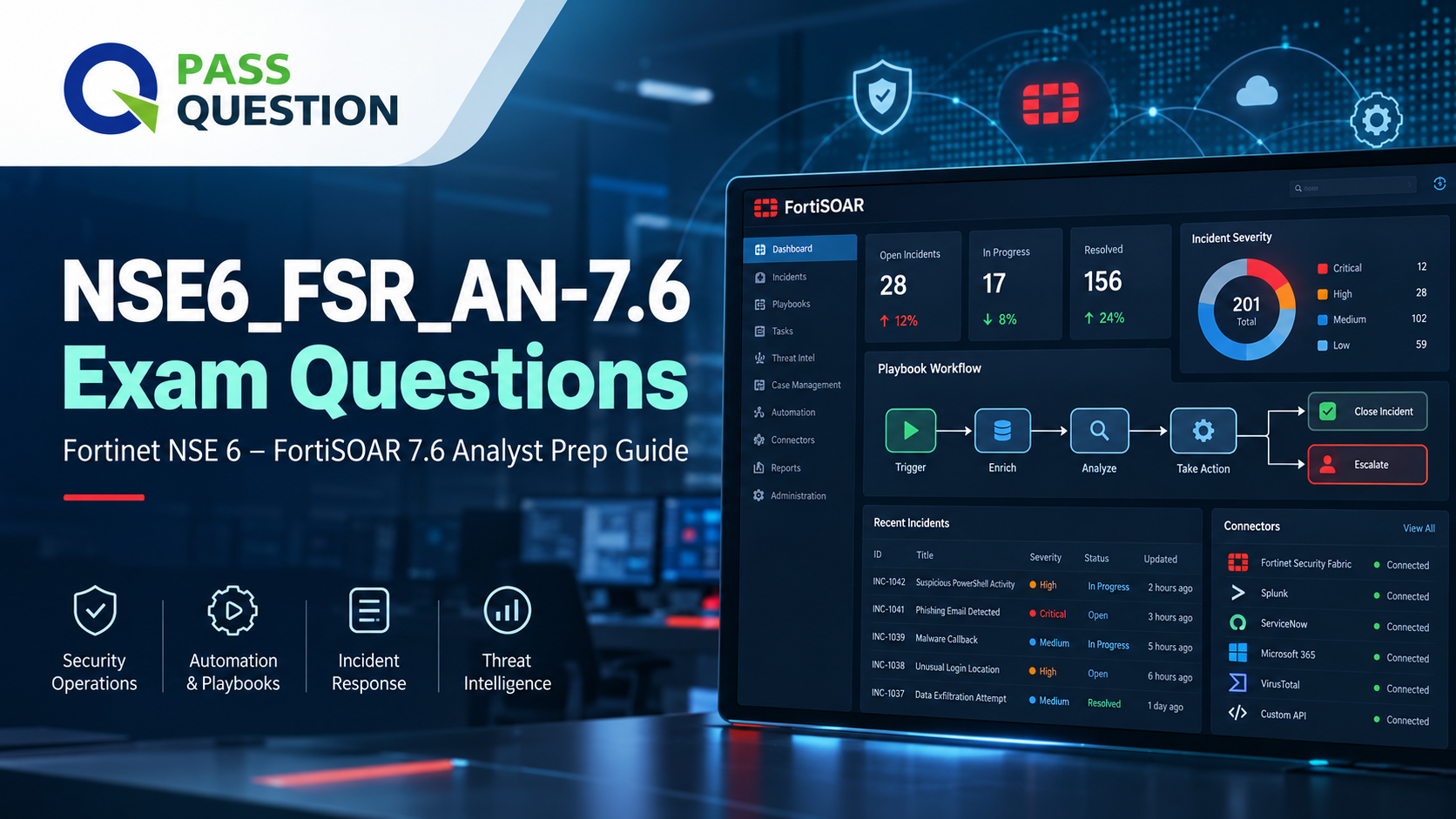
What Is the NSE6_FSR_AN-7.6 FortiSOAR Analyst Exam?
The NSE6_FSR_AN-7.6 exam is a proctored NSE 6 Security Operations exam designed for cybersecurity professionals who use FortiSOAR to automate and orchestrate security operations. It focuses on the technical capabilities needed to develop playbooks, customize the platform, integrate security tools, and coordinate incident response.
FortiSOAR helps security teams automate repetitive operational tasks, integrate security and network tools, enrich incident data, and coordinate response activities. The analyst role requires more than understanding the platform interface: candidates should be able to design playbook logic, manipulate data, configure integrations, and investigate automation failures.
NSE6_FSR_AN-7.6 Exam Details
| Exam Detail | Information |
|---|---|
| Exam Code | NSE6_FSR_AN-7.6 |
| Exam Name | Fortinet NSE 6 – FortiSOAR 7.6 Analyst |
| Product Version | FortiSOAR 7.6 |
| Exam Duration | 75 minutes |
| Number of Questions | 35–45 questions |
| Scoring | Pass or fail |
| Language | English |
| Delivery | Proctored exam through Pearson VUE |
The exam uses a pass-or-fail scoring model, with a score report available through the candidate's Pearson VUE account.
Who Should Take the FortiSOAR 7.6 Analyst Exam?
The NSE6_FSR_AN-7.6 exam is intended for network and security professionals responsible for developing automation playbooks, creating modules and dashboards, configuring integrations, and performing security incident handling.
Typical candidates include:
- Security Operations Center (SOC) Analysts
- Security Automation Engineers
- FortiSOAR Administrators
- Incident Response Specialists
- Security Operations Engineers
- Cybersecurity Technical Consultants
- Security Platform Integration Engineers
Fortinet recommends at least six months of practical experience with FortiSOAR playbook development, module and dashboard creation, and incident handling. Candidates should also be comfortable with JSON, Jinja templating, APIs, and security operations workflows.
NSE6_FSR_AN-7.6 Exam Topics and Weighting
The official exam blueprint identifies five major knowledge areas. Candidates should use the published weighting ranges to prioritize their preparation.
| Exam Domain | Weight |
|---|---|
| FortiSOAR Architecture and Data Models | 20–30% |
| Playbook Development | 25–35% |
| Incident Handling | 5–15% |
| APIs and Connectors | 15–25% |
| Troubleshooting | 15–25% |
Playbook Development is one of the most important areas, followed by FortiSOAR architecture and data models. API integration and troubleshooting also deserve significant attention because they are essential to maintaining reliable security automation workflows.
1. FortiSOAR Architecture and Data Models (20–30%)
This domain evaluates your understanding of FortiSOAR's architecture, deployment models, data structures, access controls, and user interface customization.
Candidates should understand:
- FortiSOAR system architecture and deployment models
- Automation and orchestration concepts
- Navigation and Content Hub functionality
- SOAR and SIEM use cases and differences
- Modules, records, fields, and relationships
- Solution pack content and visual correlation
- Users, roles, teams, and record ownership
- Templates, dashboards, and widgets
A key skill is understanding how FortiSOAR organizes security information and how platform configuration supports operational workflows.
For example, candidates should be able to determine how access controls should be implemented for different teams or how modules and their relationships support incident investigation.
2. Playbook Development (25–35%)
Playbook Development is a major exam domain. It focuses on building automation workflows that process security data, apply conditional logic, and execute appropriate actions.
Key topics include:
- Playbook basics, steps, and logic design
- Data ingestion and preprocessing rules
- Conditional logic using if/elif/else statements
- Loops, for-each operations, and loop variables
- Step utility actions and operators
- Jinja filters and expressions
- Dynamic variables, values, and functions
- JSON queries and YAQL statements
- Differences between JSON and YAQL query approaches
Candidates should understand how to construct workflows that make decisions based on input data and perform the required automation actions.
For instance, a playbook might ingest an alert, evaluate its attributes, enrich the associated indicators, and route the incident to the appropriate response workflow. Candidates should know how to configure the logic and data transformations needed to support this process.
3. Incident Handling (5–15%)
This domain focuses on using FortiSOAR to coordinate incident response and manage security investigations.
Candidates should understand:
- FortiSOAR incident phases
- Incident-handling workflows
- MITRE ATT&CK Framework integration
- Queue and shift assignment
- War room management
- Correlating records across modules
- Visual correlation and incident phase mapping
The main objective is to understand how FortiSOAR supports structured incident management, task assignment, investigation, and collaboration.
Candidates should also understand how related records and threat information can be connected to give analysts a more complete view of an incident.
4. APIs and Connectors (15–25%)
This domain evaluates the ability to integrate FortiSOAR with other security products and external systems.
Important topics include:
- REST API requests and responses
- FortiSOAR API usage
- FortiManager API integration
- Custom connector configuration
- HTTP methods for create, read, update, and delete operations
- REST API triggers
- Differences between REST and JSON-RPC APIs
- Connector creation workflows
API and connector knowledge is essential for automating security operations across multiple tools.
For example, a playbook may need to retrieve information from an external security platform, update an incident record, and initiate a response action. Candidates should understand how APIs, authentication, and connector configuration enable these interactions.
5. Troubleshooting (15–25%)
This domain focuses on identifying and resolving problems that affect playbook execution and connector operations.
Candidates should understand:
- Playbook logging levels
- Executed playbook logs
- Step input and output data
- Evaluated arguments
- Troubleshooting Jinja expressions
- Key log files
- Service status checks
- Common playbook and connector issues
A systematic troubleshooting approach is important. Instead of changing multiple configurations without evidence, candidates should inspect logs, validate data transformations, review step inputs and outputs, and identify the point where execution fails.
Understanding Jinja expressions and how data moves between playbook steps is particularly useful when investigating automation failures.
How to Prepare for the NSE6_FSR_AN-7.6 Exam
1. Master FortiSOAR Architecture and Data Models
Start by reviewing deployment models, modules, records, fields, relationships, roles, and teams. Understand how these components support incident management and automation.
2. Practice Building Playbooks
Spend significant time on playbook logic, conditions, loops, data ingestion, preprocessing rules, and utility actions. Practice using Jinja filters and dynamic variables to transform data within workflows.
3. Strengthen JSON, YAQL, and API Knowledge
Review JSON queries, YAQL statements, REST API operations, and connector configuration. Understand how FortiSOAR communicates with external systems and how integrations support automated response workflows.
4. Review Incident Handling and Troubleshooting
Practice incident phases, queue assignment, war rooms, record correlation, and MITRE ATT&CK mapping. Learn how to troubleshoot failed playbooks by inspecting logs, evaluating arguments, and checking connector and service status.
5. Use NSE6_FSR_AN-7.6 Practice Test Questions
Use the NSE6_FSR_AN-7.6 Exam Guide with Practice Test Questions from PassQuestion to review the five exam domains and evaluate your understanding of key FortiSOAR concepts.
Scenario-based practice can help you recognize the appropriate automation approach, choose suitable integration methods, and identify likely causes of playbook failures. Combine practice questions with Fortinet's official training materials and hands-on labs for a more complete preparation strategy.
Prepare for the NSE6_FSR_AN-7.6 FortiSOAR Analyst Exam
The Fortinet NSE 6 – FortiSOAR 7.6 Analyst exam validates the practical skills required to automate security operations, develop playbooks, integrate security tools, manage incidents, and troubleshoot FortiSOAR environments.
To prepare effectively, prioritize playbook development and FortiSOAR architecture, while also strengthening your knowledge of incident handling, APIs, connectors, and troubleshooting. Combine hands-on experience with official Fortinet documentation and the NSE6_FSR_AN-7.6 Exam Guide with Practice Test Questions from PassQuestion to identify knowledge gaps and build confidence before exam day.
- TOP 50 Exam Questions
-
Exam
All copyrights reserved 2026 PassQuestion NETWORK CO.,LIMITED. All Rights Reserved.
Passquestion doesn't offer Real Microsoft, Amazon, Cisco Exam Questions. All Passquestion content is sourced from the Internet.