

NetSec-Architect Certification Guide: Master Palo Alto Networks Security Architecture
Edina 04-21-2026
Preparing for the Palo Alto Networks Network Security Architect (NetSec-Architect) certification requires not only deep technical knowledge but also strong architectural thinking. To accelerate your preparation, the most valid and up-to-date NetSec-Architect exam questions from PassQuestion provide a practical and efficient way to understand real exam patterns, key scenarios, and critical design concepts. These carefully curated questions simulate the actual exam environment, helping candidates strengthen their decision-making skills, improve accuracy, and confidently approach complex architecture-based questions. By combining structured study with high-quality Palo Alto Networks NetSec-Architect exam questions, you can significantly enhance your chances of success on the first attempt.
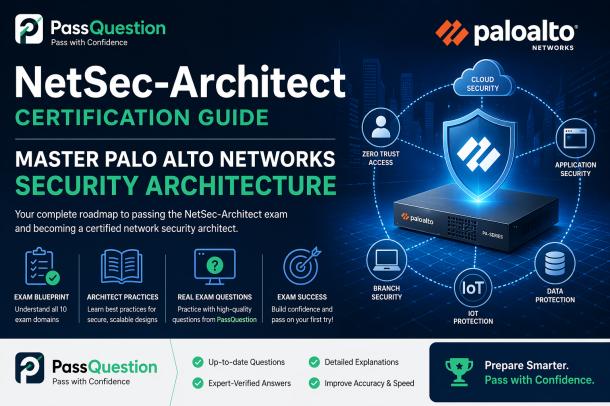
Overview of the Palo Alto Networks Certified Network Security Architect Credential
The Palo Alto Networks Certified Network Security Architect certification is an advanced-level credential designed for experienced professionals who architect secure, scalable, and highly available network security solutions. Offered by Palo Alto Networks, this certification validates both technical expertise and strategic design capabilities.
Unlike entry- or mid-level certifications, this exam focuses heavily on:
- Designing end-to-end security architectures
- Integrating multiple security platforms across hybrid environments
- Applying industry frameworks such as Zero Trust and SASE
- Aligning security strategies with compliance and organizational goals
This certification proves that you can design, lead, and optimize enterprise security infrastructures, not just manage them.
Ideal Candidate Profile: Who Should Pursue the NetSec-Architect Certification?
This certification is tailored for highly experienced professionals who are already working in advanced security roles, such as:
- Senior Network Security Architects
- Cloud Security Architects
- Enterprise Security Consultants
- Experienced Security Engineers transitioning into architecture roles
Candidates are expected to possess:
- At least 5 years of experience designing and implementing security solutions
- A minimum of 2 years of hands-on experience with Palo Alto Networks technologies
- Strong familiarity with Zero Trust, SASE, and hybrid cloud architectures
This is not an entry-level exam—it is designed for professionals who are responsible for strategic security decision-making.
Detailed Exam Structure
Before registering for the NetSec-Architect exam, it's important to understand its structure and requirements:
- Exam Duration: 90 minutes
- Question Format: Multiple-choice (scenario-based)
- Exam Fee: $300 USD
- Delivery Platform: Pearson VUE
- Language: English
The exam heavily emphasizes real-world architectural scenarios, where you must evaluate requirements and select the most effective design solution rather than simply recall facts.
In-Depth Breakdown of NetSec-Architect Exam Domains and Core Knowledge Areas
The NetSec-Architect exam covers a wide range of advanced topics:
1. Zero Trust Enterprise (8%)
1.1 Design User-ID and device health, host information profile (HIP) and security posture, and Device-IDbased least privilege access Security policy controls
1.2 Design and differentiate between network segmentation and microsegmentation
1.3 Differentiate access to specific applications
1.4 Implement continuous security scanning of allowed traffic to stop malware and exploits
1.5 Implement continuous monitoring and analytics of zero trust environment
2. AI Security (11%)
2.1 Differentiate between and explain the specific Palo Alto Networks products that make up Prisma AI Runtime Security (AIRS) and AI Access
2.2 Determine recommended standard architectures for AI security
2.3 Identify and explain the classification and attributes of AI applications and apply security controls
3. Centralized Management and IAM (13%)
3.1 Architect Panorama and log collectors
3.2 Architect Strata Cloud Manager (SCM), Strata Logging Service, and Cloud Identity Engine
3.3 Recommend Cloud Identity Engine directory sync options
3.4 Recommend Strata Logging Service log forwarding methods and integrations (e.g., syslog over TLS, HTTP, email)
3.5 Recommend User identification and authentication methods (e.g., Cloud Identity Engine, CAS for SAML)
3.6 Evaluate Cloud Identity Engine use cases
4. SSE Private Application Access (11%)
4.1 Architect Prisma Access in regional and global deployments
4.2 Differentiate between on-ramp and off-ramp architectures
4.3 Determine private application access through Prisma Browser
5. Mobile User Security (7%)
5.1 Evaluate Prisma Browser, Prisma Access Agent, explicit proxy, and GlobalProtect use cases
5.2 Architect GlobalProtect connection methods: On-demand, User-logon (Always On), Pre-logon (Always On)
5.3 Architect Prisma Access Mobile Users
5.4 Design AI-Powered Autonomous Digital Experience Manager (ADEM)
6. Modernizing Branches 11%
6.1 Compare and design branch architectures for SASE security and HA
6.2 Evaluate advanced security for Prisma SD-WAN
7. Data Security (7%)
7.1 Differentiate between SaaS Security Inline and SaaS API Security
7.2 Determine the most secure approach for SaaS application usage control
7.3 Analyze and architect to Enterprise DLP functionality
8. Securing IoT Environments 11%
8.1 Architect Device Security
8.2 Differentiate between IoT sensor placement options
8.3 Explain visibility functionality (e.g., NGFW, virtual metadata collector, Prisma SD-WAN, PAN-OS SD-WAN)
8.4 Evaluate and design to Device-ID capabilities
8.5 Confirm and design to Device Security capabilities
9. Public Cloud 11%
9.1 Explain NGFW standard integrations, including AWS, Azure, GCP, and OCI
9.2 Design for maintenance and security across CSP environments
9.3 Design to AWS NGFW standards
9.4 Design to Azure NGFW standards
9.5 Design to GCP NGFW standards
9.6 Justify VM-Series and Cloud NGFW solutions
10. Private Cloud (PA-Series, VM-Series, Hypervisors) 10%
10.1 Assess private cloud scope and capacity requirements
10.2 Design VM-Series deployments across hypervisors (e.g., AHV, KVM, ESXi)
10.3 Evaluate SSL decryption versus performance trade-offs
10.4 Architect HA deployment for private cloud resilience
10.5 Explain Layer 3 deployment routing considerations
10.6 Evaluate systems management options and considerations
10.7 Evaluate new hardware deployment trending and scoping
10.8 Evaluate SSL inspection sizing requirements
Why the NetSec-Architect Exam Is Considered One of the Most Challenging Certifications
This certification stands out due to its complexity and depth. Candidates must:
- Apply architecture-level thinking rather than operational knowledge
- Analyze and compare multiple design solutions
- Understand enterprise-scale environments and constraints
- Integrate security, networking, cloud, and business requirements into one cohesive design
Even seasoned professionals find this exam demanding without focused preparation.
Proven Strategies to Prepare Efficiently and Pass the NetSec-Architect Exam
1. Build an Architecture-First Mindset Instead of Relying on Memorization
Rather than focusing on isolated facts, train yourself to think like a security architect. Understand how different technologies fit together, evaluate trade-offs, and justify design decisions based on business and security requirements.
2. Deeply Understand Core Security Frameworks and Design Principles
Master key concepts such as Zero Trust, SASE, and cloud security architecture. These frameworks are heavily tested, and a solid understanding will help you confidently approach complex scenario-based questions.
3. Strengthen Hands-On Experience with Real Palo Alto Networks Solutions
Work directly with tools like Prisma Access, Panorama, and VM-Series firewalls. Practical experience allows you to better understand real deployment challenges and makes it easier to analyze exam scenarios accurately.
4. Use Verified PassQuestion Exam Questions for Focused and Efficient Practice
Practice with high-quality, up-to-date questions that reflect the actual exam format. This helps you become familiar with question styles, improve accuracy, and quickly identify weak areas that need further review.
5. Simulate Real Exam Conditions to Improve Speed and Confidence
Practice answering questions within a strict time limit to replicate the real exam environment. This builds confidence, enhances time management skills, and reduces pressure on exam day.
Final Thoughts: Elevate Your Career with the NetSec-Architect Certification
The NetSec-Architect certification is one of the most advanced credentials in network security, proving your ability to design enterprise-grade solutions using Palo Alto Networks technologies. It requires a combination of technical depth, architectural thinking, and real-world experience.
With the right strategy—especially leveraging accurate and updated PassQuestion exam questions—you can streamline your preparation, focus on what truly matters, and approach the exam with confidence.
If your goal is to become a top-tier network security architect, this certification is a powerful step forward.
- TOP 50 Exam Questions
-
Exam
All copyrights reserved 2026 PassQuestion NETWORK CO.,LIMITED. All Rights Reserved.
Passquestion doesn't offer Real Microsoft, Amazon, Cisco Exam Questions. All Passquestion content is sourced from the Internet.