

Model Context Protocol Associate (MCPA) Exam Guide: Build and Validate Your MCP Knowledge
Edina 09-29-2026
The Model Context Protocol Associate (MCPA) certification is a new vendor-neutral credential from the Agentic AI Foundation (AAIF) and Linux Foundation Education for practitioners who want to validate their understanding of how MCP connects AI applications, agents, tools, and external data sources. To help you prepare well for success, the most valid Model Context Protocol Associate (MCPA) Exam Guide with Practice Test Questions from PassQuestion provides focused preparation for MCP architecture, hosts, clients, servers, tools, resources, prompts, interaction lifecycles, JSON-RPC message flow, security, permissions, trust boundaries, governance, observability, and real-world MCP adoption scenarios. Because the exam focuses on how the protocol actually works rather than on one vendor's SDK, candidates should be ready to reason about protocol behavior, component responsibilities, and safe implementation patterns.
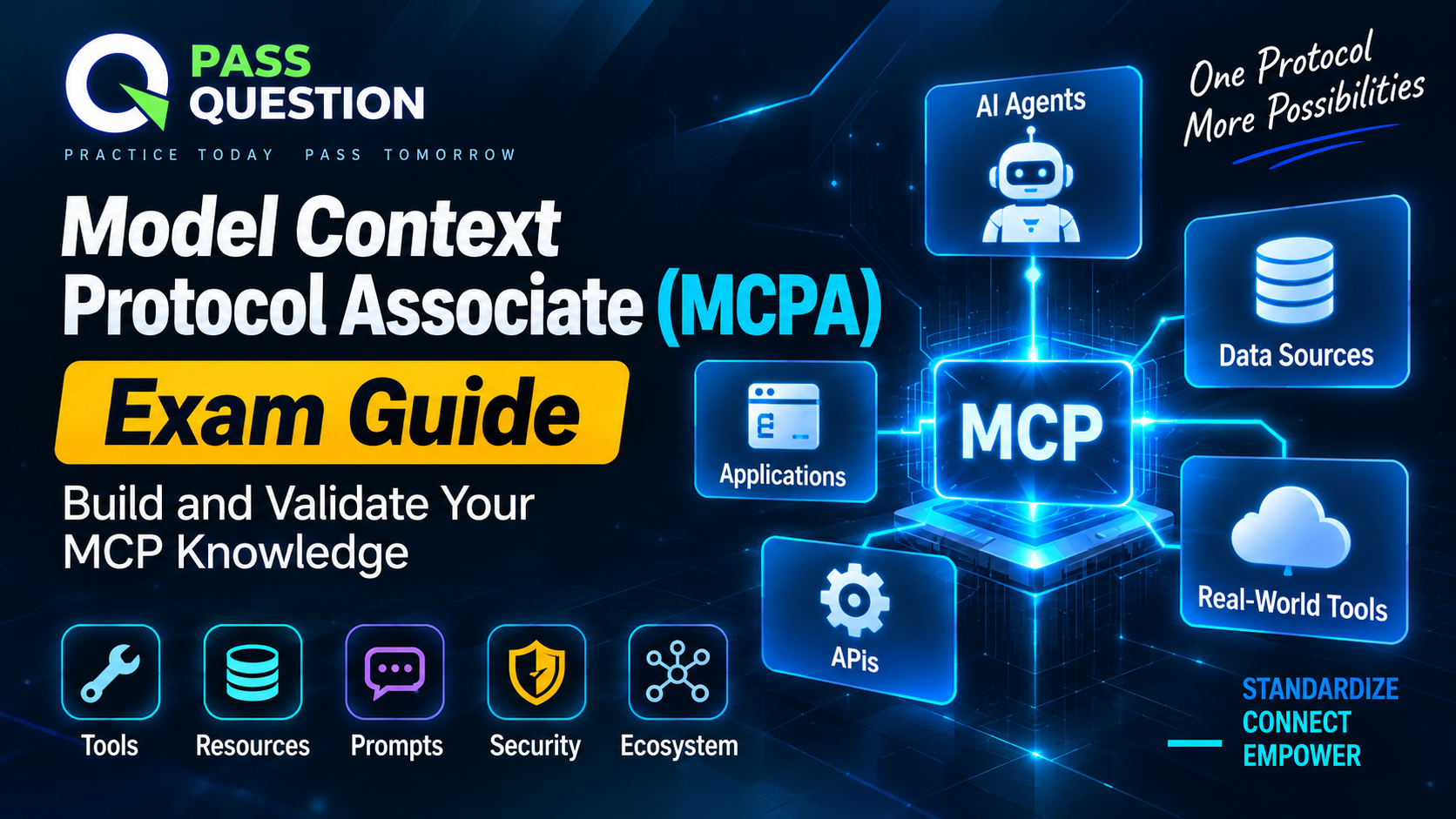
What Is the Model Context Protocol Associate (MCPA) Certification?
The MCPA is a foundational certification designed to prove that you understand core MCP concepts, use cases, and implementation considerations. The Linux Foundation describes MCP as an increasingly important standard for connecting AI applications to external tools, services, and data sources, while reducing the need for custom integration code.
The certification is especially relevant as organizations move beyond standalone chatbots and begin building agentic AI systems that must interact safely with APIs, databases, enterprise tools, and external services.
A successful MCPA candidate should understand:
- MCP clients and servers
- Hosts and model interaction flow
- Tools, resources, and prompts
- Interaction and execution lifecycles
- Protocol primitives
- Permissions and consent
- Trust boundaries
- Security and governance
- Operational use cases
- MCP portability and ecosystem adoption
Who Should Take the MCPA Exam?
The MCPA is positioned at the beginner level, but it is particularly useful for candidates already working with AI applications, APIs, agentic systems, or platform engineering.
Typical candidates include:
- AI application developers
- Agentic AI developers
- Platform engineers
- AI integration engineers
- Backend developers
- Solution architects
- DevOps and infrastructure engineers
- AI governance professionals
- Security engineers working with AI systems
The Linux Foundation does not require formal prerequisites, but it recommends familiarity with several technical areas before attempting the exam.
Recommended Background Before Taking MCPA
Candidates should ideally have:
- Foundational knowledge of JSON-RPC or similar message-based protocols
- Experience working with LLM APIs
- Understanding of agentic AI concepts such as tool use and ReAct-style workflows
- Basic security knowledge, including API keys, OAuth 2.1, tokens, and authentication headers
- Ability to interpret MCP server manifests and capability definitions
These are not formal prerequisites, but they make the exam much easier to approach.
MCPA Exam Details
| Exam Detail | Information |
|---|---|
| Certification | Model Context Protocol Associate |
| Acronym | MCPA |
| Experience Level | Beginner |
| Exam Format | Online, proctored, multiple choice |
| Duration | 90 minutes |
| Exam Price | $250 USD |
| Certification Validity | 2 years |
| Exam Eligibility | 12 months |
| Retake | One retake included |
| Prerequisites | None |
MCPA Exam Domains at a Glance
The exam is divided into five domains:
| Domain | Weight |
|---|---|
| MCP Fundamentals | 16% |
| Architecture & Components | 14% |
| Interactions & Execution | 26% |
| Security & Governance | 24% |
| Use Cases & Ecosystem | 20% |
The largest sections are Interactions & Execution and Security & Governance, which together represent half of the exam.
1. MCP Fundamentals — 16%
This domain focuses on the purpose of Model Context Protocol, the problems it solves, and why standardization matters for agentic AI. You should understand MCP's role in connecting AI applications with external tools, data, and services in a consistent way.
2. Architecture & Components — 14%
This section covers the core structure of an MCP system. Candidates should know the roles of hosts, clients, and servers, how they interact, and how MCP capabilities such as tools, resources, and prompts fit into the overall architecture.
3. Interactions & Execution — 26%
This is the largest exam domain and focuses on how MCP communication works in practice. Key areas include protocol primitives, tool invocation, request and response flow, execution lifecycles, error handling, and how results are returned to the AI application.
4. Security & Governance — 24%
This domain measures your understanding of trust boundaries, permissions, user consent, risk controls, auditability, and observability. You should know how to limit agent access, protect sensitive capabilities, and maintain visibility into MCP activity.
5. Use Cases & Ecosystem — 20%
This section focuses on where MCP fits in real-world AI systems. You should understand common adoption scenarios, operational use cases, ecosystem roles, portability, and how MCP helps different AI applications and services interoperate.
How to Prepare for the MCPA Exam
1. Master the MCP Architecture
Start with the basic structure of MCP and make sure you can clearly distinguish the roles of hosts, clients, and servers. Understanding how these components communicate will make the interaction and security topics much easier to learn.
2. Focus on Tools, Resources, and Prompts
These are core MCP primitives, so you should know what each one represents and when it is used. Practice identifying whether a scenario describes an executable capability, contextual data, or a reusable prompt template.
3. Understand Interaction and Execution Flow
Because Interactions & Execution is the largest exam domain, spend extra time on request/response flow, tool invocation, execution lifecycles, protocol messages, and error handling. Scenario-based questions may test what happens at each stage.
4. Strengthen Security and Governance Knowledge
Review trust boundaries, permissions, consent, authentication, access control, auditability, and observability. For every MCP scenario, think about who is allowed to use a capability, what data is exposed, and what actions should be logged.
5. Study Real-World MCP Use Cases
Practice mapping MCP concepts to practical scenarios such as enterprise assistants, developer tools, API integration, knowledge access, and workflow automation. This helps you understand why MCP is useful beyond just learning definitions.
6. Review the Current MCP Specification
MCP continues to evolve, so make sure your study materials align with the specification version referenced by the current MCPA exam. Avoid relying only on older tutorials or outdated implementation examples.
7. Use Valid MCPA Practice Test Questions
Use MCPA Practice Test Questions from PassQuestion to check your understanding of architecture, protocol primitives, execution flow, security, and ecosystem scenarios. After each question, review not just the correct answer, but also why the other options do not fit the MCP responsibility or trust model.
Why the MCPA Certification Is Important for Agentic AI
The Linux Foundation and AAIF launched the MCPA to provide a vendor-neutral benchmark for practitioners working with MCP and agentic AI integrations. The launch announcement highlights the growing need for developers who understand both how MCP works and the security implications of giving agents access to external tools and data.
This is significant because MCP knowledge is increasingly relevant across different AI platforms rather than being tied to a single model provider.
The credential can therefore be useful for professionals working across:
- AI engineering
- Platform engineering
- Agentic application development
- AI security
- AI governance
- Enterprise integration
Final Thoughts: Learn How MCP Works, Not Just How to Use an SDK
The Model Context Protocol Associate (MCPA) exam is fundamentally about understanding the protocol itself.
The best preparation mindset is:
Architecture → Interaction → Security → Use Case
You should be able to identify which MCP component performs a given role, understand how messages and tool invocations flow, recognize where trust boundaries exist, and explain how MCP enables interoperable AI systems.
By combining the latest MCP specification, Linux Foundation resources, hands-on experimentation, and the most valid Model Context Protocol Associate (MCPA) Exam Guide with Practice Test Questions from PassQuestion, you can build the foundational knowledge needed to succeed on the MCPA exam and work more confidently with modern agentic AI integrations.
- TOP 50 Exam Questions
-
Exam
All copyrights reserved 2026 PassQuestion NETWORK CO.,LIMITED. All Rights Reserved.
Passquestion doesn't offer Real Microsoft, Amazon, Cisco Exam Questions. All Passquestion content is sourced from the Internet.