

MC-Con-201 Exam Questions: Salesforce Certified Marketing Cloud Next Consultant Prep Guide
Edina 10-22-2026
The Salesforce Certified Marketing Cloud Next Consultant (MC-Con-201) exam validates the skills required to implement, configure, and optimize Marketing Cloud Next solutions for businesses of different sizes. To help you prepare effectively, the most valid MC-Con-201 Exam Guide with Practice Test Questions from PassQuestion provides focused preparation across the official exam objectives, including platform setup and governance, consent management, Data 360, identity resolution, audience segmentation, campaign orchestration, Agentforce, and marketing analytics. By combining exam-focused practice questions with hands-on experience and Salesforce learning resources, candidates can strengthen their understanding of modern data-driven marketing solutions and prepare for the certification exam.
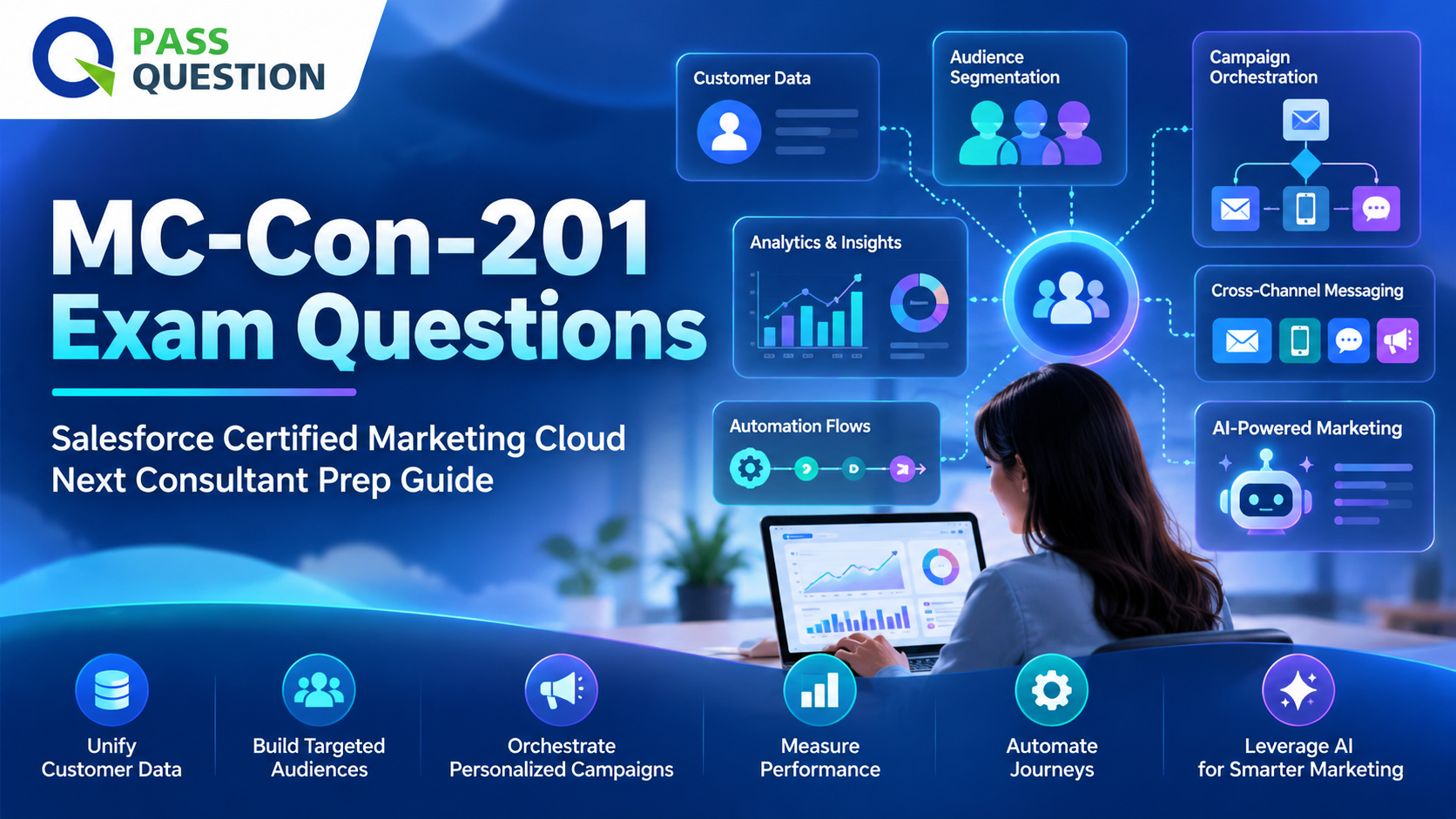
Unlike traditional marketing platform certifications that concentrate primarily on campaign execution, Marketing Cloud Next combines customer data, cross-channel engagement, automation, and AI-powered marketing capabilities within the Salesforce ecosystem. Consultants must understand how these components work together to create personalized customer experiences while maintaining appropriate governance, consent, and data management practices.
What Is the Salesforce Certified Marketing Cloud Next Consultant Exam?
The MC-Con-201 exam focuses on the knowledge and skills needed to design, implement, and optimize Marketing Cloud Next solutions. It is intended for professionals working in consulting, implementation, or customer-facing technical roles.
The certification emphasizes the ability to:
- Configure Marketing Cloud Next environments and governance models.
- Apply consent management and compliance requirements.
- Connect, harmonize, and unify customer data using Data 360.
- Build audience segments and activate customer data for marketing.
- Personalize content across channels using customer information.
- Orchestrate campaigns and messaging with Salesforce Flow.
- Use Agentforce to support campaign creation and conversational engagement.
- Analyze marketing performance through Salesforce reporting and analytics.
The central skill set is the ability to connect customer data with marketing execution. Candidates should understand not only how individual features work, but also how to select the appropriate configuration for a business requirement.
MC-Con-201 Exam Details
| Exam Detail | Information |
|---|---|
| Certification | Salesforce Certified Marketing Cloud Next Consultant |
| Exam Code | MC-Con-201 |
| Question Format | Multiple-choice |
| Exam Questions | 60 scored questions, plus up to 5 unscored questions |
| Exam Duration | 105 minutes |
| Passing Score | 72% |
| Exam Version | Summer '26 release |
| Registration Fee | USD $200, plus applicable taxes |
| Retake Fee | USD $100, plus applicable taxes |
| Delivery | Proctored online or at a testing center |
| Prerequisites | None |
Salesforce recommends combining practical experience with self-study and training. The exam guide identifies approximately six to twelve months of hands-on experience implementing or administering Marketing Cloud Next in a consulting or customer-facing capacity as the recommended background.
The exam is closed-book, and candidates cannot reference hard-copy or online materials during the test. Check the official Salesforce exam guide for the latest registration and delivery details.
MC-Con-201 Exam Objectives and Weighting
The exam is divided into six knowledge domains. Understanding the weighting helps candidates prioritize their preparation.
| Exam Domain | Weight |
|---|---|
| Platform Setup & Governance | 13% |
| Consent | 13% |
| Data Modeling, Identity Resolution & Segmentation | 25% |
| Campaign Design, Flow Orchestration & Content | 30% |
| Agentforce & AI Innovation | 11% |
| Analytics & Performance Insights | 8% |
Campaign Design, Flow Orchestration & Content is the largest domain at 30%, followed by Data Modeling, Identity Resolution & Segmentation at 25%. Together, these two areas account for 55% of the exam and deserve particular attention during preparation.
1. Platform Setup & Governance — 13%
This domain focuses on preparing Marketing Cloud Next for business use and establishing the appropriate governance structure.
Candidates should understand:
- Core Salesforce organization requirements and Data 360 provisioning.
- Marketing Data Kit installation and permission sets.
- Business Unit selection and configuration.
- User access, roles, content governance, and Enhanced CMS Workspaces.
- Domain authentication and authorization for branded email delivery.
- DKIM and SPF requirements for authenticated sending.
The key is to understand how organizational structure, permissions, content management, and email authentication work together. In scenario-based questions, candidates may need to determine when separate Business Units are appropriate or how to configure governance for different teams.
2. Consent — 13%
Consent management helps organizations respect customer preferences and meet applicable compliance requirements.
This domain covers:
- Consent management concepts.
- The purpose and relationships of consent-related platform objects.
- Creating, managing, and updating consent records.
- Configuring consent banners on marketing landing pages and external pages.
- Supporting consent collection throughout customer engagement.
Candidates should understand how consent information is captured and maintained and how marketing activities should reflect customer preferences.
For example, a business may need to collect consent on a landing page and ensure that the resulting preferences are represented correctly in the platform. The appropriate configuration depends on the collection method and the intended use of the consent data.
3. Data Modeling, Identity Resolution & Segmentation — 25%
This is the second-largest exam domain and a foundational area for Marketing Cloud Next.
Candidates should understand how Data 360 connects customer information from different sources and makes that information available for segmentation and personalization.
Important topics include:
- Data Model Objects (DMOs) and their relationships.
- Data ingestion, mapping, and harmonization.
- CRM objects, records, and Actionable Lists.
- Identity Resolution and unified customer profiles.
- Audience segmentation and activation.
- Data 360 consumption-based entitlements.
- The impact of marketing automation design on platform consumption.
Identity Resolution is especially important because customer information may originate from multiple systems. Candidates should understand how identity rules help connect records into unified profiles and how those profiles support more effective audience targeting.
Preparation should also cover how data modeling and ingestion decisions affect downstream segmentation, activation, and platform usage.
4. Campaign Design, Flow Orchestration & Content — 30%
This is the largest MC-Con-201 domain. It focuses on designing marketing campaigns, automating business processes, and delivering personalized content across channels.
Candidates should understand:
- Handlebars, AMPscript, merge fields, repeaters, and content variations.
- Cross-channel campaign and messaging personalization.
- Salesforce Flow types, triggers, and configuration settings.
- Flow elements, conditions, and business logic.
- Selecting appropriate data sources for personalized messages.
- Activation templates and contact point values.
- Landing page components and configuration.
The main challenge is selecting the right combination of data, content, and automation for a given business scenario.
For example, a company may want to send personalized messages to a segmented audience and trigger follow-up activities based on customer interactions. Candidates should understand how to choose the appropriate Flow configuration, retrieve relevant customer data, and personalize the resulting content.
The exam does not expect deep expertise in writing extensive raw AMPscript or complex SQL scripts. Instead, candidates should focus on choosing and configuring the appropriate platform capabilities.
5. Agentforce & AI Innovation — 11%
This domain evaluates how AI capabilities can support marketing operations and customer engagement.
Candidates should understand:
- Automating campaign creation and audience segmentation with marketing agents.
- Generating marketing content using Agentforce.
- Deploying out-of-the-box Agentforce Marketing Agents.
- Configuring conversational messaging.
- Managing response handling and ongoing customer interactions.
- Selecting appropriate predictive AI features.
The emphasis is on applying available AI capabilities to marketing use cases rather than developing custom large language models.
Candidates should understand how marketing agents can help automate campaign workflows and audience generation while maintaining appropriate oversight and governance.
6. Analytics & Performance Insights — 8%
The final domain focuses on interpreting marketing performance and making data-driven decisions.
Candidates should understand:
- Selecting pre-built dashboards for reporting requirements.
- Identifying relevant marketing data and insights.
- Surfacing marketing analytics across the Salesforce platform.
- Using reporting capabilities to support business decisions.
Scenario-based questions may ask which dashboard or reporting approach best meets a particular business requirement. Candidates should focus on matching the available reporting capabilities to the information stakeholders need.
How to Prepare for the Salesforce MC-Con-201 Exam
1. Prioritize Campaign Orchestration and Data 360
Start with the two largest exam domains: Campaign Design, Flow Orchestration & Content (30%) and Data Modeling, Identity Resolution & Segmentation (25%). Review Flow configuration, personalization methods, data modeling, identity resolution, and audience activation.
2. Understand Platform Setup and Governance
Review Business Units, permission sets, Enhanced CMS Workspaces, Data 360 provisioning, and authenticated email delivery. Focus on choosing configurations that meet organizational requirements for access, content management, and data isolation.
3. Study Consent and Customer Data Management
Learn how consent records and consent collection work, and understand how customer data moves through ingestion, harmonization, identity resolution, segmentation, and activation.
4. Review Agentforce and Marketing Analytics
Understand the marketing tasks that Agentforce can support, including campaign creation, content generation, audience generation, and conversational engagement. Also review the available reporting and analytics capabilities.
5. Practice Scenario-Based Questions
The exam emphasizes selecting the right platform capability for a business requirement. Practice scenarios involving governance, data sources, personalization, Flow orchestration, consent, and AI-powered marketing.
Use the MC-Con-201 Exam Guide with Practice Test Questions from PassQuestion to evaluate your knowledge across the six domains, identify weak areas, and reinforce your understanding of practical implementation decisions.
Prepare for the MC-Con-201 Marketing Cloud Next Consultant Exam
The Salesforce Certified Marketing Cloud Next Consultant certification focuses on implementing data-driven marketing solutions that combine customer data, personalized content, automation, and AI-powered engagement.
For effective preparation, prioritize campaign orchestration and Data 360, then strengthen your understanding of platform governance, consent, Agentforce, and analytics. Combine hands-on practice with Salesforce's official learning resources and MC-Con-201 Practice Test Questions from PassQuestion to identify knowledge gaps and improve your readiness for the exam.
- TOP 50 Exam Questions
-
Exam
All copyrights reserved 2026 PassQuestion NETWORK CO.,LIMITED. All Rights Reserved.
Passquestion doesn't offer Real Microsoft, Amazon, Cisco Exam Questions. All Passquestion content is sourced from the Internet.