

HPE3-CL18 Exam: HPE ATP Edge-to-Cloud Architect Certification Path
Edina 11-16-2026
The HPE3-CL18 Edge-to-Cloud – Compute exam is a key requirement in the HPE ATP – Edge-to-Cloud Architect certification path, validating candidates' understanding of HPE compute technologies and their applications in modern enterprise infrastructure. To help candidates prepare effectively, the latest HPE3-CL18 Prep Guide with Practice Test Questions from PassQuestion provides a focused study resource covering essential compute concepts, HPE ProLiant servers, compute management technologies, HPC and AI solutions, liquid cooling, and HPE Synergy. By reviewing these topics and practicing exam-related questions, candidates can strengthen their product knowledge, identify learning gaps, and build confidence for the certification exam.
What Is the HPE3-CL18 Edge-to-Cloud – Compute Exam?
The HPE3-CL18 Edge-to-Cloud – Compute exam evaluates knowledge of HPE compute technologies and their role in modern enterprise infrastructure. Compute is a fundamental part of edge-to-cloud environments, supporting business applications, virtualization, data analytics, AI workloads, and distributed IT operations. Understanding how HPE compute solutions fit into different customer environments is important for professionals working in technical pre-sales, consulting, and infrastructure solution development.
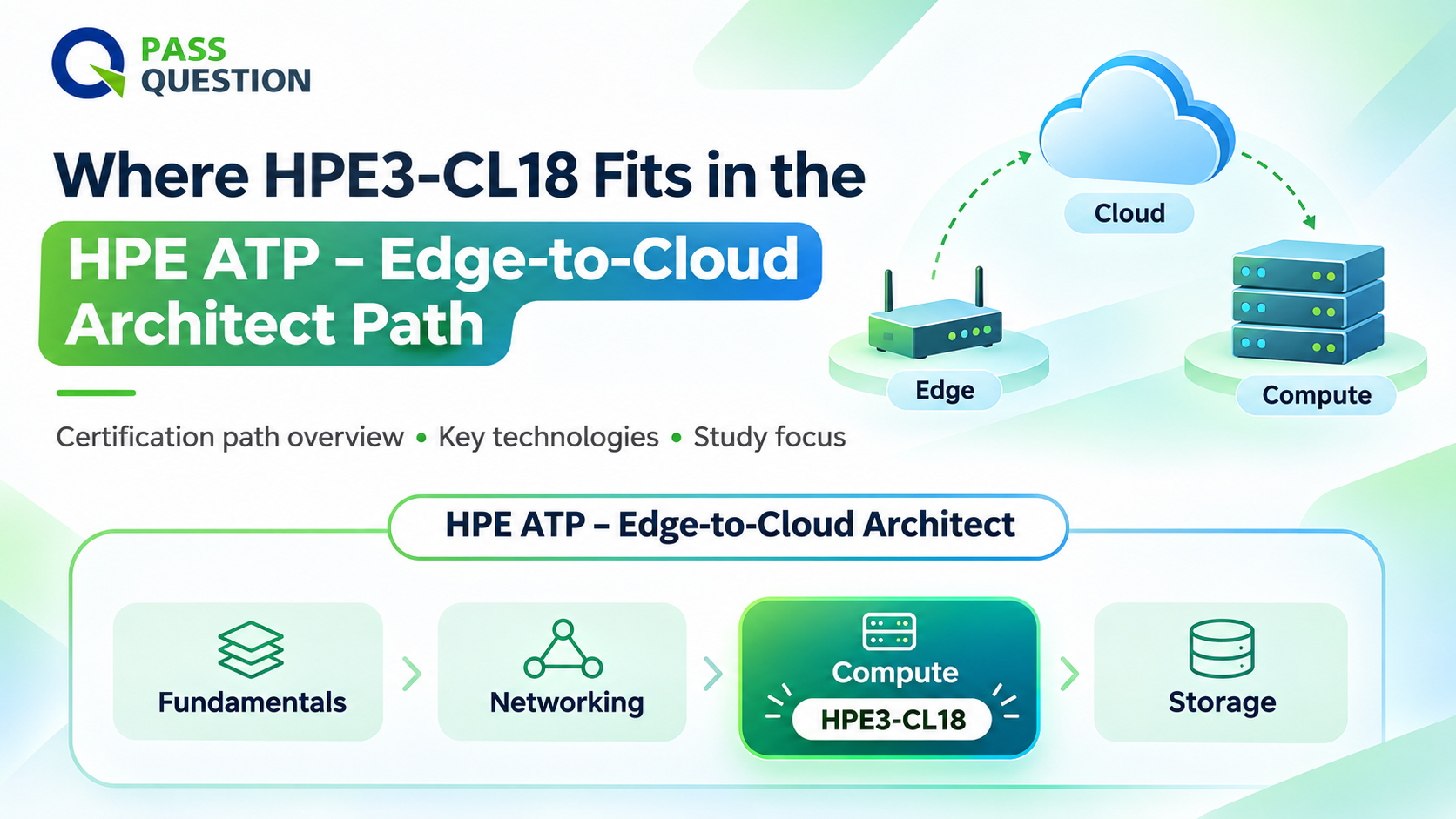
As part of the HPE ATP – Edge-to-Cloud Architect certification path, HPE3-CL18 covers the compute component of a broader certification journey that also includes networking, storage, and edge-to-cloud fundamentals. Candidates should develop an understanding of HPE's compute portfolio, server technologies, management solutions, and how compute resources support different workload requirements.
HPE ATP – Edge-to-Cloud Architect Certification Path
The HPE ATP – Edge-to-Cloud Architect certification is designed to develop foundational knowledge across HPE's enterprise technology portfolio. Unlike a product-specific certification, this path combines compute, networking, storage, and broader edge-to-cloud fundamentals.
According to HPE's certification path updated November 14, 2026, candidates must complete the following requirements:
| Requirement | Exam or Course |
|---|---|
| Compute | HPE3-CL18 – Edge-to-Cloud - Compute Exam |
| Networking | HPE3-CL19 – Introduction to HPE Networking Exam |
| Storage | HPE3-CL01 – Storage Portfolio Exam |
| Fundamentals Training | HPE Edge-to-Cloud Fundamentals, Rev. 26.21 |
| Fundamentals Examination | HPE0-V18 – HPE Edge-to-Cloud Fundamentals |
The recommended training is delivered through Virtual Instructor-Led Training (VILT) or Instructor-Led Training (ILT), with a duration of five days and Course ID 0001215494. Candidates must also pass the HPE0-V18 examination.
Important: Passing HPE3-CL18 alone does not complete the HPE ATP – Edge-to-Cloud Architect certification. It is one of three required learning-path exams, alongside HPE3-CL19 and HPE3-CL01, followed by the HPE Edge-to-Cloud Fundamentals training and HPE0-V18 examination.
HPE3-CL18 Exam Information
| Exam Attribute | Details |
|---|---|
| Exam Code | HPE3-CL18 |
| Exam Name | Edge-to-Cloud - Compute Exam |
| Certification Path | HPE ATP – Edge-to-Cloud Architect |
| Technology Area | HPE Compute |
| Related Exams | HPE3-CL19, HPE3-CL01 |
| Associated Fundamentals Course | HPE Edge-to-Cloud Fundamentals, Rev. 26.21 |
| Course ID | 0001215494 |
| Course Duration | 5 Days |
| Training Delivery | VILT / ILT |
| Fundamentals Exam | HPE0-V18 |
The official HPE3-CL18 exam page is available through the HPE Certification and Learning platform. Its detailed exam duration, question count, passing score, and fee are not included here because they could not be independently verified from the accessible official exam information. Candidates should check the current exam page before registration.
Who Should Take the HPE3-CL18 Exam?
HPE3-CL18 is relevant to professionals who want to develop their knowledge of HPE compute technologies as part of a broader edge-to-cloud solution portfolio.
Suitable candidates include:
- HPE Partner Pre-Sales Engineers: Professionals who recommend and position HPE compute solutions based on customer requirements.
- Solution Architects: Individuals who need to understand compute infrastructure when developing enterprise edge-to-cloud solutions.
- IT Infrastructure Consultants: Professionals who advise customers on server technologies, infrastructure options, and workload requirements.
- Systems Engineers: Technical specialists who work with HPE server platforms and enterprise infrastructure.
- Data Center Professionals: Individuals involved in server infrastructure, virtualization, and data center modernization.
- Technical Sales Professionals: Candidates who want to strengthen their understanding of HPE compute products and their business applications.
The broader HPE Edge-to-Cloud Fundamentals learning path is designed for HPE partners, customers, and employees who need foundational knowledge of HPE server, storage, networking, and management solutions.
Key HPE3-CL18 Study Areas and Compute Knowledge
The HPE3-CL18 exam focuses on compute within the broader edge-to-cloud environment. Although the accessible exam page does not expose a complete domain-weighted blueprint, HPE's associated Edge-to-Cloud Fundamentals training provides useful official compute learning topics.
The following areas are recommended for focused preparation. They are based on HPE's published training outline and should not be interpreted as a separate official HPE3-CL18 exam weighting table.
1. HPE Compute Portfolio and Server Solutions
Candidates should become familiar with HPE's compute portfolio and understand how different server platforms support enterprise workloads.
Important products and technologies covered in HPE's fundamentals training include:
- HPE ProLiant ML servers.
- HPE ProLiant DL servers.
- HPE ProLiant DL XD.
- HPE Edgeline systems.
- HPE Synergy.
- HPE Compute Scale-Up Server.
- HPE Superdome Flex.
Understand the positioning and typical use cases of different compute platforms. For example, customers may have different requirements for general enterprise applications, virtualization, edge workloads, high-performance computing, and AI infrastructure.
A strong understanding of the compute portfolio helps candidates recognize how HPE server solutions can be matched to different business and workload requirements.
2. HPE Compute Management Technologies
Enterprise compute environments require effective management to maintain visibility, simplify administration, and support infrastructure operations.
Candidates should review the following management technologies identified in HPE's training outline:
| Technology | Key Area to Understand |
|---|---|
| HPE Compute Ops Management (COM) | Management of distributed compute environments |
| HPE OneView | Infrastructure management and administration |
| HPE iLO | Server management and remote administration |
Understand the purpose of each management option and how it supports HPE compute solutions.
In particular, review the benefits of the HPE iLO management processor and the role of HPE OneView in managing compute infrastructure. <Cite refs={["turn193208view0"]}/>
3. HPE ProLiant Gen12 Security Features
Server security is an important consideration when designing enterprise infrastructure.
Candidates should become familiar with HPE ProLiant Gen12 security features and understand how server security contributes to protecting enterprise workloads and infrastructure.
Preparation should focus on understanding the security capabilities of the HPE ProLiant portfolio and their relevance to enterprise deployment environments.
4. HPC and AI-Era Compute Workloads
Modern compute environments support increasingly demanding workloads, including high-performance computing (HPC), artificial intelligence, and data-intensive applications.
HPE's fundamentals training identifies several related technologies:
- HPE Cray.
- HPE Compute XD.
- HPE ProLiant XD.
- HPE Slingshot.
- HPE HPC Software Solutions.
Candidates should understand the positioning of these technologies and how specialized compute platforms support HPC and AI-era workloads.
It is also useful to review HPE liquid cooling technologies and their relevance to high-density compute environments.
5. HPE Synergy Solutions
HPE Synergy is another compute-related solution included in the official training outline.
Candidates should understand the main components of HPE Synergy, how they work together, and the types of infrastructure requirements the platform is designed to address.
Focus on understanding the role of Synergy components rather than memorizing product names without understanding their purpose.
6. Compute in Edge-to-Cloud Environments
Compute is one of the three fundamental infrastructure components in an edge-to-cloud architecture, alongside storage and networking.
HPE explains that compute resources provide the processing capability required to run applications, execute instructions, and support workloads across data centers, cloud environments, and edge locations. <Cite refs={["turn684309view0"]}/>
Candidates should understand the relationship between compute resources and different deployment environments:
- On-Premises Compute: Infrastructure deployed within an organization's own data center.
- Cloud Compute: Processing resources delivered through cloud environments.
- Edge Compute: Processing resources positioned closer to users, devices, and data sources.
- Hybrid Compute: A combination of on-premises, cloud, and edge infrastructure.
Understanding these deployment models helps candidates recognize why different customers may require different compute solutions.
How to Prepare for the HPE3-CL18 Exam
A structured preparation strategy should combine HPE product knowledge, compute architecture concepts, and an understanding of the broader edge-to-cloud portfolio.
1. Understand the HPE Edge-to-Cloud Certification Path
Start by understanding how HPE3-CL18 fits into the HPE ATP – Edge-to-Cloud Architect certification.
Review the requirements for HPE3-CL19, HPE3-CL01, and HPE0-V18 as well. This helps establish how compute knowledge connects with networking, storage, and broader infrastructure fundamentals.
2. Study the HPE Compute Portfolio
Review the HPE ProLiant ML and DL server families, Edgeline, Synergy, Compute Scale-Up Server, and Superdome Flex.
Understand their positioning and how different platforms support enterprise workloads.
3. Learn Compute Management Technologies
Focus on HPE Compute Ops Management, HPE OneView, and HPE iLO.
Understand their respective purposes and how they contribute to infrastructure management.
4. Review HPC, AI, and Specialized Compute
Study HPE Cray, HPE Compute XD, HPE ProLiant XD, HPE Slingshot, and HPE liquid cooling technologies.
Pay attention to the requirements of high-performance computing and AI-era workloads.
5. Understand Edge-to-Cloud Workload Requirements
Practice comparing different compute deployment environments and identifying the infrastructure considerations associated with each.
Think about workload performance, scalability, security, management, and where processing should take place.
6. Use HPE3-CL18 Practice Test Questions
The latest HPE3-CL18 Prep Guide with Practice Test Questions from PassQuestion can help candidates review important compute concepts and evaluate their understanding through structured practice.
Use practice questions to reinforce knowledge of HPE server technologies, compute management, specialized workloads, and edge-to-cloud infrastructure concepts.
Attempt each question independently before reviewing the answer and explanation. Revisit unfamiliar topics and use HPE's official product documentation to strengthen your understanding.
Building Your HPE Edge-to-Cloud Compute Expertise
The HPE3-CL18 Edge-to-Cloud – Compute exam represents an important step toward the HPE ATP – Edge-to-Cloud Architect certification. It provides an opportunity for candidates to strengthen their understanding of HPE compute technologies and how they contribute to enterprise infrastructure across data center, cloud, and edge environments.
Successful preparation should go beyond recognizing server product names. Candidates should understand the HPE compute portfolio, management technologies, specialized HPC and AI solutions, and the relationship between compute resources and broader edge-to-cloud requirements. Combining HPE's official training and product documentation with the latest HPE3-CL18 Prep Guide and Practice Test Questions from PassQuestion can help reinforce essential knowledge, identify learning gaps, and build confidence throughout the certification journey.
- TOP 50 Exam Questions
-
Exam
All copyrights reserved 2026 PassQuestion NETWORK CO.,LIMITED. All Rights Reserved.
Passquestion doesn't offer Real Microsoft, Amazon, Cisco Exam Questions. All Passquestion content is sourced from the Internet.