

D-ZT-DS-01 Replaces D-ZT-DS-23: What Changed in Dell Zero Trust Design v2
Edina 09-26-2026
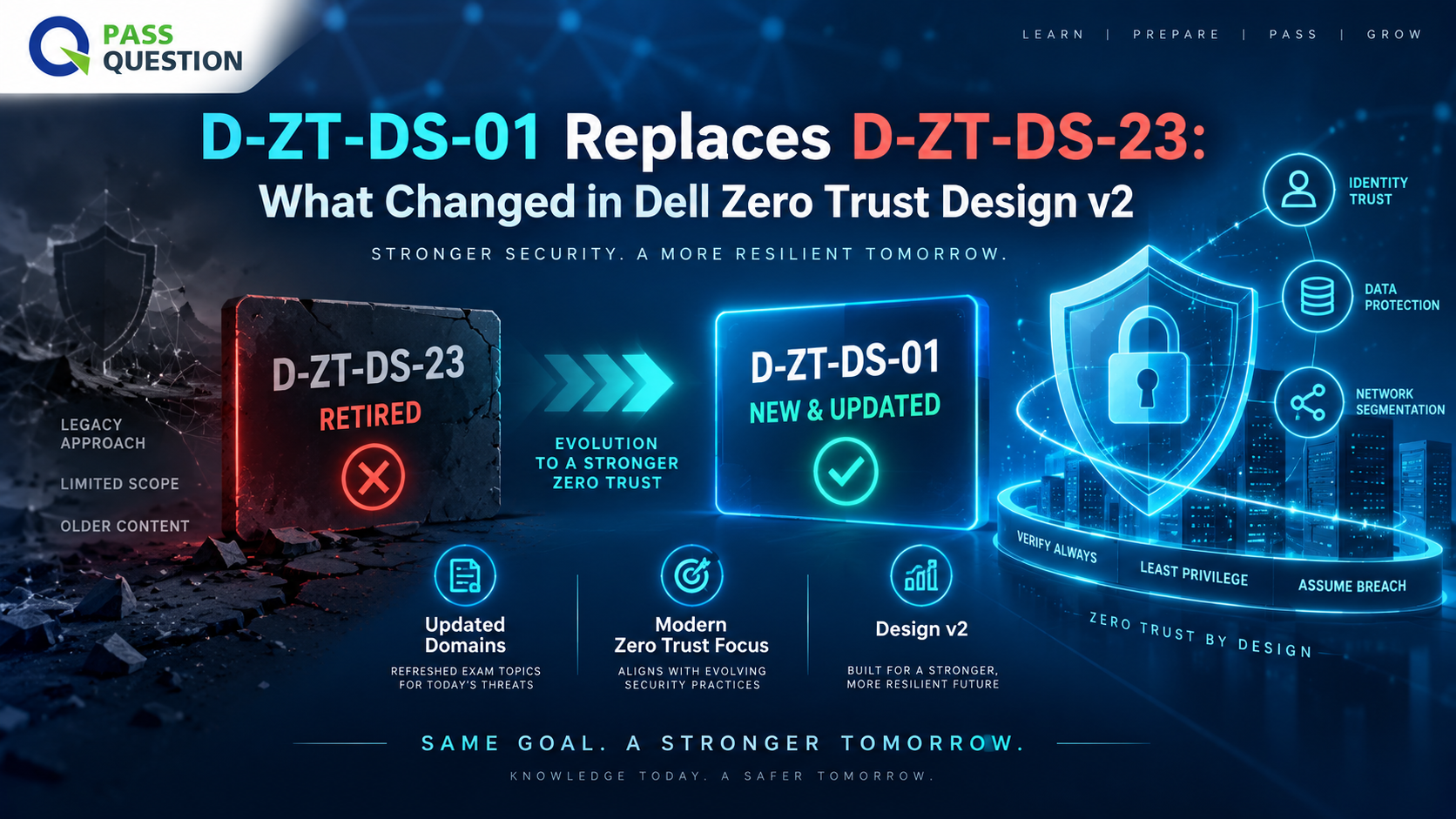
The D-ZT-DS-01 Zero Trust Design v2 Exam is the updated version of Dell's Zero Trust Design certification exam and replaces D-ZT-DS-23, which retired on September 10, 2026. The new D-ZT-DS-01 became available on September 11, 2026. To help you prepare well for success, the most valid D-ZT-DS-01 Exam Guide with Practice Test Questions from PassQuestion provides focused preparation for Zero Trust principles, tenets and pillars, maturity models, implementation roadmaps, network and data-centric design, identity-based Zero Trust, cloud and hybrid environments, AI-enabled Zero Trust, and ongoing monitoring and automation.
What Is the D-ZT-DS-01 Zero Trust Design v2 Exam?
The D-ZT-DS-01 exam validates your ability to design and implement Zero Trust strategies across users, devices, data, applications, networks, cloud environments, and AI-enabled environments. Dell states that candidates should understand Zero Trust principles, architectures, maturity models, implementation approaches, adoption roadmaps, and the use of visibility, analytics, automation, and orchestration to support ongoing operations.
This makes D-ZT-DS-01 a design-focused security exam rather than a narrow product exam. Candidates should be able to look at a business or technical environment, identify trust gaps, and recommend a Zero Trust architecture that reduces risk while still supporting business objectives.
D-ZT-DS-01 Replaces D-ZT-DS-23
Dell officially retired D-ZT-DS-23 on September 10, 2026, with D-ZT-DS-01 available beginning September 11, 2026. Candidates who were still pursuing the older version had to complete scheduling and delivery before its retirement date.
The update is not a complete rewrite of the exam. Most of the previous Zero Trust foundation remains, but the new blueprint shifts some weighting and adds a dedicated Zero Trust in AI domain.
What Changed from D-ZT-DS-23 to D-ZT-DS-01?
The most visible update is the addition of Zero Trust in AI — 6%. At the same time, the weighting of Data Centric Zero Trust decreases from 10% to 8%, and Identity based Zero Trust decreases from 12% to 8%. The major domains such as Introduction to Zero Trust, Tenets and Pillars, Applying Zero Trust, Network Zero Trust, Cloud, Hybrid Zero Trust, and Monitoring and Maintenance remain part of the blueprint.
| Exam Area | D-ZT-DS-23 | D-ZT-DS-01 |
|---|---|---|
| Introduction to Zero Trust | 8% | 8% |
| Zero Trust Tenets and Pillars | 14% | 14% |
| Applying Zero Trust | 22% | 22% |
| Zero Trust in Networks | 12% | 12% |
| Data Centric Zero Trust | 10% | 8% |
| Identity based Zero Trust | 12% | 8% |
| Zero Trust for the Cloud | 4% | 4% |
| Zero Trust in AI | — | 6% |
| Hybrid Zero Trust | 4% | 4% |
| Monitoring and Maintenance | 14% | 14% |
The biggest practical takeaway is that candidates now need to understand how Zero Trust principles extend into AI environments, not just traditional users, devices, applications, networks, data, and cloud.
Who Should Take the D-ZT-DS-01 Exam?
The exam is a strong fit for professionals involved in security architecture, infrastructure design, cloud security, data protection, and technical consulting.
Typical candidates may include:
- Security architects
- Cloud architects
- Infrastructure architects
- Solution architects
- Data protection consultants
- Systems engineers
- Pre-sales engineers
- Implementation specialists
- Storage and infrastructure administrators
Because the exam is design-oriented, candidates should be comfortable evaluating current environments, identifying risks, building adoption roadmaps, and translating Zero Trust principles into practical architecture decisions.
What Should You Focus on Most for the D-ZT-DS-01 Exam?
Not every D-ZT-DS-01 domain deserves the same amount of study time. The exam puts the strongest emphasis on applying Zero Trust in real environments, then builds outward into network, identity, data, AI, cloud, and ongoing monitoring.
1. Applying Zero Trust — Highest Priority
This is the most important domain at 22%. Focus on Zero Trust adoption roadmaps, maturity progression, microsegmentation, Software-Defined Perimeter concepts, identity governance, and how Zero Trust applies across users, devices, applications, workloads, networks, data, and infrastructure.
2. Tenets, Pillars, and Continuous Monitoring
Zero Trust Tenets and Pillars and Monitoring and Maintenance each account for 14%. Make sure you understand the core principles behind Zero Trust decisions and how visibility, analytics, automation, orchestration, and policy improvement support Zero Trust after deployment.
3. Network Zero Trust
At 12%, network design is another major area. Review segmentation, least-privilege connectivity, trust boundaries, policy enforcement, and methods for reducing lateral movement.
4. Identity and Data Protection
Identity Based Zero Trust and Data Centric Zero Trust each represent 8%. Focus on authentication, authorization, least privilege, data classification, access control, and protection of sensitive information.
5. Zero Trust in AI
Although Zero Trust in AI represents 6%, it is the most important new addition in D-ZT-DS-01. Review how Zero Trust applies to AI workloads, automated services, data access, identities, monitoring, and policy enforcement.
6. Cloud and Hybrid Zero Trust
The cloud and hybrid domains have lower individual weights, but they are still important because many scenario questions may combine them with identity, network, and data controls.
Recommended study order:
Applying Zero Trust → Tenets & Pillars / Monitoring → Networks → Identity & Data → AI → Cloud & Hybrid
How to Prepare for the D-ZT-DS-01 Exam
1. Master the Zero Trust Framework
Start with the tenets, pillars, maturity models, and reference architectures. These concepts influence nearly every other domain.
2. Focus on the Implementation Roadmap
Because Applying Zero Trust represents 22% of the exam, spend extra time on maturity progression, implementation sequencing, microsegmentation, SDP, identity governance, and adoption planning.
3. Study Zero Trust Across Different Environments
Practice applying the same principles to network, data, identity, cloud, hybrid, and AI scenarios.
4. Pay Special Attention to Zero Trust in AI
This is the biggest content change in D-ZT-DS-01. Make sure you understand how identity, access, data, monitoring, and policy controls apply to AI workloads and services.
5. Use Valid D-ZT-DS-01 Practice Test Questions
Valid D-ZT-DS-01 Practice Test Questions from PassQuestion can help you work through architecture scenarios involving adoption roadmaps, segmentation, identity, cloud, data protection, AI, and monitoring.
A strong study method is to ask not only which answer is correct, but also why the other options violate Zero Trust principles or maturity goals.
Final Thoughts: D-ZT-DS-01 Brings Zero Trust into the AI Era
The D-ZT-DS-01 Zero Trust Design v2 Exam continues Dell's focus on practical Zero Trust architecture while adding a clear new emphasis on AI-enabled environments.
The exam still expects candidates to understand the full Zero Trust lifecycle:
Understand → Design → Apply → Monitor → Improve
But the updated blueprint now reflects a broader security reality where trust decisions must also account for AI services, automated workloads, and modern hybrid environments.
By reviewing Dell's updated objectives, understanding the differences from D-ZT-DS-23, and using the most valid D-ZT-DS-01 Exam Guide with Practice Test Questions from PassQuestion, you can prepare more effectively for the current Zero Trust Design certification.
- TOP 50 Exam Questions
-
Exam
All copyrights reserved 2026 PassQuestion NETWORK CO.,LIMITED. All Rights Reserved.
Passquestion doesn't offer Real Microsoft, Amazon, Cisco Exam Questions. All Passquestion content is sourced from the Internet.