

Complete AI-200 Certification Guide for Microsoft Azure AI Cloud Developer Associate Exam
Edina 05-26-2026
The AI-200 Developing AI Cloud Solutions on Azure exam is a new Microsoft exam for the Microsoft Certified: Azure AI Cloud Developer Associate certification. It represents Microsoft's shift from traditional Azure development toward AI-powered cloud development. The AZ-204: Developing Solutions for Microsoft Azure exam and its related Azure Developer Associate certification are scheduled to retire on July 31, 2026, and AI-200 is the new direction for developers who want to validate their ability to build, integrate, deploy, secure, and monitor AI solutions on Azure. To help candidates prepare effectively, the most valid AI-200 study guide with practice test questions from PassQuestion covers the latest exam objectives, real-world Azure AI development scenarios, and key technical skills needed to pass the exam successfully.
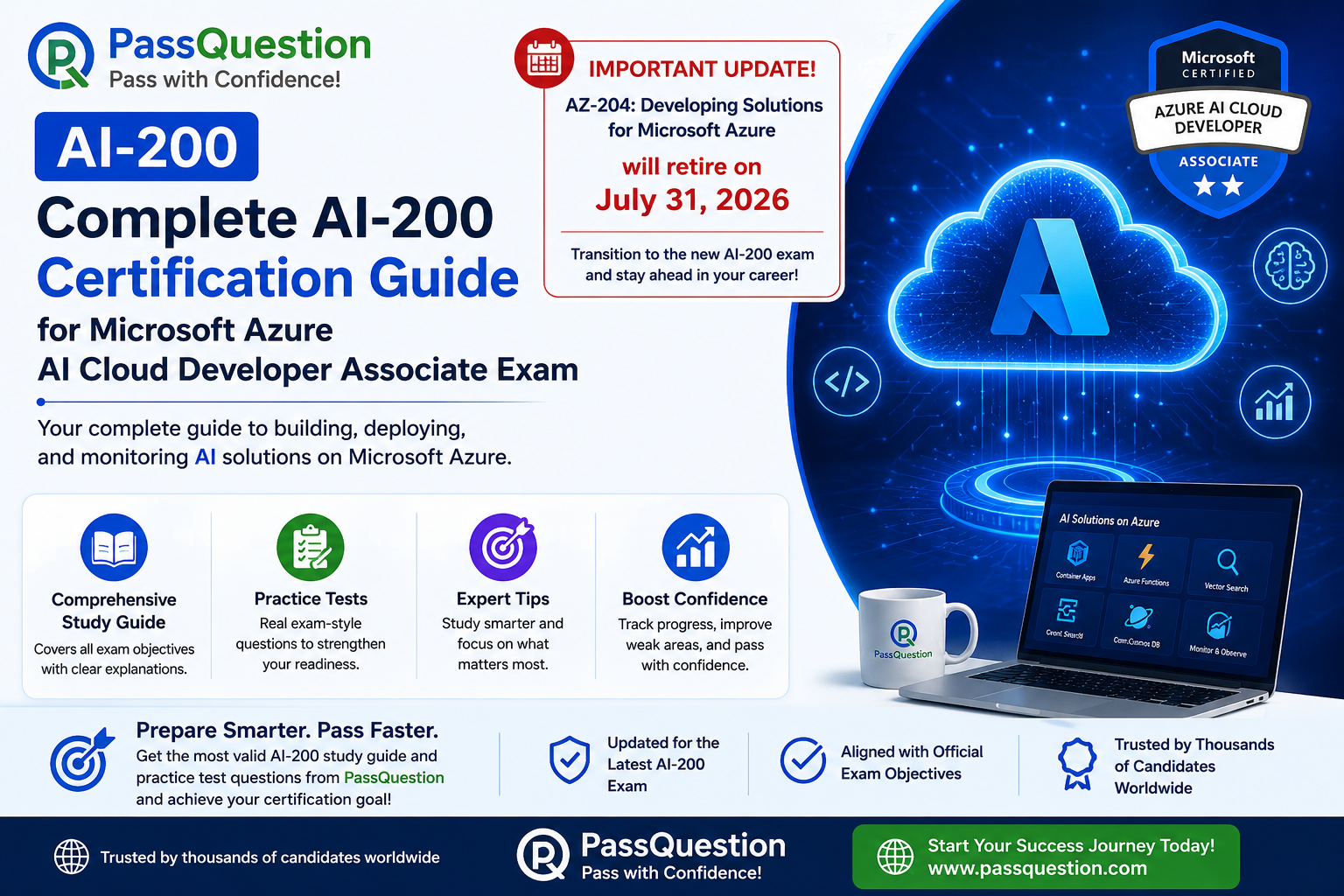
AI-200 Exam Overview: A New Certification for Azure AI Cloud Developers
The AI-200 Microsoft Certified Azure AI Cloud Developer Associate exam validates a developer's ability to contribute to all phases of implementing AI solutions on Azure. This includes requirements gathering, solution design, development, deployment, security, monitoring, and troubleshooting.
Unlike AZ-204, which focused more broadly on Azure application development, AI-200 places stronger emphasis on AI-enabled cloud solutions, including containerized compute, vector-enabled databases, serverless APIs, event-driven AI workflows, secure configuration management, and distributed observability. Microsoft describes this certification as focused on designing, building, and implementing AI solutions on Azure with emphasis on back-end services and scalable architectures.
Who Should Take the AI-200 Exam?
The AI-200 exam is designed for developers who build and operate AI-powered cloud applications on Microsoft Azure. Candidates should be comfortable working with back-end services, cloud-native architecture, AI data workflows, and modern application deployment patterns.
You should be proficient in:
- Azure SDKs and third-party SDKs used in Azure
- Azure data management services
- Azure monitoring and troubleshooting
- Azure messaging and eventing services
- Vector databases and semantic retrieval
- Python programming
- Containerized application deployment on Azure
This exam is especially suitable for developers moving from traditional Azure development into AI cloud application development.
Why AI-200 Replaces the AZ-204 Direction
The retirement of AZ-204 reflects a broader Microsoft certification update that aligns developer skills with AI-driven cloud workloads. Modern Azure developers are increasingly expected to work with intelligent applications, vector search, retrieval-augmented generation, event-driven pipelines, serverless compute, secure secrets management, and observability tools.
AI-200 helps validate these updated skills by focusing on how developers build, connect, secure, and monitor AI solutions across Azure services. For candidates who were previously planning to take AZ-204, AI-200 is the more future-focused path for proving Azure development expertise in an AI-first environment.
Skills Measured in the AI-200 Exam
Develop containerized solutions on Azure (20–25%)
Implement container application hosting
- Build, store, version, and manage container images by using Azure Container Registry
- Build and run images by using Azure Container Registry Tasks
- Deploy containers to Azure App Service, including configuring App Service to supply environment variables and secrets
Implement container-orchestrated solutions
- Deploy applications to Azure Container Apps, including environment configuration and revision management
- Implement event-driven scaling by using Kubernetes Event‑driven Autoscaling (KEDA) in Container Apps
- Deploy and manage applications to Azure Kubernetes Service (AKS) by using manifest files
- Monitor and troubleshoot solutions on AKS and Container Apps by inspecting logs, events, and end-to-end connectivity
Develop AI solutions by using Azure data management services (25–30%)
Develop AI solutions by using Azure Cosmos DB for NoSQL
- Connect to Azure Cosmos DB for NoSQL by using the SDK and run queries
- Optimize query performance and Request Units (RUs) consumption by using indexing policies and consistency levels
- Store and retrieve embeddings and execute vector similarity search for semantic retrieval
- Implement a change feed processor to detect and handle new or updated items
Develop AI solutions by using Azure Database for PostgreSQL
- Connect and query Azure Database for PostgreSQL by using SDKs
- Model schemas and implement indexing strategies, including designing tables and choosing appropriate data types
- Implement indexing strategies, including optimizing query latency and reducing pgvector compute overhead
- Configure compute, memory, and storage resources to support vector workloads
- Run vector similarity search, including storing embeddings, semantic retrieval, and implementing retrieval-augmented generation (RAG) patterns by using metadata filter
- Implement connection optimization to improve throughput and minimize latency
Integrate Azure Managed Redis in AI solutions
- Implement Azure Managed Redis data operations, including caching, expiration, and invalidation
- Implement vector indexing to enable similarity search
Connect to and consume Azure services (20–25%)
Develop event- and message-based AI solutions
- Queue and process back-end operations by using Azure Service Bus, including dead-letter queue handling, messages, topics, and subscriptions
- Implement event-driven workflows by using Azure Event Grid, including filters, custom events, and retries
Develop and implement Azure Functions
- Build serverless APIs, including implementing triggers and bindings
- Configure and deploy function apps
Secure, monitor, troubleshoot Azure solutions (20–25%)
Implement secure Azure solutions
- Secure secrets by using Azure Key Vault, including rotation and retrieval
- Store and retrieve app configuration information by using Azure App Configuration
Monitor and troubleshoot Azure solutions
- Trace distributed systems by using OpenTelemetry SDKs
- Write KQL queries to analyze logs and metrics
Best Preparation Strategies for the AI-200 Exam
1. Understand the Certification Transition from AZ-204 to AI-200
Begin by understanding that AI-200 is not just a simple replacement for AZ-204. It shifts the focus from general Azure development to AI cloud solution development. Review the updated skill areas carefully and identify which topics are new for you, especially vector databases, RAG patterns, AI pipelines, and distributed observability.
2. Study the Official AI-200 Skills Outline by Domain Weight
Focus more time on higher-weighted areas such as Azure data management services for AI solutions, which accounts for 25–30% of the exam. Containerized solutions, Azure service integration, and secure monitoring are also major areas and should be studied evenly.
3. Practice with AI-200 Questions from PassQuestion
Use the latest AI-200 practice test questions from PassQuestion to become familiar with the exam format and realistic scenario-based questions. Practice questions help reinforce important concepts, reveal weak areas, and improve your confidence before the real exam.
4. Build Hands-On Experience with Azure AI Workloads
Practice building containerized applications, deploying to Azure Container Apps or AKS, connecting to Cosmos DB and PostgreSQL, creating Azure Functions, using Service Bus and Event Grid, and monitoring solutions with logs and metrics. Hands-on experience is especially important because AI-200 focuses on practical development and integration skills.
5. Review Weak Areas and Focus on Continuous Improvement
During your preparation, regularly evaluate your progress and identify topics where your understanding is still weak. Consistent improvement and targeted review help strengthen your overall knowledge, improve problem-solving ability, and increase your confidence for the real AI-200 exam.
Prepare Smarter for the AI-200 Azure AI Cloud Developer Associate Certification
The AI-200 Developing AI Cloud Solutions on Azure exam is an important new certification path for developers who want to prove their ability to build modern AI-powered applications on Microsoft Azure. As AZ-204 and its related certification retire on July 31, 2026, AI-200 becomes a future-focused option for candidates who want to stay aligned with Microsoft's AI-driven cloud development direction.
By combining hands-on Azure practice, a clear understanding of the AI-200 exam objectives, and the most valid AI-200 study guide with practice test questions from PassQuestion, candidates can prepare more efficiently, strengthen real-world development skills, and improve their chances of passing the exam successfully.
- TOP 50 Exam Questions
-
Exam
All copyrights reserved 2026 PassQuestion NETWORK CO.,LIMITED. All Rights Reserved.
Passquestion doesn't offer Real Microsoft, Amazon, Cisco Exam Questions. All Passquestion content is sourced from the Internet.