

CIPS Level 5 Advanced Diploma in Procurement and Supply: Complete Path and Exam Guide
Edina 07-14-2026
The CIPS Level 5 Advanced Diploma in Procurement and Supply is a crucial step for procurement professionals seeking to progress toward MCIPS Chartered Status. To prepare effectively for its demanding computer-based assessments, candidates should combine the official syllabus, structured study materials, and the latest CIPS Level 5 practice questions from PassQuestion. Working through updated questions can help you review important concepts, become familiar with the Objective Response exam format, identify weaker knowledge areas, and improve your ability to apply procurement principles in realistic business scenarios.
What Is the CIPS Level 5 Advanced Diploma in Procurement and Supply?
The CIPS Level 5 Advanced Diploma builds on the knowledge developed through the CIPS Level 4 Diploma. It moves beyond foundational procurement activities and focuses on more advanced managerial, contractual, financial, ethical, and supply chain responsibilities.
The qualification helps learners develop the confidence and professional judgment needed to improve procurement and supply performance within an organisation. Candidates study areas such as:
- Managing individuals and teams
- Identifying and mitigating supply chain risks
- Evaluating contracts and their legal implications
- Managing financial performance
- Applying ethical procurement practices
- Supporting organisational objectives through procurement strategy
This is an Ofqual-regulated qualification positioned at the same academic level as the second year of an undergraduate degree. It is also a major milestone on the pathway toward the CIPS Level 6 Professional Diploma and eventual MCIPS membership.
Who Is the CIPS Level 5 Qualification For?
The CIPS Level 5 Advanced Diploma is designed for procurement and supply professionals who have already developed a solid understanding of operational procurement and are ready to take on more advanced responsibilities.
It is particularly suitable for:
- Procurement managers
- Contract managers
- Category managers
- Supply chain managers
- Senior buyers
- Commercial professionals
- Procurement specialists preparing for leadership roles
Building on Level 4 knowledge, the qualification develops a deeper understanding of risk management, contract evaluation, financial decision-making, leadership, ethics, and organisational performance.
The updated syllabus also incorporates Environmental, Social and Governance considerations, reflecting the increasing importance of sustainability, responsible sourcing, transparency, and ethical decision-making in modern procurement.
CIPS Level 5 Entry Requirements
The normal entry route is the successful completion of the CIPS Level 4 Diploma in Procurement and Supply.
After completing Level 4, candidates can progress to the Level 5 Advanced Diploma and then continue to the CIPS Level 6 Professional Diploma in Procurement and Supply. Completion of the required qualifications and professional experience can support an application for MCIPS Chartered Status.
The typical progression path is:
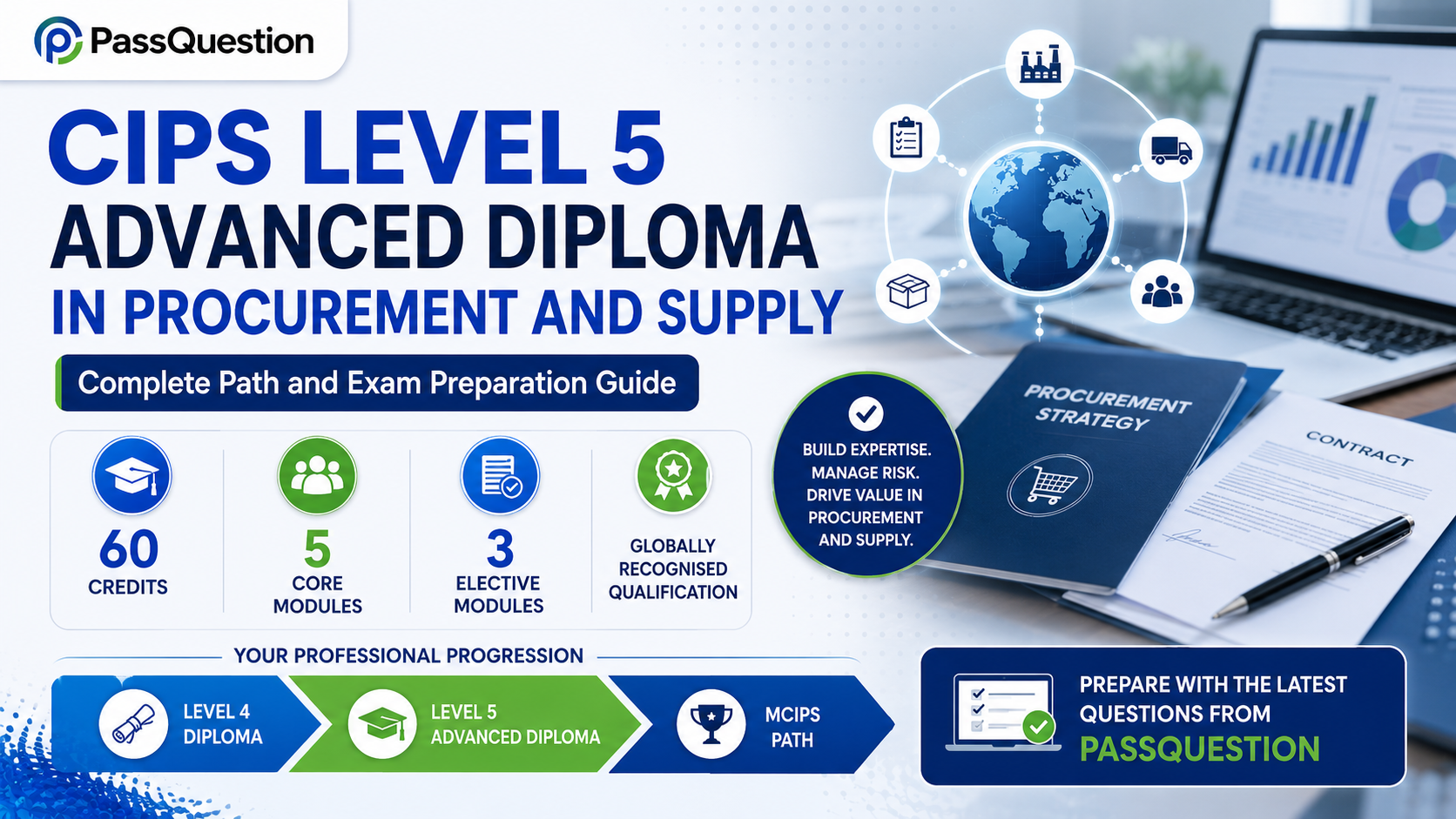
CIPS Level 4 Diploma → CIPS Level 5 Advanced Diploma → CIPS Level 6 Professional Diploma → MCIPS Chartered Status
This structured route allows procurement professionals to develop progressively from operational knowledge to strategic leadership capability.
CIPS Level 5 Credits and Study Requirements
The qualification is worth a total of 60 credits. Candidates must complete five core modules and select three elective modules.
CIPS recommends planning approximately ten hours of study for each credit. Based on this guidance, completing the full 60-credit qualification may require around 600 hours of learning, revision, assessment preparation, and examination time.
The credit structure is:
| Module Group | Number of Modules | Credits |
|---|---|---|
| Core modules | 5 | 42 |
| Elective modules | 3 selected from 6 | 18 |
| Total | 8 modules | 60 |
Candidates must pass every selected module to achieve the complete qualification.
Five Core CIPS Level 5 Modules
All candidates must complete the following five core modules.
L5M1 Managing Teams and Individuals — 12 Credits
This module examines how managers can lead, motivate, develop, and manage people effectively. It covers leadership approaches, organisational culture, team performance, communication, conflict resolution, and employee development.
Learners develop an understanding of how effective people management contributes to procurement and supply performance.
L5M2 Managing Supply Chain Risk — 6 Credits
L5M2 focuses on the identification, evaluation, and management of risk throughout supply chains. Candidates study different risk categories, risk assessment techniques, business continuity, supplier-related threats, and mitigation strategies.
The module is especially relevant in an environment affected by geopolitical uncertainty, cyber threats, supplier failures, logistics disruption, and changing regulatory requirements.
L5M3 Managing Contractual Risk — 6 Credits
This module develops knowledge of contractual obligations and the risks that can arise throughout the contract lifecycle. Candidates learn about contract formation, legal responsibilities, contractual terms, dispute resolution, breach of contract, and methods of reducing commercial exposure.
It helps procurement professionals make informed decisions while protecting their organisations from avoidable contractual risks.
L5M4 Advanced Contract and Financial Management — 12 Credits
L5M4 covers the management of contracts and financial resources at a more advanced level. Topics may include contract performance, cost analysis, financial statements, budgeting, investment decisions, payment mechanisms, and supplier financial evaluation.
The module helps learners understand the financial consequences of procurement decisions and improve value delivery throughout commercial relationships.
L5M5 Managing Ethical Procurement and Supply — 6 Credits
This module explores ethical conduct, responsible procurement, sustainability, corporate governance, and professional standards. Candidates examine issues such as modern slavery, corruption, environmental responsibility, social value, transparency, and supplier conduct.
The inclusion of ESG considerations makes this module increasingly relevant to organisations seeking to balance commercial performance with environmental and social responsibilities.
CIPS Level 5 Elective Modules
Candidates must choose three elective modules, each worth six credits, from the following six options.
L5M6 Category Management
This module covers the structured management of procurement categories. Learners examine spend analysis, market research, stakeholder engagement, category planning, supplier positioning, and value-improvement opportunities.
It is especially useful for professionals involved in category strategy or strategic sourcing.
L5M7 Achieving Competitive Advantage Through the Supply Chain
L5M7 explores how effective supply chain management can create organisational value and competitive differentiation. It considers supply chain design, collaboration, innovation, responsiveness, customer value, and operational efficiency.
L5M8 Project and Change Management
This module focuses on planning and managing projects and organisational change. Candidates study project lifecycles, stakeholder management, risk, resource allocation, communication, resistance to change, and performance monitoring.
It is valuable for professionals involved in procurement transformation, system implementation, restructuring, or improvement projects.
L5M9 Operations Management
L5M9 examines the processes organisations use to produce and deliver goods and services. Topics include capacity, quality, process design, inventory, lean operations, performance measurement, and continuous improvement.
This module is suitable for candidates working closely with manufacturing, logistics, service delivery, or operational supply chains.
L5M10 Logistics Management
This module covers the planning, movement, storage, and distribution of goods. Candidates study transportation, warehousing, inventory control, network design, international logistics, and logistics performance.
L5M15 Advanced Negotiation
L5M15 develops higher-level negotiation knowledge and skills. It considers negotiation planning, power, persuasion, stakeholder interests, communication strategies, cultural factors, conflict, and complex commercial negotiations.
This elective is particularly relevant for procurement professionals responsible for high-value or strategically important supplier agreements.
How Is the CIPS Level 5 Qualification Assessed?
Every module is assessed through a computer-based examination. Depending on availability and CIPS arrangements, candidates may take exams at an approved global examination centre or through remote invigilation from a suitable home or office environment.
CIPS uses two principal assessment formats.
Objective Response Exams
Objective Response assessments provide candidates with a selection of possible answers. Candidates must evaluate the available information and select the correct response.
Although this format is often associated with multiple-choice questions, successful preparation requires more than memorising definitions. Candidates must understand how procurement concepts apply to scenarios, contracts, organisations, suppliers, and supply chain decisions.
Constructed Response Exams
Constructed Response assessments use essay-style questions. Candidates must develop structured written answers that demonstrate knowledge, analysis, application, and professional judgment.
Strong answers normally require candidates to:
- Address every part of the question
- Apply theory to the scenario
- Explain rather than simply list points
- Present logical arguments
- Use relevant procurement terminology
- Provide appropriate examples
- Manage examination time carefully
Because the modules can use different assessment approaches, candidates should confirm the assessment format for each module before beginning detailed preparation.
How to Prepare for CIPS Level 5 Exams
Preparation should begin with the official learning outcomes and syllabus. These identify the concepts and professional capabilities that may be assessed.
Candidates can then follow a structured process:
- Study each learning outcome and create concise revision notes.
- Connect procurement theory with workplace examples and case scenarios.
- Review important models, legal principles, financial calculations, and risk frameworks.
- Practise writing timed answers for Constructed Response modules.
- Complete updated Objective Response questions under exam conditions.
- Analyse incorrect answers and return to the relevant syllabus area.
- Complete full mock exams before the actual assessment.
The latest questions from PassQuestion can support this process by giving candidates additional opportunities to check their understanding and practise answering exam-style questions. They should be used alongside official CIPS materials rather than as a replacement for learning the syllabus.
Choosing the Right Elective Modules
The best elective combination depends on your current responsibilities and future career objectives.
Candidates interested in strategic sourcing may prefer Category Management, Advanced Negotiation, and Achieving Competitive Advantage Through the Supply Chain.
Professionals working in production, distribution, or service operations may find Operations Management and Logistics Management more relevant.
Those involved in procurement transformation or system implementation may benefit from Project and Change Management.
Before choosing, consider:
- Your current job responsibilities
- The knowledge required by your employer
- Your preferred procurement career path
- Your previous academic or professional experience
- The assessment format of each module
- The subjects you expect to study at Level 6
Why Earn the CIPS Level 5 Advanced Diploma?
Completing the qualification demonstrates that you can address procurement and supply challenges at an advanced managerial level. It can help you strengthen your knowledge of leadership, contracting, risk, financial management, ethics, operations, logistics, and negotiation.
More importantly, it prepares you for the strategic content of the CIPS Level 6 Professional Diploma and moves you closer to MCIPS Chartered Status.
Final Thoughts
The CIPS Level 5 Advanced Diploma in Procurement and Supply is a comprehensive qualification for professionals seeking to move from operational procurement into management and strategic decision-making. To earn the award, candidates must complete five compulsory modules and three electives, achieving a total of 60 credits.
A successful study plan should combine syllabus-based learning, consistent revision, scenario analysis, timed exam practice, and the latest PassQuestion practice questions. With a clear module strategy and disciplined preparation, candidates can improve their procurement capabilities, pass their examinations, and continue progressing toward MCIPS Chartered Status.
- TOP 50 Exam Questions
-
Exam
All copyrights reserved 2026 PassQuestion NETWORK CO.,LIMITED. All Rights Reserved.
Passquestion doesn't offer Real Microsoft, Amazon, Cisco Exam Questions. All Passquestion content is sourced from the Internet.