

AI-300 Exam Guide 2026: How to Pass Machine Learning Operations (MLOps) Engineer Associate Certification
Edina 04-20-2026
The AI-300: Operationalizing Machine Learning and Generative AI Solutions exam is the required exam for earning the Microsoft Certified: Machine Learning Operations (MLOps) Engineer Associate certification. This certification replaces the retiring Microsoft Certified: Azure Data Scientist Associate (DP-100) certification, which will officially retire on June 01, 2026. After this date, candidates will no longer be able to earn or renew the DP-100 certification, including its related exam and renewal assessments. This transition highlights Microsoft's shift toward modern AI roles that focus not only on building models but also on operationalizing, scaling, and maintaining machine learning and generative AI solutions in real-world production environments.
If you are aiming to pass the AI-300 exam on your first attempt, using the most valid AI-300 practice test questions from PassQuestion can significantly improve your preparation efficiency. These updated practice questions closely reflect the real exam format and objectives, helping you understand key concepts such as MLOps pipelines, GenAIOps, and Azure-based AI deployment. By practicing with real-exam–style questions, you can quickly identify weak areas, strengthen your knowledge, and build the confidence needed to pass the exam easily.
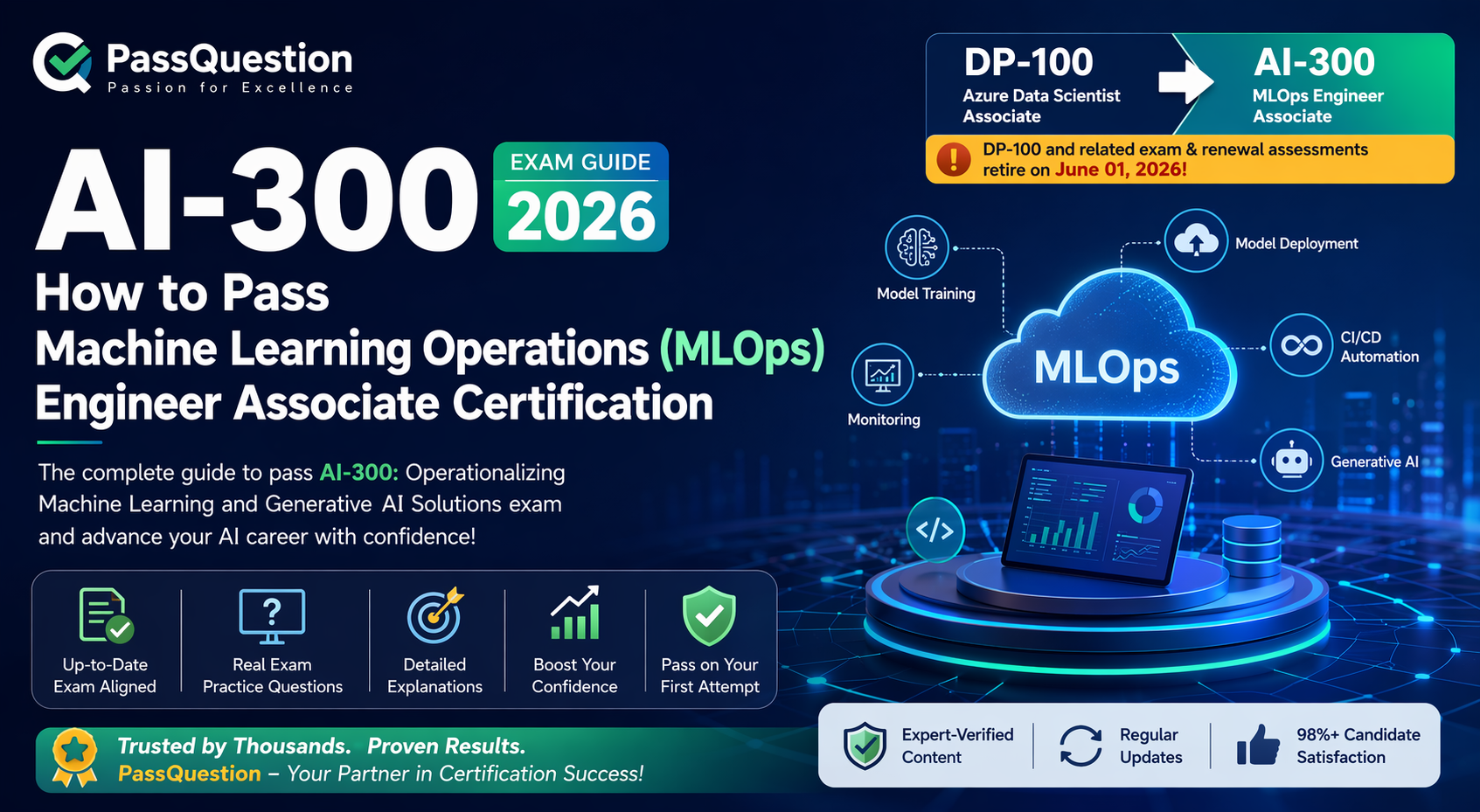
AI-300: Operationalizing Machine Learning and Generative AI Solutions
As a candidate for this Microsoft Certification, you should have subject matter expertise in setting up infrastructure for machine learning operations (MLOps) and generative AI operations (GenAIOps) solutions on Azure, together referred to as AI operations (AIOps). You need experience training, optimizing, deploying, and maintaining traditional machine learning models by using Azure Machine Learning, in addition to experience deploying, evaluating, monitoring, and optimizing generative AI applications and agents by using Microsoft Foundry.
You should have a data science background with experience in Python programming and an entry-level understanding of DevOps practices, including using tools like GitHub Actions and working with command-line interfaces (CLIs).
Who Should Take the AI-300 Exam?
The AI-300 exam is ideal for professionals working at the intersection of AI engineering, data science, and DevOps.
You should consider this certification if you:
- Work with Microsoft Azure AI services and cloud infrastructure
- Have hands-on experience with Azure Machine Learning
- Are familiar with Python-based machine learning workflows
- Understand DevOps fundamentals and tools like GitHub Actions
- Participate in deploying, monitoring, or optimizing AI/ML systems
This certification is particularly valuable for professionals transitioning from data science roles to AI engineering or MLOps roles.
Deep Dive into AI-300 Exam Domains: What You Need to Master
1. Design and Implement MLOps Infrastructure (15–20%)
This section focuses on setting up the foundation for machine learning operations:
- Creating and managing ML workspaces
- Managing datastores, compute targets, and environments
- Implementing identity and access control
- Using Infrastructure as Code (IaC) with Azure CLI and Bicep
- Automating workflows with CI/CD pipelines
Strong understanding of automation and cloud resource management is essential here.
2. Implement Machine Learning Lifecycle and Operations (25–30%)
This is one of the most important sections of the exam.
Key topics include:
- Experiment tracking using MLflow
- Automated model training and hyperparameter tuning
- Building and managing training pipelines
- Model registration and versioning
- Deployment strategies (real-time & batch endpoints)
- Monitoring and retraining models
Expect scenario-based questions on model lifecycle management and deployment strategies.
3. Design and Implement GenAIOps Infrastructure (20–25%)
AI-300 goes beyond traditional ML by introducing Generative AI operations (GenAIOps).
You'll need to understand:
- Setting up environments using Microsoft Foundry
- Deploying foundation models
- Managing model versions in production
- Configuring security and networking
This section tests your ability to operationalize LLMs and AI agents at scale.
4. Implement Generative AI Quality Assurance and Observability (10–15%)
This domain focuses on evaluating and monitoring AI systems:
- Measuring AI quality (relevance, coherence, groundedness)
- Detecting harmful or unsafe outputs
- Monitoring latency, throughput, and performance
- Logging and tracing for debugging
Observability is critical for maintaining reliable and responsible AI systems.
5. Optimize Generative AI Systems (10–15%)
This section dives into performance optimization:
- Improving Retrieval-Augmented Generation (RAG)
- Fine-tuning embedding models
- Implementing hybrid search strategies
- Managing token usage and cost
Expect questions around performance tuning and cost optimization in production AI systems.
AI-300 reflects real-world enterprise AI needs, not just experimentation.
AI-300 vs DP-100: Why This Upgrade Matters for Your Career
The transition from DP-100 to AI-300 represents a fundamental shift in Microsoft’s certification strategy.
- DP-100 focused on building and training models
- AI-300 focuses on operationalizing, scaling, and maintaining AI systems
AI-300 introduces new capabilities such as:
- Generative AI deployment
- Observability and monitoring
- Infrastructure automation
- Enterprise-grade AI governance
This makes AI-300 far more aligned with current industry demands, where companies need professionals who can manage AI systems end-to-end in production.
Proven Strategies to Pass the AI-300 Exam on Your First Attempt
1. Practice with High-Quality, Real Exam–Style Questions
Use trusted resources like PassQuestion AI-300 practice tests to simulate the real exam environment. This helps you become familiar with question patterns, improve accuracy under time pressure, and quickly identify weak areas that need improvement.
2. Build Hands-On Experience with Azure Machine Learning
Spend time working directly with Azure Machine Learning to understand how concepts are applied in real scenarios. Practical experience with model training, deployment, and monitoring will make it much easier to handle scenario-based questions in the exam.
3. Strengthen Your MLOps and DevOps Foundations
Focus on learning CI/CD pipelines, version control, and automation tools such as GitHub Actions. A solid understanding of these concepts is essential for managing AI workflows and is heavily tested in AI-300.
4. Master Generative AI and GenAIOps Concepts
Go beyond traditional machine learning by studying prompt engineering, RAG architectures, and LLM deployment strategies. Understanding how generative AI systems are built and optimized is critical for success in this exam.
5. Practice Scenario-Based Problem Solving
AI-300 focuses heavily on real-world use cases rather than simple theory. Train yourself to analyze scenarios, choose the best solution, and justify your decisions—this will significantly improve your performance on complex exam questions.
Final Thoughts: Why AI-300 Is a Must-Have Certification in 2026 and Beyond
The AI-300 certification is more than just an upgrade—it represents the future of AI careers. As organizations increasingly rely on scalable, production-ready AI systems, professionals who can manage the full lifecycle of machine learning and generative AI solutions are in high demand.
By combining hands-on experience, deep conceptual knowledge, and high-quality practice questions from PassQuestion, you can position yourself as a highly competitive AI operations professional and confidently achieve certification success.
- TOP 50 Exam Questions
-
Exam
All copyrights reserved 2026 PassQuestion NETWORK CO.,LIMITED. All Rights Reserved.
Passquestion doesn't offer Real Microsoft, Amazon, Cisco Exam Questions. All Passquestion content is sourced from the Internet.