

AI-103 vs AI-102: Complete Guide to Microsoft Azure AI Apps and Agents Developer Associate Certification
Edina 05-28-2026
The AI-103: Developing AI Apps and Agents on Azure exam is designed for the new Microsoft Certified: Azure AI Apps and Agents Developer Associate certification. This new exam replaces the previous AI-102 Azure AI Engineer Associate certification, which will retire on June 30, 2026. To help candidates prepare efficiently for this updated certification, the latest AI-103 practice test questions from PassQuestion provide focused coverage of the new exam objectives, including AI solution planning, Foundry services, generative AI implementation, agent orchestration, multimodal content processing, text analysis, and information extraction. With realistic questions and detailed explanations, PassQuestion helps candidates strengthen their knowledge, improve exam readiness, and prepare for success with confidence.
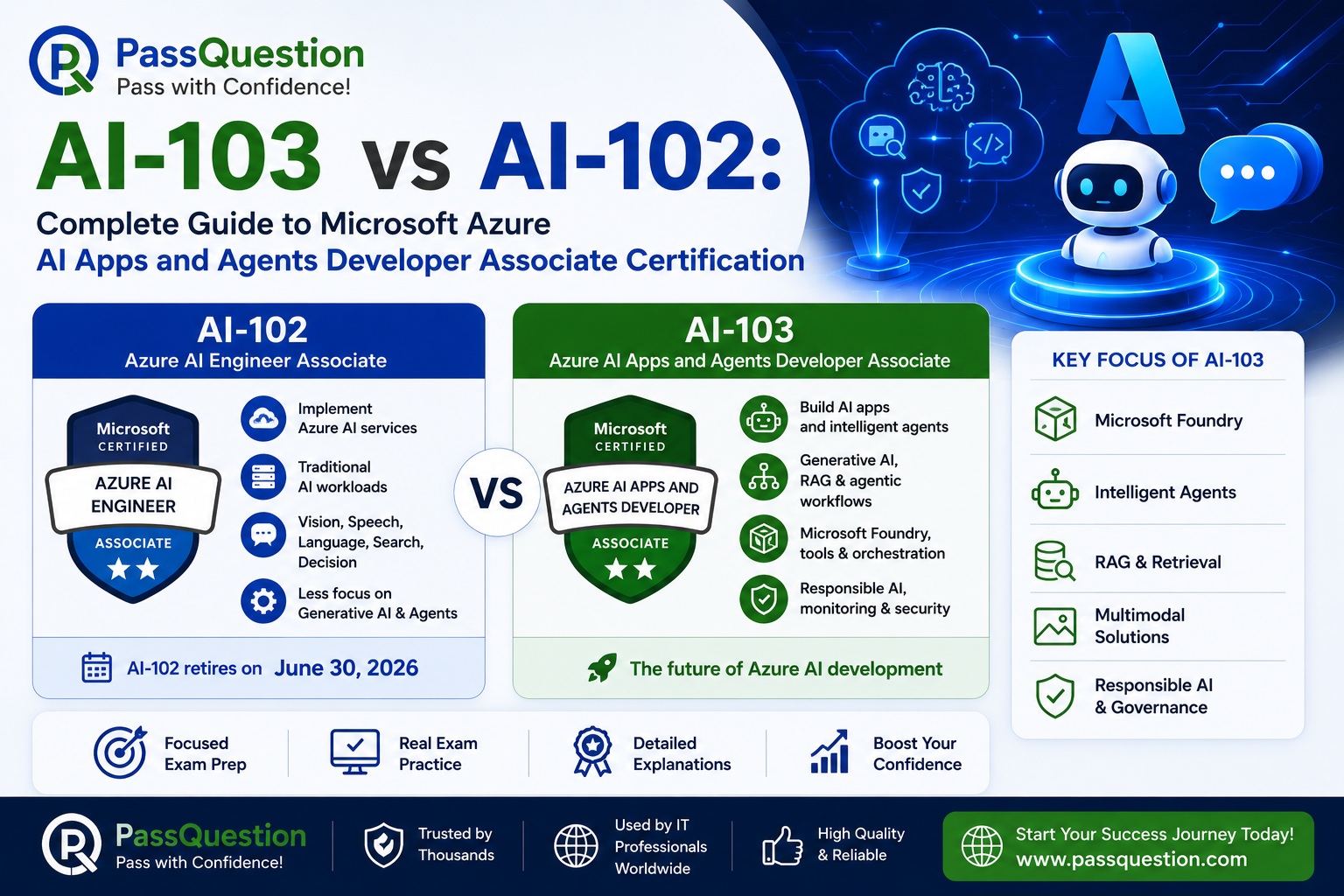
AI-103 Exam Overview: A New Azure AI Apps and Agents Developer Certification
The AI-103 Azure AI App and Agent Developer Associate certification is intended for developers, AI engineers, and technical professionals who build modern AI applications and intelligent agents on Microsoft Azure. This exam focuses on practical skills for developing generative AI applications, building agentic workflows, integrating tools and knowledge sources, and deploying production-ready AI solutions with Microsoft Foundry.
As a candidate, you are expected to build, manage, and deploy agents and AI solutions that take advantage of Microsoft Foundry. You should also have experience developing applications with Python and understand general AI, generative AI, and Azure services. Microsoft’s official AI-103 study guide explains that the exam guide is designed to help candidates understand what to expect and focus their study on covered topics.
Who Should Take the AI-103 Exam?
The AI-103 exam is suitable for professionals who want to validate their ability to design and implement AI-powered applications and agent-based solutions on Azure.
This exam is ideal for:
- Azure AI engineers
- AI application developers
- Python developers working with Azure AI
- Generative AI solution developers
- Cloud developers building agent workflows
- Professionals working with Microsoft Foundry
- Developers responsible for AI app security, monitoring, and deployment
In this role, candidates often collaborate with business stakeholders, solution architects, data scientists, DevOps engineers, and cloud security engineers to design, implement, and maintain AI solutions.
Skills Measured in the AI-103 Exam
Plan and manage an Azure AI solution
Weight: 25–30%
This domain focuses on planning, selecting, configuring, securing, and managing AI solutions in Microsoft Foundry. Candidates should know how to choose appropriate models for different tasks, including large language models, small language models, multimodal models, and Foundry Tools.
You should understand how to choose Foundry services for generative tasks, grounding, vector search, agent workflows, and multimodal processing. You also need to know how to design Azure infrastructure, configure model and agent deployments, integrate Foundry projects with CI/CD pipelines, manage quotas and rate limits, monitor performance and safety events, and apply security controls such as managed identity, private networking, keyless credentials, and role policies.
Responsible AI is also a major part of this section. Candidates should understand safety filters, guardrails, risk detection, content moderation, trace logging, provenance metadata, approval workflows, and tool-access controls.
Implement generative AI and agentic solutions
Weight: 30–35%
This is the largest exam domain and should be one of your main study priorities. Candidates must understand how to build generative AI applications using Microsoft Foundry, deploy and consume language and multimodal models, implement RAG, design multistep reasoning workflows, and integrate generative AI into applications by using Foundry SDKs and connectors.
You should also know how to build agents by defining roles, goals, conversation tracking, and tool schemas. Important skills include integrating retrieval, function calling, conversation memory, APIs, knowledge stores, search, content understanding, and custom functions.
This section also includes orchestrated multi-agent solutions, autonomous or semiautonomous workflows, safeguards, approval controls, monitoring, agent evaluation, and error analysis. Candidates should also understand how to optimize generative AI systems through prompt engineering, model parameters, self-critique loops, tracing, token analytics, safety signals, latency analysis, and hybrid orchestration.
Implement computer vision solutions
Weight: 10–15%
This section focuses on image, video, and multimodal AI capabilities. Candidates should understand how to generate images and videos from text prompts and reference media, configure image-editing workflows such as inpainting and mask-based edits, and implement video editing workflows.
You also need to know how to build multimodal understanding workflows that analyze visual context, generate captions, answer questions grounded in visual evidence, produce accessibility-focused alt text, and use Azure Content Understanding in Foundry Tools to extract visual characteristics.
Responsible AI for visual content is also important. Candidates should understand how to classify unsafe visual content, detect indirect prompt injection from embedded image text, apply watermarks, flag prohibited symbols, and enforce brand or visual policy rules.
Implement text analysis solutions
Weight: 10–15%
This domain validates your ability to apply language models and Foundry Tools for text analysis and speech-based workflows. Candidates should know how to extract entities, topics, summaries, and structured JSON outputs using generative prompting.
You should also understand sentiment detection, tone analysis, safety issue detection, sensitive content identification, translation workflows, compliance summarization, and domain-specific extraction.
For speech solutions, candidates should understand speech-to-text, text-to-speech, speech as an agent modality, custom speech models, multimodal reasoning from audio inputs, and speech translation using language models and Foundry Tools.
Implement information extraction solutions
Weight: 10–15%
This domain focuses on retrieval, grounding, content ingestion, indexing, and document extraction. Candidates should understand how to ingest and index content from documents, images, audio, and video.
You should know how to configure semantic search, hybrid search, and vector search for grounding, enrich content using built-in or custom skills, configure RAG ingestion flows, apply OCR, and connect retrieval pipelines directly to agent tools and workflows.
For document extraction, you should understand multimodal pipelines that combine OCR, layout analysis, and field extraction. You should also know how to use Content Understanding to produce clean, grounded representations for downstream reasoning, agents, and RAG workflows.
AI-103 vs AI-102: What Has Changed?
The key difference between AI-103 and AI-102 is the shift from traditional Azure AI engineering to modern AI app and agent development. AI-102 focused mainly on implementing Azure AI services such as vision, speech, language, search, and decision solutions. In contrast, AI-103 places much stronger emphasis on Microsoft Foundry, generative AI applications, retrieval-augmented generation, intelligent agents, tool integration, multi-agent orchestration, responsible AI, multimodal workflows, and production-level monitoring. For candidates who planned to take AI-102, AI-103 is the new recommended path to validate current Azure AI development skills and stay aligned with Microsoft’s latest AI certification direction.
Best Preparation Strategies to Pass the AI-103 Exam
1. Understand the AI-102 to AI-103 Certification Transition
Start by understanding that AI-103 is not simply a renamed AI-102 exam. It places much stronger emphasis on generative AI apps, Microsoft Foundry, intelligent agents, multimodal workflows, RAG, orchestration, observability, and responsible AI governance.
2. Study the AI-103 Skills Outline by Exam Weight
Because Implement Generative AI and Agentic Solutions accounts for 30–35%, this should be your highest-priority study area. Also spend significant time on Plan and Manage an Azure AI Solution, which accounts for 25–30%.
3. Practice with Updated AI-103 Questions from PassQuestion
Use the latest AI-103 practice test questions from PassQuestion to become familiar with the question style and exam structure. Practice questions help you identify weak areas, reinforce technical concepts, and improve your ability to answer scenario-based questions.
4. Build Hands-On Experience with Microsoft Foundry
Practical experience is important for this exam. Practice creating Foundry projects, selecting and deploying models, connecting applications to Foundry, building RAG workflows, configuring agents, integrating tools, and monitoring agent behavior.
5. Review Weak Areas and Improve Continuously
After each study session or practice test, review incorrect answers carefully and identify patterns in your mistakes. Focus more time on weak areas such as multi-agent orchestration, vector search, multimodal workflows, Content Understanding, responsible AI instrumentation, or Foundry deployment configuration. Revisit the related concepts, complete additional hands-on practice, and retake similar questions until you can answer confidently.
Prepare Smarter for the AI-103 Azure AI Apps and Agents Developer Associate Exam
The AI-103: Developing AI Apps and Agents on Azure exam is an important certification for professionals who want to prove their ability to build modern AI applications and intelligent agents using Microsoft Azure and Microsoft Foundry. As the AI-102 Azure AI Engineer Associate certification retires on June 30, 2026, AI-103 becomes the new path for candidates who want to stay aligned with Microsoft's evolving Azure AI certification direction.
By combining hands-on Microsoft Foundry experience, a clear understanding of the exam objectives, and the most valid AI-103 practice test questions from PassQuestion, candidates can prepare more efficiently, strengthen real-world AI development skills, and approach the exam with confidence.
- TOP 50 Exam Questions
-
Exam
All copyrights reserved 2026 PassQuestion NETWORK CO.,LIMITED. All Rights Reserved.
Passquestion doesn't offer Real Microsoft, Amazon, Cisco Exam Questions. All Passquestion content is sourced from the Internet.